



Spain's internet-user rate reached 95.75745 people per 100 in 2024, up from 93.20565 in 2020, according to the World Bank and FRED series for Spain. That changes the email operations problem. For teams working with email addresses in Spain, the challenge is no longer reaching a small or newly connected online audience. It's validating a large, mature address base without damaging deliverability or violating consent rules.
A technically deliverable address isn't automatically a usable marketing contact. Spain combines near-universal connectivity, high email adoption, stricter commercial-email expectations, and ongoing churn among legacy ISP domains. The right workflow therefore evaluates syntax, mailbox risk, sender reputation, provider status, and consent provenance together.
Why Spain's Email Market Demands Rigorous Verification
Spain's internet use reached 95.8% among people aged 16 to 74 in 2024, and 91.5% used the internet daily. That reach gives email teams a large addressable audience for onboarding, customer communication, CRM enrichment, and outbound campaigns. It also means that weak data can affect a substantial send quickly.
The operational risk sits in the address file. Invalid, dormant, duplicated, role-based, and disposable mailboxes can enter through website forms, CRM imports, event registrations, partner data, or older customer records. Verification provides a control between collection and delivery, but it does not determine whether an address is legally usable or still commercially valuable.
Operational rule: Treat Spain as a scale-validation market. Broad internet access shows that the audience is reachable, not that every stored address is current, consented, or worth mailing.
Spain's high connectivity also hides provider churn. Older ISP and business domains can remain in a CRM long after a mailbox has been abandoned, migrated, or replaced. A syntactically correct address may therefore pass a basic check while still creating bounce, complaint, or engagement risk.
Current estimates put Spain at 45.58 million internet users at the start of 2024, with 96.0% penetration, and 46.1 million users at the end of 2025, with 96.4% penetration, according to DataReportal's cited market coverage. These figures support a current operational conclusion: connectivity is no longer the main constraint. Address quality, provider status, and permission records deserve greater attention.
A verification workflow should separate at least two decisions. First, can the domain and mailbox accept mail? Second, does the team have a defensible reason to contact that person? An SMTP response cannot answer the second question. It also cannot identify whether an address is a shared role account, whether an older domain is weakening, or whether the record should be suppressed under the campaign's rules.
Spain-specific review should combine syntax checks, domain and mailbox testing, duplicate handling, role-account review, provider-risk signals, and consent provenance. Tools such as BillionVerify's Local Business Email Verification can support the technical checks, while the data owner must decide whether each record is suitable for outreach. That distinction prevents a clean verification result from being mistaken for marketing permission.
Spain's Consent Rules Change What Valid Means
Many international teams treat GDPR as a complete answer to email compliance across Europe. That assumption is risky in Spain because technical validity and legal usability are separate tests, especially for commercial outreach and B2B prospecting.
An SMTP-responsive mailbox may accept a message and still be unsuitable for a campaign. The team may lack evidence showing how the address was obtained, whether the person consented to commercial communication, or whether the contact was covered by the stated purpose. A role address such as ventas@empresa.es can be operationally reachable, but that doesn't remove the need for a defensible outreach basis or a functioning suppression process.
Spanish commercial-email practice generally emphasizes opt-in handling, consent documentation, a clear one-click opt-out, and evidence of acquisition. Recent legal commentary describes a documentation burden that is increasing rather than easing, making provenance a practical data field rather than a legal afterthought. Teams should retain the source, collection context, timestamp, stated purpose, and relevant consent record for each address where consent is relied upon. The B2B compliance guidance from Data Innovation provides background for this distinction.
Build two statuses, not one
A useful CRM model keeps verification status and permission status separate.
- Verification status: syntax result, domain result, SMTP result, catch-all indication, disposable flag, role-address flag, and final risk category.
- Permission status: consent source, acquisition date, purpose, lawful basis, opt-out state, suppression history, and evidence location.
This structure prevents a common mistake. A sales representative sees “deliverable” and assumes “sendable,” while the compliance record tells a different story. Imported CRM contacts, employee addresses, scraped role addresses, and partner-supplied records deserve review before entering an automated sequence.
Practical distinction: Verification answers, “Can this mailbox probably receive mail?” Consent records answer, “Should this organization send commercial mail to it?”
One-click unsubscribing must work without friction, and suppression should apply across every sending system. If a recipient opts out through a newsletter, the same address shouldn't reappear in a sales sequence, retargeting workflow, or reactivation campaign. Deduplication also matters because duplicate records can cause inconsistent preference handling and repeated contact.
For B2B teams, the safest approach is conservative. Verify the address, preserve the provenance record, document the outreach basis, and suppress immediately when permission is withdrawn. The marketing privacy compliance tips are most useful when translated into CRM fields and automation rules rather than left as a policy document.
Building Versus Buying Spanish Email Lists
Buying a Spanish email list offers immediate volume, but volume isn't the same as permission or commercial value. A vendor may provide addresses that are syntactically correct and technically reachable while offering weak evidence about consent, acquisition context, recency, or intended use.
Organic list building takes longer, but it gives the sender control over the relationship. Website forms, product registrations, event signups, gated resources, and customer checkouts can capture the purpose and consent context at the moment of collection. That record makes later segmentation and suppression far easier.
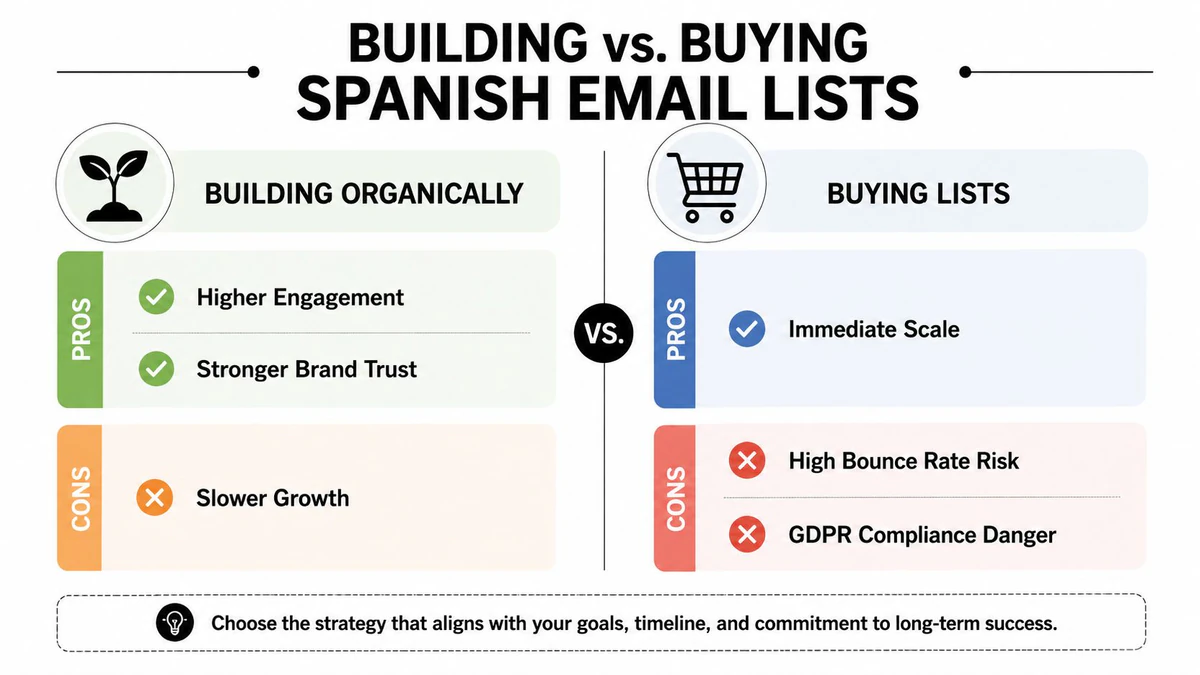
The trade-off is control versus speed
| Approach | What it does well | Where it creates risk |
|---|---|---|
| Organic acquisition | Establishes clearer consent provenance and usually supports better audience context | Growth is slower and requires disciplined form, CRM, and preference management |
| Purchased data | Adds contacts quickly and may support market exploration | Consent evidence, freshness, duplicate records, role accounts, and provider churn may be unclear |
| Partner-supplied data | Can reach a relevant professional audience | The sender must verify what permission was collected and whether it covers the planned message |
Legacy domains make purchased and older imported data more complicated. Reporting on Orange Spain and MásOrange describes the shutdown of a large set of legacy email domains. One analysis found those domains accounted for only 0.05% of email traffic to Spanish users in June, according to Batch's analysis of the Spanish email-service change. That share is small, but it isn't zero, and long-tail addresses can remain in old CRM exports for years.
Spanish email volume also magnifies the operational effect of small data changes. One 2025 benchmark reported 2.1 billion emails sent, while another reported 3.493 billion sent in 2024, as summarized in the same market reporting. A low-volume legacy segment may still create avoidable bounces when included in a large campaign.
Decision rule: Don't buy a list merely because a supplier calls it “verified.” Require consent provenance, collection purpose, refresh practices, suppression handling, and a clear policy for legacy domains.
Organic acquisition still needs verification. Forms collect typos, disposable addresses, shared inboxes, and abandoned accounts. The strongest model combines permission-first acquisition with real-time validation, then performs periodic bulk cleaning before significant sends. Teams building a durable audience should focus on how to grow your email list without losing control of consent records.
Complete Verification Workflow for Spanish Addresses
A production workflow for email addresses in Spain should move from low-cost structural checks to deeper mailbox-risk analysis. Verification services commonly use syntax validation, domain and MX checks, SMTP-level probing, and risk flags for catch-all, disposable, and role-based addresses, as outlined in this email verification process.
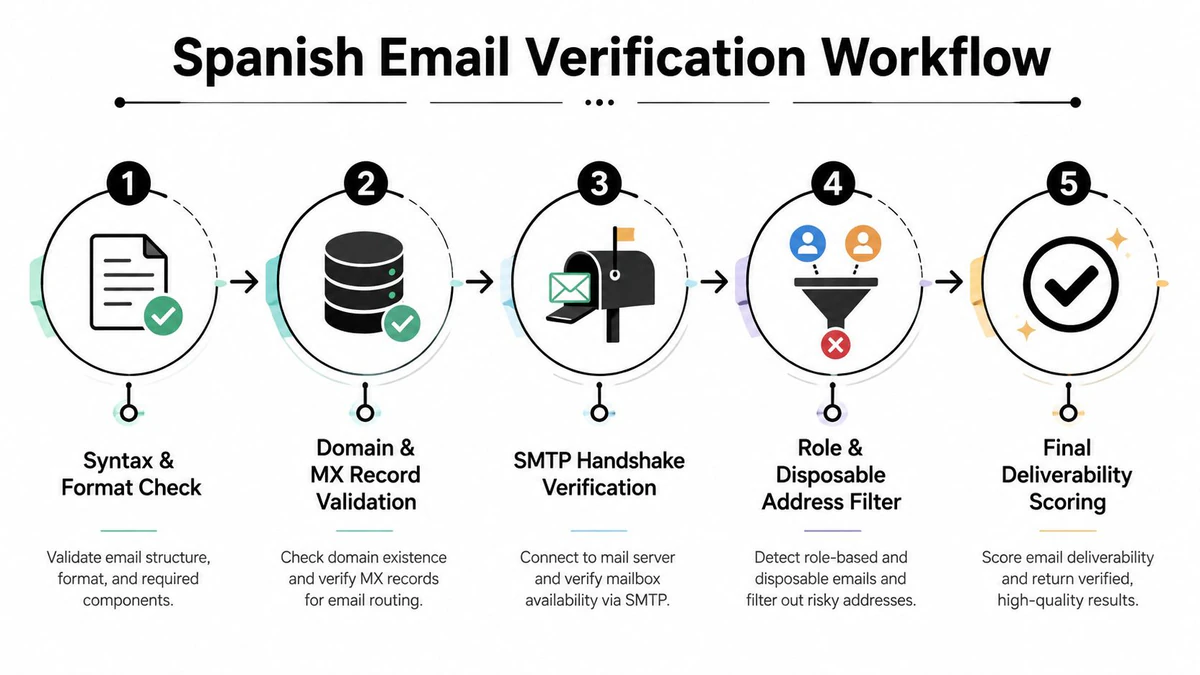
Start with normalization
Remove accidental spaces, standardize obvious formatting issues, and identify malformed addresses before spending resources on deeper checks. Normalization should also preserve the original value in an audit field, because teams may need to compare the submitted address with the cleaned record.
Next, validate the domain and confirm that it has the infrastructure required to receive mail. A valid domain doesn't confirm that a named mailbox exists, but a missing or unusable mail-exchange setup is a strong reason to reject or review the address.
SMTP probing comes after those checks. The service tests whether the receiving system appears to recognize the mailbox, but providers may limit responses, disguise mailbox status, or accept mail for every address on a domain. Results should therefore be categorized as confirmed, risky, unknown, or invalid, rather than reduced to a false binary.
Treat risky results as a workflow decision
Catch-all domains deserve special handling. If a domain accepts arbitrary recipients, the verification service can't reliably confirm the individual mailbox. That address may remain usable, but it belongs in a risk segment rather than the cleanest send pool.
Disposable and role-based addresses need different policies. Disposable addresses may be unsuitable for durable customer relationships, while role addresses can be appropriate for operational notifications or business-level communication but may perform differently in personal outreach. Don't delete both categories automatically. Route them according to campaign purpose.
Use bulk cleaning for an existing Spanish database, especially before a reactivation or major campaign. Use real-time checks at signup, account creation, lead capture, and CRM entry so new errors don't replenish the same list. A BillionVerify workflow can perform professional email verification for bad-data control, while an Email Validation API can place that decision directly inside a form or application flow.
Don't interpret an accepted address as proof of inbox placement. Filtering, reputation, engagement, authentication, and complaints still influence delivery after the receiving server accepts a message. For Spain-facing campaigns, combine technical status with consent status and engagement history before deciding whether an address belongs in the active segment.
Deliverability Benchmarks and Provider Churn Impact
Spain's 2025 deliverability data shows why list hygiene deserves continuous attention. The soft bounce rate fell from 1.45% to 0.49%, the hard bounce rate declined from 0.67% to 0.45%, and the acceptance rate rose from 97.88% to 99.07%, according to Spotler's Spain email-marketing benchmark. Those changes indicate that list quality, domain reputation, and mailbox hygiene affect whether addresses remain usable at scale.
Acceptance still isn't inbox placement. A receiving system can accept a message and later filter it, route it away from the primary inbox, or associate the sender with unwanted communication. The same benchmark notes that Spain's spam complaint rate in 2025 was slightly above the global average, so teams shouldn't celebrate a strong acceptance figure while ignoring complaints and engagement.
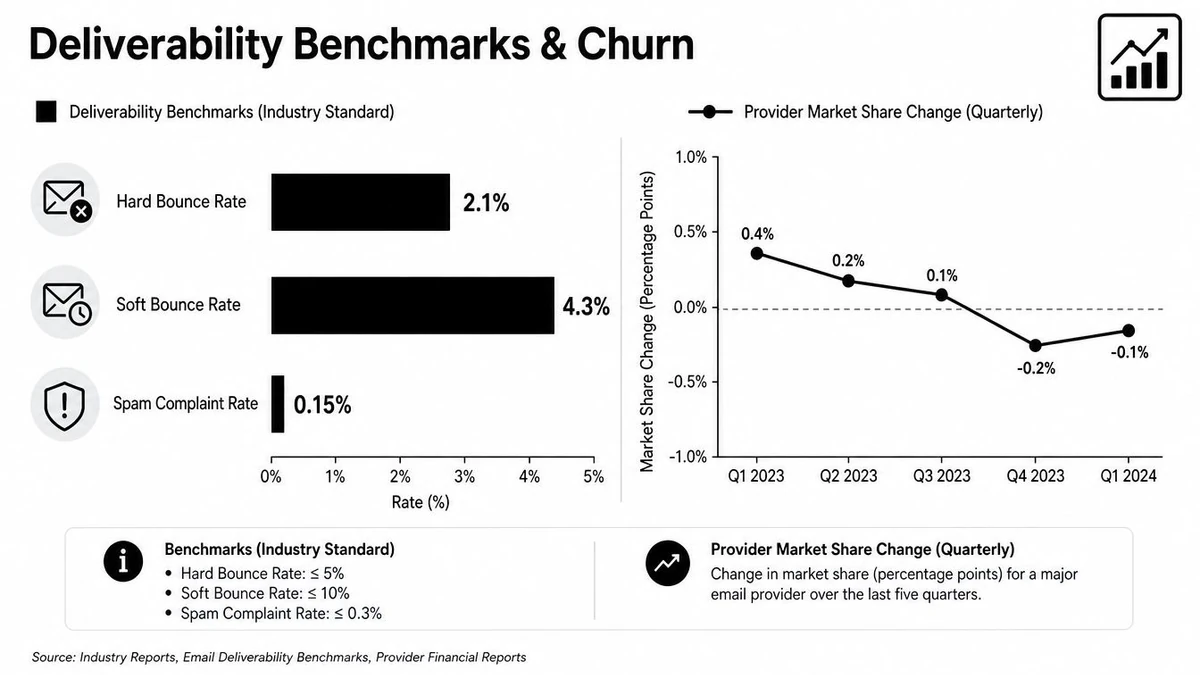
An independent comparison reported Spain-wide averages of 22.25% open rate, 1.03% click rate, and 0.07% unsubscribe rate, while a separate Spain report found that 3.61% of sent emails did not reach recipients. These benchmarks shouldn't become campaign targets. They work better as warning signals, especially when a database shows unusual bounce, complaint, or unsubscribe behavior.
Provider churn changes the meaning of an old address
Legacy ISP shutdowns create a risk that ordinary verification can miss. An address tied to a retiring domain may remain present in a CRM export, look familiar to a sales team, and still be strategically low-value even before it starts producing hard bounces. Re-verification should happen before reactivation campaigns, after long periods of dormancy, and whenever provider changes affect a known segment.
Use several indicators together:
- Bounce behavior: Separate soft and hard bounces, then suppress repeated failures according to your sending policy.
- Acceptance data: Track it as a transport signal, not as evidence of inbox placement.
- Complaint activity: Treat complaints as a sender-reputation problem even when delivery looks strong.
- Engagement recency: A technically valid address with no meaningful response may belong in a lower-priority segment.
- Provider and domain status: Review older ISP addresses before including them in a large send.
The Email Verification Benchmark can provide a reference point for interpreting verification outcomes, but Spain-specific decisions still require your own campaign history. A healthy database isn't defined by one impressive metric. It combines reachable mailboxes, documented permission, sensible segmentation, and suppression rules that respond to actual recipient behavior.
Integrating Verification into Your Spain Campaign Stack
Verification works best when it becomes part of the data path, not a manual cleanup task performed only after a campaign fails. Start by defining the fields your CRM and sending platform will receive: verification status, risk category, domain result, SMTP result, catch-all status, disposable flag, role flag, verification timestamp, consent source, and suppression state.
For an existing list, export the relevant Spanish records, remove obvious duplicates, and submit the file for bulk verification. Use live progress tracking where available, review the output, and import the results into dedicated fields rather than overwriting the original address. Preserve rejected records separately so the team can audit why contacts were excluded.
At acquisition points, real-time API validation should run before an address becomes an active subscriber or sales lead. A form can accept a correction for a formatting error, flag a disposable address for review, and prevent an obviously invalid mailbox from entering Mailchimp, HubSpot, Salesforce, or a similar system. The API result should not create marketing permission. It only informs data quality and routing.
Create suppression logic that respects both tests
A practical Spain campaign stack can use rules such as:
- Reject invalid results before synchronization with the sending platform.
- Review unknown and catch-all results instead of treating them as clean.
- Segment role addresses according to the campaign's purpose.
- Suppress disposable addresses when a durable customer relationship is required.
- Block opted-out contacts globally, including contacts stored in sales and support tools.
- Re-verify stale or dormant records before reactivation.
- Store consent provenance beside verification results so a deliverable address isn't mistaken for a permitted one.
This structure supports personalization without turning verification into a compliance shortcut. A clean address can improve the reliability of segmentation, but the message still needs an appropriate purpose, documented permission where required, and a simple opt-out path.
BillionVerify provides email verification for identifying bad email data before it creates avoidable campaign and CRM problems. Visit BillionVerify to evaluate how its verification workflow can support Spanish list cleaning, real-time validation, and clearer separation between technical deliverability and consent records.