



You've launched a major outreach campaign after spending days building the list. Then the bounce notifications arrive, followed by weaker inbox placement and a sender reputation problem that's harder to fix than it was to create. An email extractor and verifier combines list building with deliverability checks, helping marketing, sales, and developer teams remove risky addresses before campaigns or signup flows use them.
That distinction matters. Independent benchmarks place permission-based programs at about 1.5% combined bounce rate, or roughly 98.5% delivery, with practical targets near 1% hard bounces and 2% total bounces before sender reputation starts to suffer, according to Validity's email deliverability benchmark. Below, you'll find the strongest extraction and verification tools for 2026, with attention to real workflows, free access, paid scaling, and integration depth.
1. BillionVerify
BillionVerify is a professional email verification service built around a clear operational problem, bad email data costs businesses money. It's the strongest fit on this list for teams that already have addresses from a CRM, form, campaign source, or prospecting tool and need a fast verification layer before sending.
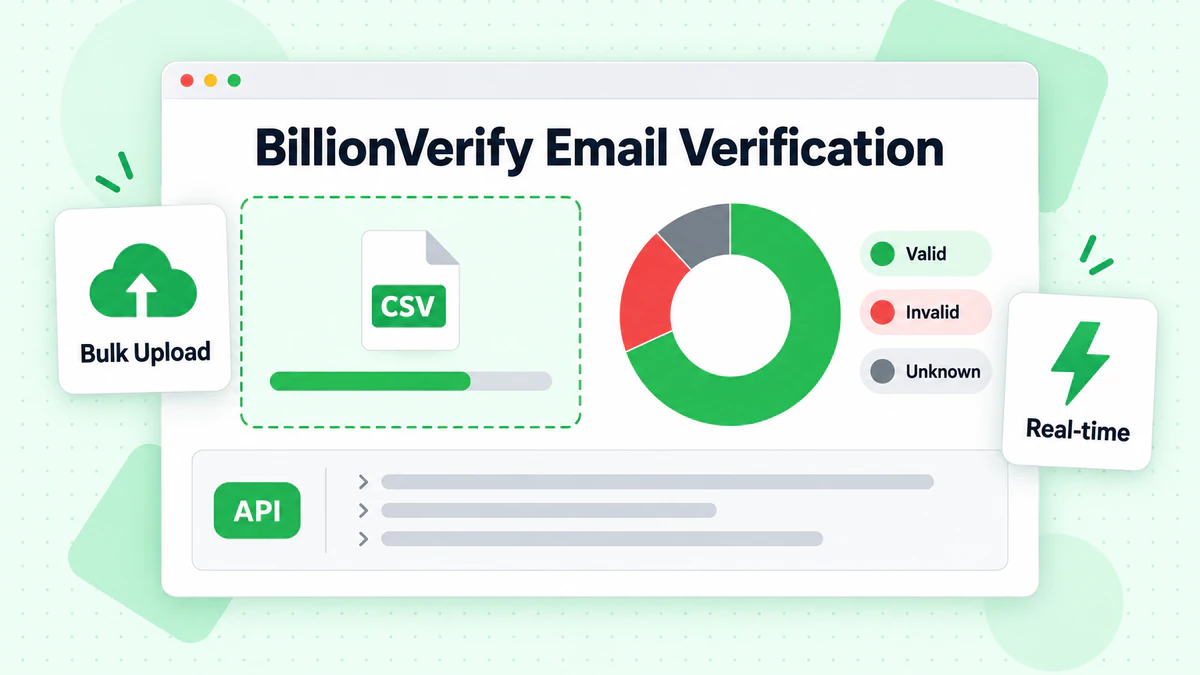
The platform supports single address checks, bulk uploads, and a real-time API that returns structured JSON. Its verification workflow identifies catch-all domains, disposable addresses, and role accounts, giving teams more useful segmentation than a basic syntax check. SMTP-level verification matters because an MX lookup only confirms which server receives mail for a domain. It doesn't confirm that a specific mailbox exists, as explained in this overview of SMTP verification mechanics.
Why teams choose it
BillionVerify's product profile emphasizes 99.9% SMTP-level accuracy across single checks, bulk list cleaning, and API responses. That figure is a product claim, so buyers should still test representative data from their own sources, especially catch-all and older CRM records.
Its integration ecosystem includes Mailchimp, SendGrid, HubSpot, Salesforce, and Zapier. CSV uploads provide live progress, notifications, and export-ready filters, while agencies can use a whitelabel portal for branded client workflows. A free tier is available without a credit card, which makes controlled testing practical before a larger implementation.
The main limitation is equally important. BillionVerify is primarily a verifier, not a full prospect discovery database. Teams that need LinkedIn, domain, or website extraction will likely pair it with a specialized extractor, then send the resulting file or API stream through verification.
Practical rule: Treat extraction and verification as separate decisions, even when one platform helps connect them. A found address is a prospecting result, not a sending permission signal.
2. Hunter
Hunter is a practical choice for sales and marketing teams that begin with a known company domain or a person's name. Its domain search, email finder, bulk list verification, confidence scoring, and deliverability insights keep the workflow relatively easy to understand.
The browser extension is useful for quick lookups while researching company websites or professional profiles. Teams can also upload lists for bulk verification, use REST API endpoints, and connect records with Salesforce, HubSpot, or Pipedrive. That combination makes Hunter more than a simple extractor, but it still feels focused rather than overloaded.
Hunter's main strength is transparency around the result. A confidence score helps users distinguish a directly supported address from a pattern-based discovery. That's particularly useful for small companies, where public information may be limited and an address can look plausible without being live.
Where it fits best
Hunter works well when a salesperson knows the target account and wants a focused set of contacts rather than a large database export. Its free access is limited, so it's better suited to targeted research than continuous high-volume list production.
Verification quality can vary on catch-all domains, because the receiving server may accept mail for addresses that aren't confirmed individual inboxes. For teams that need an efficient email extraction solution, a useful workflow is to use Hunter for discovery and apply a dedicated SMTP verifier before importing contacts into an outbound sequence.
3. Snov.io
Snov.io combines prospect discovery, verification, and outreach automation in one interface. Sales teams can search by prospect, domain, or company, upload lists for bulk verification, review deliverability reports, and move suitable contacts into drip campaigns without exporting between several systems.
That all-in-one approach is its defining advantage. A team running outbound sequences can find an address, check its status, apply campaign logic, and automate follow-ups in the same environment. API access and Zapier integration also give operations teams a path to connect the platform with external workflows.
Best use case
Snov.io is strongest for smaller sales teams that value workflow consolidation over deep specialization. Its automation triggers are useful when verification status should determine what happens next. For example, a questionable result can remain out of the sequence while a safer record continues to enrichment or review.
The trade-off is operational complexity. New users may find the interface crowded because prospecting, verification, and campaign functions share the same workspace. Verification can also slow on larger lists, so teams should validate processing behavior with their normal file sizes instead of assuming a small test will represent production performance.
Teams building custom registration, CRM, or lead-routing flows can also compare Snov.io with an Email Validation API. The important question isn't only whether an address is found. It's whether the result can reach the next system with a clear status and an action attached.
4. Voila Norbert
Voila Norbert takes a simpler approach to email finding and verification. It suits marketers, recruiters, and sales representatives who need accurate individual lookups or small-batch processing rather than a broad extraction operation across many sources.
Users can find addresses from a person's name and company information, upload a list, and review verification results that include bounce and catch-all detection. An API supports custom integrations, while the Chrome extension makes LinkedIn-based research more convenient for individual prospects.
Why simplicity matters
The interface is easier to adopt than broader sales engagement platforms. Pay-as-you-go credits also make the tool attractive when usage is irregular, such as a consultant researching a small account list or a recruiter validating contact records before outreach.
Its limits become visible at scale. Voila Norbert isn't optimized for large-scale extraction, and its integration set is narrower than enterprise-oriented tools. It also doesn't replace a full data pipeline when a team needs automated CRM synchronization, recurring list hygiene, or complex routing rules.
For small-batch work, the decision often comes down to how much certainty the team needs before export. A dedicated AI-first email validation layer can be useful when the source list contains older records, shared inboxes, or addresses collected from several prospecting channels.
5. Skrapp
Skrapp is built for B2B prospecting from LinkedIn and company domains. Its browser workflow helps users discover contacts while browsing professional profiles, while bulk verification and status tags make exported lists easier to sort before they enter a CRM or sequence.
The platform supports LinkedIn and domain prospecting, bulk verification, real-time API checks, and integrations with HubSpot and Salesflare. Status indicators are especially useful for SDR teams because they reduce the ambiguity that often appears in a raw CSV. A salesperson can separate accepted, risky, catch-all, and unusable records before another system treats them as ready.
Extraction strengths and limits
Skrapp's strongest use case is a B2B team that starts prospecting on LinkedIn and wants a direct path to company contact data. Its pricing is positioned competitively, but free-plan verification results can be inconsistent, so teams shouldn't judge production reliability from a small free-tier sample alone.
The platform is less suitable for non-B2B domains or consumer-oriented acquisition. That limitation matters because the quality of an extractor depends heavily on the source it was designed to search. A LinkedIn-focused tool may be efficient for professional contacts but less useful for website forms, document parsing, or broad consumer databases.
A sound workflow is to export only the records with an acceptable status, preserve the original source and timestamp, then run a final verification pass immediately before sending.
6. GetEmail.io
GetEmail.io uses predictive email finding to suggest professional addresses from names and company information. Its confidence score gives users a way to separate stronger predictions from records that need additional review.
The platform supports bulk uploads, verification, API access with JSON responses, and connections through Zapier and Google Sheets. Webhook support is useful for real-time alerts, especially when a team wants a downstream workflow to react when a verification result changes or a new record completes processing.
A good fit for lightweight automation
GetEmail.io is appealing to teams that want fast predictions without adopting a large sales engagement suite. Credit-based usage can be easier to understand for occasional prospecting, and Google Sheets support makes it accessible to small operations teams that aren't ready to build a full CRM integration.
Prediction-based discovery still requires careful interpretation. Accuracy may fall in niche industries where naming patterns are unusual or public data is sparse. A confidence score is a prioritization aid, not proof that a mailbox will accept mail.
Developers should distinguish the API's response format from its verification depth. JSON makes automation easier, but the workflow should still inspect the actual status, SMTP result, domain records, and risk categories before adding an address to a campaign.
7. NeverBounce
NeverBounce is a verification platform for organizations that already obtain contacts through an extractor, CRM, or other source. It handles bulk list cleaning, real-time API checks, deliverability grades, and team collaboration, rather than discovering addresses from LinkedIn or company domains.
Its team dashboard and audit logs suit organizations where multiple people review uploads and approvals. Connections with Mailchimp, HubSpot, and Klaviyo place verification nearer to campaign execution, reducing dependence on manual CSV cleanup. Developers can also connect an upstream extractor to the API, then map verification statuses back to the original records.
Best for controlled list operations
NeverBounce's enterprise focus appears in its security and compliance controls, auditability, and high-volume batch processing. Data and operations teams can track which records were checked, when checks occurred, and which addresses were excluded. Teams evaluating AI-powered email verification can use NeverBounce as a more operations-focused comparison, especially when review history and workflow ownership matter.
The main limitation in an extractor-and-verifier comparison is the absence of built-in extraction. Addresses must come from another source, creating an additional export, transfer, and reconciliation step. Field mapping, duplicate handling, and a clear record ID therefore matter during integration.
Disposable addresses should receive their own status. Temporary inboxes are created for short-term use, and verification systems commonly flag them separately from ordinary invalid addresses, as explained in this explanation of disposable email detection. Sending teams should exclude or isolate those records instead of treating every non-invalid result as ready for a campaign.
8. ZeroBounce
ZeroBounce supports teams that need mailbox validation alongside broader risk screening. Its workflow covers bulk and single checks, abuse and complaint detection, spam-trap identification, deliverability scoring, API access, and SMTP validation. That scope makes it relevant to marketing operations and developer-led pipelines, although it does not replace an extraction tool.
Connections with Zapier, SendGrid, and Mailgun can route checks into campaign automation and sending infrastructure. Detailed reports help teams separate invalid, risky, abusive, disposable, and otherwise unsuitable contacts, preserving useful status information instead of removing every address that fails a basic validity test.
Strong risk controls, heavier interface
ZeroBounce suits organizations that treat abuse prevention and sender reputation as core operating requirements. Its plan notes include 100 free validation credits per month, giving teams a defined way to test the workflow before paid use. For a broader comparison of verification capabilities, see BillionVerify's expert analysis.
The interface can feel complex for one-off checks, while processing speed may vary during busy periods. Batch schedules reduce the impact for operations teams, but a salesperson validating one address may prefer a simpler lookup flow.
ZeroBounce works best as a risk-focused verifier rather than a discovery engine. If contacts come from scraping, document parsing, or several sales databases, teams can pass the extracted records through its checks before sending them to SendGrid, Mailgun, or a CRM. Stable record IDs and status mapping help preserve the verification result across those handoffs.
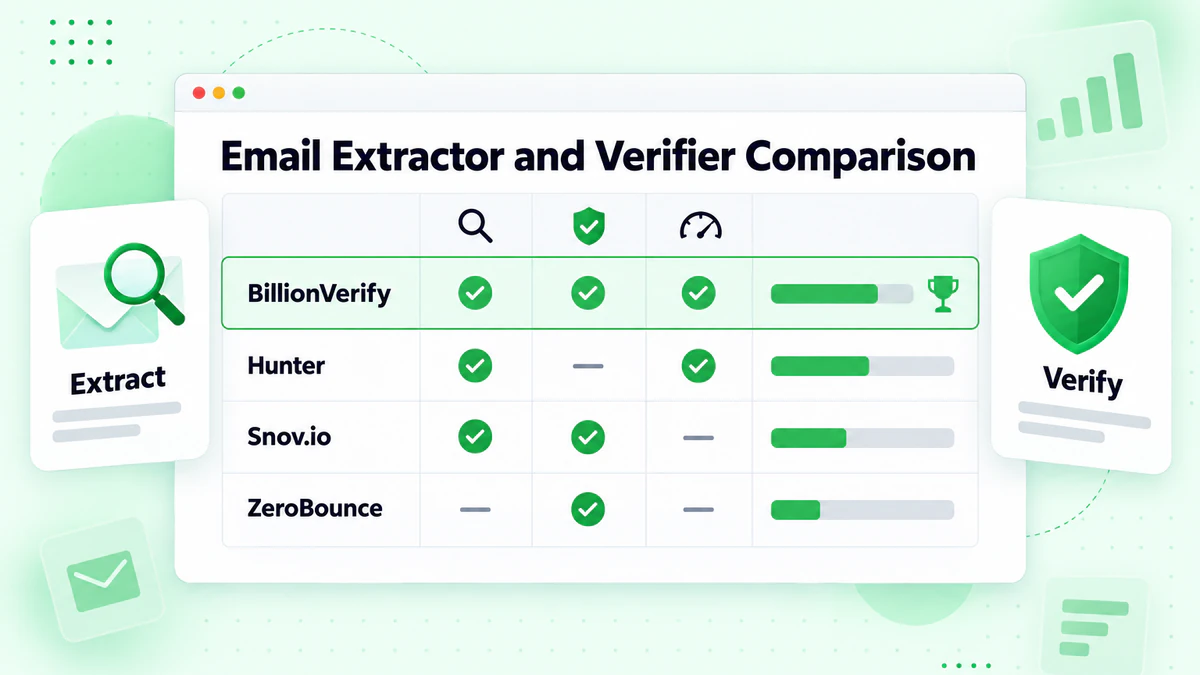
Top 8 Email Extractor & Verifier Comparison
| Product | Core features | Accuracy / Quality ★ | Value / Price 💰 | Target audience 👥 | Unique selling points ✨ |
|---|---|---|---|---|---|
| BillionVerify 🏆 | 99.9% SMTP accuracy; single/bulk/API; structured JSON; MX & catch‑all checks | ★★★★★ 99.9% | 💰 Free tier; low-cost at scale | 👥 Sales, marketing, product teams & agencies | ✨ AI-first, whitelabel portal, native MCP Server, wide integrations |
| Hunter | Domain/email finder, bulk verify, API, Chrome extension | ★★★★☆ ~95% | 💰 Limited free credits; paid tiers | 👥 Sales & lead-gen teams | ✨ Quick lookups via browser extension; detailed confidence scores |
| Snov.io | Finder + verifier + drip campaigns; API & Zapier | ★★★★☆ Good (speed varies) | 💰 Affordable plans with automation | 👥 Outreach & SMB sales teams | ✨ All-in-one finder+outreach workflow |
| Voila Norbert | Single lookup, bulk upload, API, Chrome extension | ★★★★☆ High for single lookups | 💰 Pay-as-you-go credits | 👥 Individual SDRs & small teams | ✨ Simple UI; strong single-lead accuracy |
| Skrapp | LinkedIn & domain prospecting; bulk verify; API | ★★★☆☆ Mixed on free plan | 💰 Competitive pricing | 👥 B2B recruiters & sales | ✨ Seamless LinkedIn integration; clear status tags |
| GetEmail.io | Predictive email finder (ML); bulk verify; API & webhooks | ★★★☆☆ Fast ML; niche accuracy drops | 💰 Credit-based pricing | 👥 Recruiters & sales needing predictions | ✨ ML-powered predictions; webhook support |
| NeverBounce | Bulk cleaning, real-time API, team dashboard & logs | ★★★★☆ Enterprise-grade | 💰 Higher cost for small teams | 👥 Enterprises & compliance-focused teams | ✨ Audit logs, security/compliance, high throughput |
| ZeroBounce | Bulk/single validation, abuse & spam-trap detection, API | ★★★★☆ Strong abuse detection | 💰 Free 100 credits/mo; paid tiers | 👥 Marketers & deliverability teams | ✨ Spam-trap & abuse detection; detailed reports |
Your Next Steps to Cleaner Email Data
The comparison points to a conclusion that isn't obvious from feature pages alone. The best tool depends less on the longest feature list and more on where your records originate, how often they change, and whether your team needs discovery, verification, or both in the same operational path.
Choose a prospecting-led platform when your team works mainly from LinkedIn, domains, or named contacts. Hunter, Snov.io, Skrapp, and GetEmail.io are better aligned with finding addresses. Choose a verification-led service when your organization already owns the data and needs dependable list cleaning, API checks, audit history, or campaign controls. BillionVerify, NeverBounce, and ZeroBounce fit that model more directly.
The separation between extraction and verification deserves attention. Recent industry coverage indicates that extracted-but-unverified lists can bounce 20–40%, while catch-all detection remains essential for avoiding false confidence, according to Tomba's review of email extractor tools. The practical implication is that a tool can be excellent at finding addresses and still be unsuitable as the final sending gate.
Email verification has also become a substantial software category. One market projection places the global email verification software market at USD 1.28 billion in 2026, reaching USD 2.46 billion by 2035 at a 7.47% CAGR, as reported by MailCleanup's email verification statistics. Another market report projects growth from $0.71 billion in 2025 to $0.79 billion in 2026, implying a 10.4% CAGR, which reinforces the operational demand for list hygiene in outbound and marketing workflows, according to Research and Markets.
Start with a controlled sample from your own acquisition channels. Compare status categories, catch-all handling, API reliability, export fields, and the number of manual steps required before a record reaches your CRM or sending platform. Don't measure success by extracted volume alone. The stronger measure is whether the workflow prevents risky data from becoming campaign volume.
A useful test sequence is straightforward:
- Extract from real sources: Use the domains, profiles, forms, and files your team handles.
- Verify before synchronization: Keep unverified records out of campaigns and separate uncertain statuses from confirmed results.
- Preserve decision data: Store verification status, source, timestamp, and risk category with each contact.
- Review compliance: Confirm that the collection source and intended outreach comply with the rules and expectations of the markets you serve.
- Watch deliverability: Treat bounce patterns as an operational signal, not merely a reporting metric.
For teams evaluating early-stage technology vendors or adjacent data infrastructure, this directory of early-stage US investors can provide additional market context. The immediate purchasing decision, however, should stay grounded in your own list quality, integration requirements, and sending risk.
BillionVerify combines single checks, bulk list cleaning, catch-all and disposable detection, and a real-time JSON API for marketing, sales, and developer workflows. Test your extraction pipeline before sending, then visit BillionVerify to evaluate a verification layer designed to keep bad email data out of your campaigns and signup flows.