


To get a literary agent, finish and revise your manuscript, research agents who represent your genre, choose 30 to 60 of them, and send each one a short, personalized query that follows their submission guidelines. Send in small batches, verify every email address before it goes out, log every reply, and adjust your query or your pages based on what comes back. Most writers who get a literary agent do it by working through a well-researched list over several months, not by sending one perfect email.
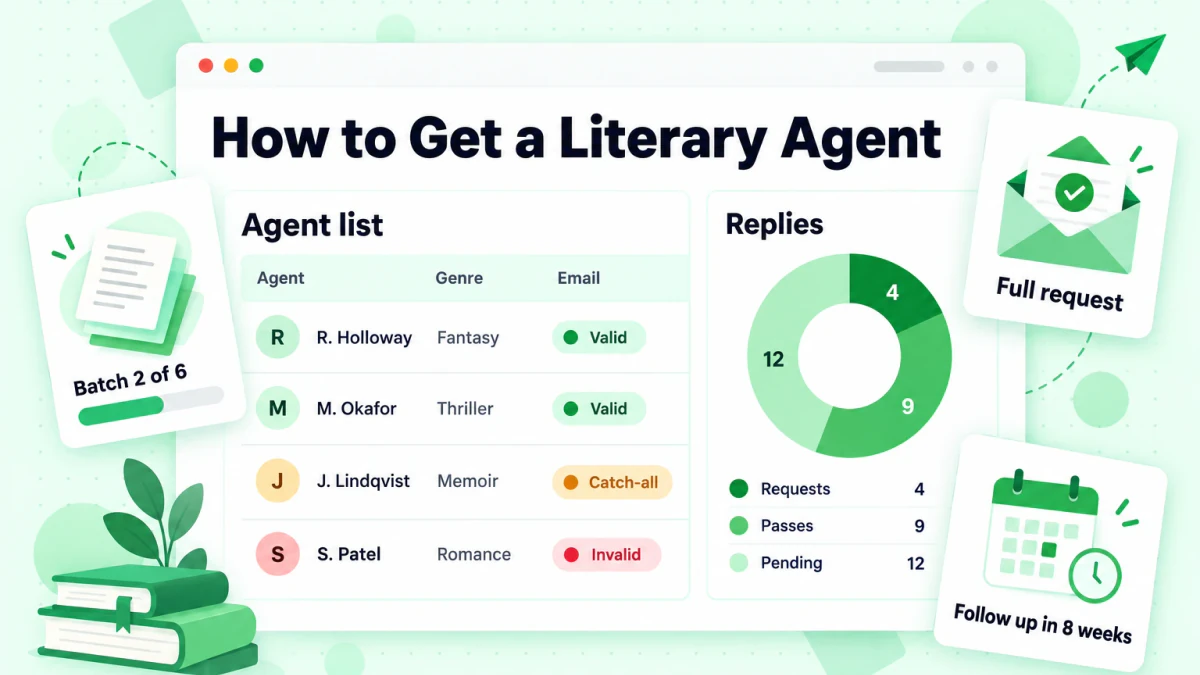
This guide on how to get a literary agent walks through that process in order: what an agent actually does, where to find agents, how to build and check your list, how to query a literary agent so the email reaches the inbox, how to track replies, and what to do after an offer or a stack of rejections. The outreach part matters more than most writing advice admits. A query that bounces, lands in spam, or goes to an old address is a query nobody reads, however good the opening line is.
How to Get a Literary Agent, Step by Step
Here is the whole process on one screen. Each step has its own section below.
- Finish and revise the book. A complete, revised manuscript for fiction and memoir; a book proposal for most nonfiction.
- Research agents. Find agents who sell books in your category and are open to queries now.
- Build and check your list. 30 to 60 agents in a spreadsheet, each checked for legitimacy, with a personal note and a verified email address.
- Write the query. One page, personalized, in the format each agent requests.
- Send in small batches. 5 to 10 queries at a time, one agent per email, from an address that inbox providers trust.
- Track every reply. Log requests, rejections and silences, and read the pattern after each batch.
- Handle the outcome. Prepare for the offer call, or revise and keep going after rejections.
The steps are simple to list. What separates writers who get a literary agent from writers who give up is usually the middle of the list: research that matches the book to the right agents, and outreach that actually arrives.
What Is a Literary Agent?
A literary agent is a publishing professional who represents authors and sells their books to publishers. The agent pitches your manuscript to editors, negotiates the advance and the contract, handles subsidiary rights such as translation, audio and film, collects payments from the publisher, and advises you on your career. In exchange, a reputable agent takes a commission on what you earn from the deals they make, commonly 15% of domestic income and a higher share on foreign rights sold through co-agents. A reputable agent does not charge reading fees or upfront fees, and does not make representation conditional on buying editing or other services.
The Wikipedia article on literary agents gives the history and the general model. The practical point for you is this: the agent earns money only when your book sells, so the agent is choosing projects they believe they can sell. Your query is a pitch to a business partner, not a request for a favour.
Do you need a literary agent?
You need a literary agent if you want to sell book-length fiction or general nonfiction to one of the large publishing houses or their imprints. Many of those imprints do not accept submissions from authors directly, and the Writer Beware guide to literary agents from the Science Fiction & Fantasy Writers Association explains why agents became the first filter for most of traditional publishing. You probably do not need an agent if you plan to submit to small presses that accept work directly from authors, if you write in a niche with its own specialist publishers, or if you plan to self-publish. The guide on how to get a book published compares these routes side by side.
| Your goal | Agent needed? | Why |
|---|---|---|
| Novel or general nonfiction with a large publisher | Usually yes | Many large imprints accept agented submissions only |
| Book with a small or independent press | Often no | Many small presses read direct submissions |
| Academic or professional book | Usually no | University and specialist presses work with authors directly |
| Picture book | Usually yes for larger houses | Same agented-only rule applies at most large houses |
| Self-published book | No | You handle distribution and marketing yourself |
Before You Query: Is the Book Ready?
The single most common reason queries fail is that the writer queried too early. Agents read the opening pages to decide whether to ask for more, and they rarely read a revised version of a manuscript they already declined.
For fiction and memoir, that means a complete, revised manuscript. Not a strong first draft, not a draft with the last three chapters still to fix. Most agents want the whole book done before they consider a debut novelist, because they need to know you can finish and land the ending.
For most nonfiction, the requirement is different. You query with a book proposal: an overview, a market and competition section, an author platform section, a chapter-by-chapter outline and one or two sample chapters. The proposal sells the book before it is written, so it carries the weight a finished manuscript carries for fiction.
Before you start your list, check these four things:
- Word count fits the category. A debut adult novel far outside the usual range for its genre will get passed over on the numbers alone. Look up the usual range for your genre before you query.
- You can name the genre and category. "Upmarket women's fiction", "adult epic fantasy", "narrative nonfiction about science". Agents list what they represent in these terms.
- You have two or three comparable titles. Recent books (from roughly the last five years) that share your audience. Comps show an agent where your book would sit in a bookshop.
- Someone other than you has read it. Critique partners or beta readers catch the problems you can no longer see.
How to Find a Literary Agent
To find a literary agent, start with agents who represent books like yours and who are open to queries right now. Use several sources, because each one shows a different slice of the market, and confirm every detail on the agency's own website before you add a name to your list.
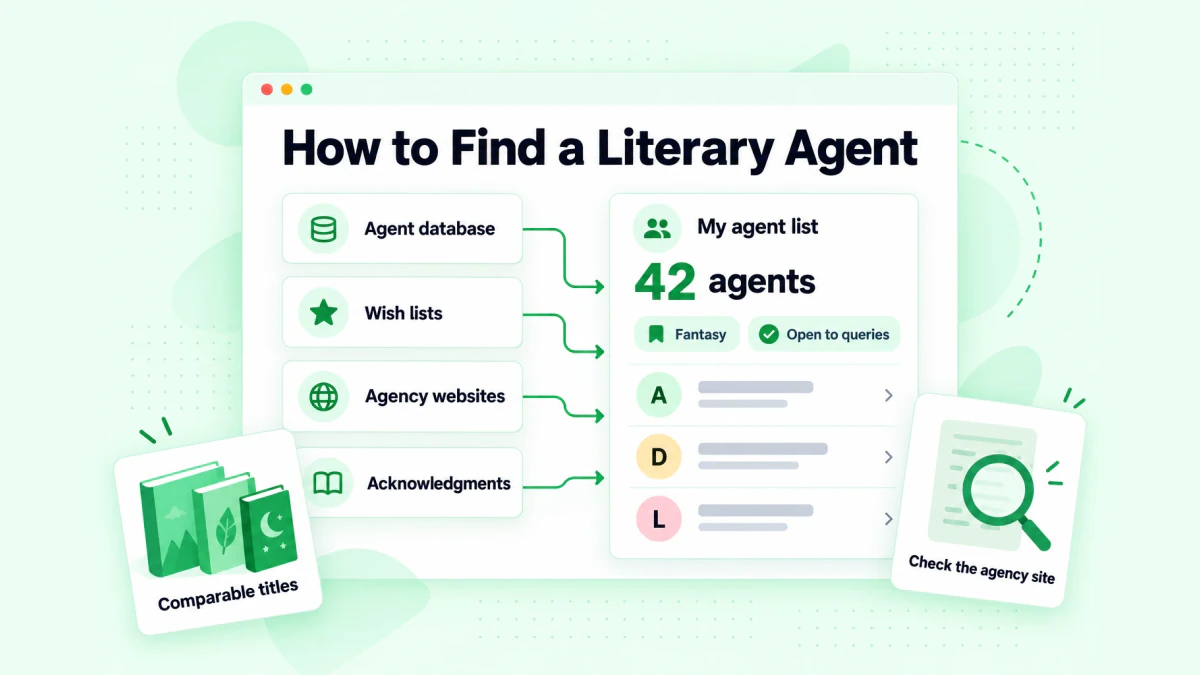
How to find a literary agent, source by source:
- QueryTracker. QueryTracker is a searchable database of agents with genre filters, links to agency pages, and reply data reported by writers who queried them. It is useful for discovery and for seeing whether an agent tends to reply. Treat the reply data as a rough signal from other writers, not a guarantee.
- Publishers Marketplace. A subscription site where agents and editors report deals. Searching deals in your genre shows which agents actually sell books like yours, which is the best evidence you can get about an agent's track record. The site requires a paid membership for most of its data.
- Manuscript Wish List. On Manuscript Wish List, agents and editors post the kinds of stories they want to see, often in very specific terms. A wish-list post you can quote in your query is the strongest personalization you can have. Agents also post wishes on social media under the #MSWL tag.
- Agency websites. Every agency page lists its agents, what each one represents, whether they are open to queries, and how to submit. This is the source of truth. Anything you read elsewhere should be checked here.
- Acknowledgments pages. Open books you admire in your genre and read the acknowledgments. Authors almost always thank their agent by name. This gives you a list of agents who sold books close to yours, which is exactly who you want.
- Trade associations. In the UK, the Association of Authors' Agents lists member agencies, which follow a code of practice. In the US, the Association of American Literary Agents (AALA) publishes a member directory and a code of ethics. Membership is not required to be a good agent, but it is a useful signal.
- Conferences and pitch events. Writers' conferences, online pitch events and agent Q&A sessions let you hear what an agent wants in their own words. Some conferences offer short pitch sessions; a request from a pitch session still means you send a query, but you can mention where you met.
Literary agents accepting submissions
Literary agents accepting submissions are agents whose page currently says they are open to queries. Agents close to queries when their inbox is full or when they are focusing on current clients, and they reopen on their own schedule. Literary agents accepting submissions today may be closed next month, so before every batch, open each agent's page and confirm three things: they are open now, they still represent your genre, and the submission method has not changed. A query sent to a closed agent is usually deleted unread, and some agencies say so on the page.
Build Your Literary Agent List
A literary agent list is a spreadsheet of every agent you plan to query, with the details you need to personalize, send and follow up. Building it properly takes a few evenings, and it saves you from the worst mistakes: querying two agents at the same agency at once, sending to an address that changed last year, or forgetting who asked for pages.
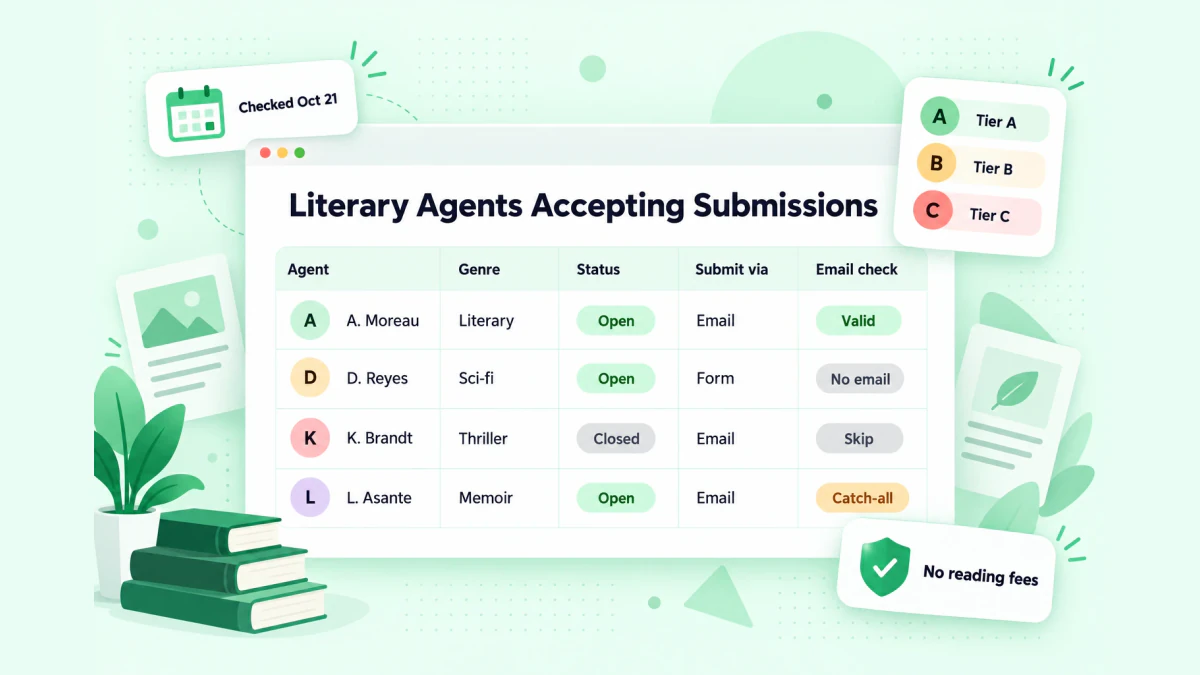
Use one row per agent and these columns, so the sheet always shows which literary agents accepting submissions fit your book and how to reach them:
| Column | What to record | Why it matters |
|---|---|---|
| Agent name | Full name, spelled as on the agency site | A misspelled name is an instant signal of a mass mailing |
| Agency | Agency name | Most agencies want one query per agency at a time |
| Genres | What they represent, in their words | Keeps you from querying outside their list |
| Open status | Open or closed, with the date you checked | Agents open and close often |
| Submission method | Email address, or form (for example QueryManager) | Determines how you send and what you can verify |
| What they ask for | Query only, query plus first pages, synopsis, proposal | Each agent's guidelines differ |
| Personal note | A wish-list line, a client book, an interview quote | The one sentence that makes the query theirs |
| Email status | Result of verifying the address | Stops bounces before they happen |
| Tier | A, B or C | Controls the order you query in |
| Sent, reply, outcome | Dates and results | Your tracking record |
Aim for 30 to 60 agents. Fewer than that and a run of form rejections leaves you with nobody left before you have learned anything. Far more than that usually means the list includes agents who do not really fit.
Split the list into three tiers. Tier A is your best fits: agents who sold comparable books or posted a wish that matches yours. Tier B is solid fits. Tier C is agents who take your category but without a specific link to your book. Do not start with all of tier A. Mix tiers in each batch so that your first, least-tested version of the query does not use up your best chances.
Check every agent before you add them
There are no licensing requirements for literary agents, and anyone can call themselves one. Before a name goes on the list, check for the warning signs that Writer Beware documents: reading fees, upfront "marketing" or "submission" fees, a requirement to buy an edit or critique, referrals to a paid publishing package, or an unsolicited offer of representation. Look for a public record of sales to publishers you have heard of. If you cannot find any sales, it is a weak agent at best.
How to Query a Literary Agent
To query a literary agent, send a one-page pitch, addressed to that agent by name, in exactly the format their guidelines request. The query has three jobs: show the agent your story or idea in a few paragraphs, give the facts (title, genre, word count, comps), and say briefly who you are. Agents decide in seconds whether to read your pages, so clarity beats cleverness.
The structure that most agents expect:
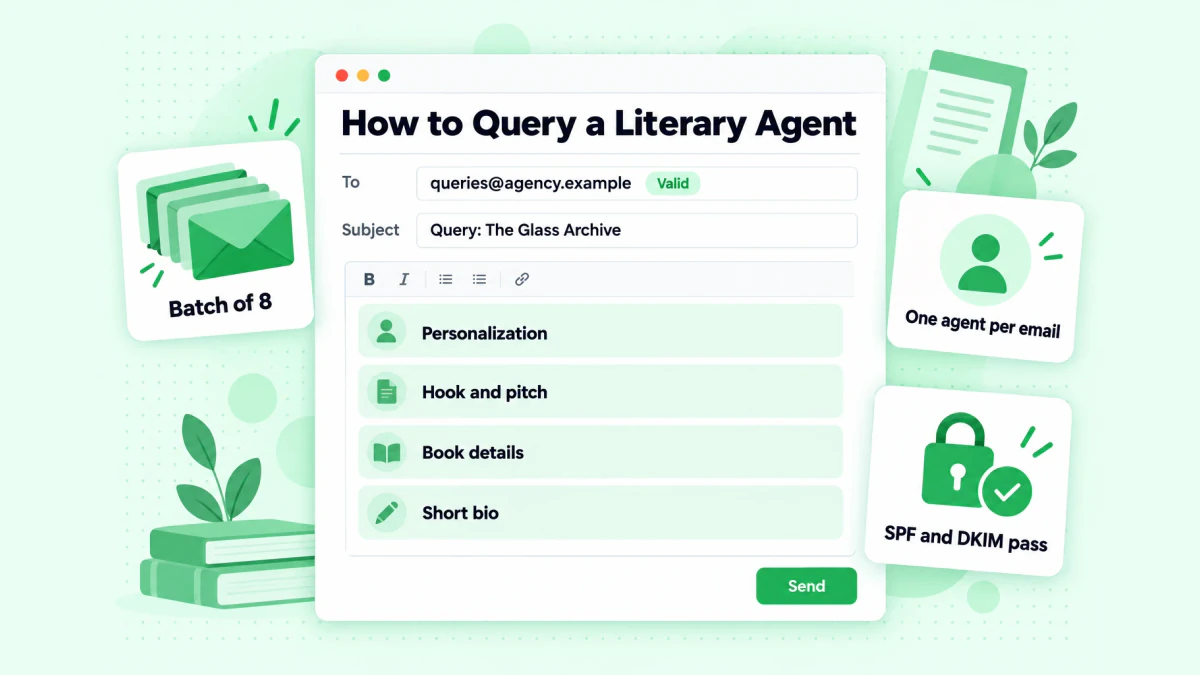
- Personalization (one sentence). Why this agent: a wish-list item, a client book you admire, something they said in an interview. Keep it short and specific. "I'm querying you because you mentioned wanting a heist novel set in a museum" works. "I love your agency" does not.
- The hook and pitch (two or three short paragraphs). Main character, what they want, what stands in the way, what they risk. For nonfiction, the problem the book addresses, the approach, and why readers need it now.
- Book details (one or two sentences). Title, genre, word count, comps.
- Bio (two to four sentences). Relevant credentials, publications, platform, or the experience that led you to write this book. If you have none, keep it to one line. That is fine for fiction.
- Closing. Thank them, note that the requested materials are included, and sign with your name and contact details.
Each part is covered in more depth, with a worked example, in the guide to writing a query letter.
Then follow the guidelines exactly. If the agent asks for the query and the first ten pages pasted into the email body, paste them in the body. If they use a form, use the form and do not also email. If they say no attachments, send no attachments. Agents receive hundreds of queries; a query that ignores the guidelines is the easiest one to decline.
How to get an agent for your book also depends on the subject line, which most guides skip. Use the format the agent asks for. If they give none, "Query: TITLE (Genre, word count)" is clear and easy to filter.
Send Queries That Reach the Inbox
Learning how to query a literary agent also means learning how email delivery works. A query is cold outreach: you are writing to someone who does not know you, from an address they have never seen, about something they did not ask for. Inbox providers treat it accordingly. The writing gets you a request for pages; the sending decides whether the query is read at all.
Verify every agent email before you send
Agency staff move, agencies merge, and agents leave to start their own shops. The address in a three-year-old interview or a database listing may no longer exist. Sending to a dead address produces a hard bounce, and a run of bounces from a new personal address tells mailbox providers that you are mailing a list you did not maintain, which is exactly what spammers do.
Run your list through an email checker before each batch. BillionVerify checks the syntax, confirms the domain has mail servers, and opens an SMTP conversation with the receiving server to ask whether the mailbox exists, without sending an email. For a full list, upload the spreadsheet as a CSV to bulk email verification and keep the status column next to each agent.
What each result means for a query list:
| Status | What it means | What to do |
|---|---|---|
| Valid | The mailbox exists and accepts mail | Send |
| Invalid | The mailbox or domain does not exist | Do not send; find the current address on the agency site |
| Catch-all | The agency's server accepts mail for any address, so the mailbox cannot be confirmed | Re-check the exact address on the agency's submission page, then send |
| Role | A shared address such as queries@ or submissions@ | Normal for agencies; send if it is the address the guidelines give |
| Unknown | The server did not give a clear answer | Retry later; confirm the address on the agency site |
Two of these need a word of explanation. Many small agencies use a catch-all domain, so a catch-all result is common and not a reason to drop an agent; it is a reason to copy the address directly from the agency's current submission page. Role addresses are often the official querying route for an agency, so unlike in a marketing list, you keep them. The catch-all verifier and role account detection pages explain how each flag is decided.
Control the sending pace
Send in batches of 5 to 10 queries, a week or two apart. This is good querying strategy, because it lets you see whether the query gets requests before you use up your list. It is also good sending practice, because a sudden burst of identical cold emails from a new address is a spam pattern. Practical rules:
- One agent per email. Never put several agents in To, CC or BCC. It breaks personalization and looks like bulk mail.
- Write each email individually. Mail-merge tools that send the same text with a swapped name look like bulk mail to filters and to agents.
- Spread the sends. Send a few a day across the week rather than the whole batch in one minute.
- Plain text or simple formatting. No images, no tracking pixels, no link shorteners, no attachments unless requested.
Use an address that will be trusted
A personal address from a large mailbox provider, or an address on your own author domain, both work. If you use your own domain, make sure it is authenticated with SPF and DKIM, and preferably DMARC. Google's email sender guidelines list these requirements and ask senders to keep spam complaints below 0.3%. Use a professional address based on your name, not a nickname, and keep the display name as your real name. Check your setup with an email deliverability test before the first batch.
If several of your queries are failing to arrive, the cold email deliverability guide goes deeper into authentication, sender reputation and spam filters.
Track Replies and Follow Up
Every query has one of five outcomes: a full request, a partial request, a rejection, a revise-and-resubmit, or no reply. Your tracker turns those outcomes into decisions.
Log each reply on the same row as the agent, with the date. When an agent requests pages, send exactly what they asked for, promptly, in the format they asked for, and reply in the same email thread so they can see the context. Update the row to "full requested" or "partial requested" with the date you sent the material.
On follow-ups, the agent's guidelines decide. Many agents state a reply window, often between six and twelve weeks, and many say that no reply by the end of that window means no. Do not follow up on a query unless the guidelines invite it. A follow-up on a full or partial manuscript is different: after the stated window has passed, or after roughly three months if none is stated, a short, polite check-in is normal. The cold email follow-up guide covers timing and wording for follow-ups in general; with agents, keep it to one or two sentences.
Read your numbers after each batch:
| Signal after 10 to 15 queries | Likely cause | Next step |
|---|---|---|
| No requests at all | The query is not landing | Rewrite the hook and pitch before the next batch |
| Requests, then rejections on partials | The opening pages are not holding the reader | Revise the opening chapters |
| Requests, then rejections on fulls | A problem later in the manuscript | Look at structure, pacing or ending; seek feedback |
| Many bounces or no replies at all | Sending or address problems | Verify addresses and check deliverability |
When an Agent Offers Representation
An offer usually starts with an email asking for a phone or video call. On the call, the agent will tell you what they love about the book, what revisions they would suggest, and how they plan to submit it. Ask your own questions too:
- Which editors and imprints would you send it to first?
- What revisions do you think it needs before submission?
- How do you communicate with clients, and how often?
- What happens if this book does not sell?
- Can I speak with one or two of your current clients?
- What does your agency agreement say about commission and ending the agreement?
After the call, it is standard to email every agent who still has your query or manuscript, tell them you have an offer of representation, and give them a deadline, usually one to two weeks, to respond. Some will step aside, some will read quickly, and occasionally you will end up choosing between offers. Then read the agency agreement carefully before you sign, and ask about anything you do not understand.
What to Do After Rejections
Rejection is the normal result of most queries, including queries for books that later sell. Form rejections tell you very little on their own; the pattern across a batch tells you much more, which is why you send in batches.
If the pattern says the query is the problem, rewrite it and test the new version on the next batch. If it says the pages are the problem, stop querying and revise, because agents rarely reconsider a manuscript they have declined unless they invited a resubmission. If an agent sends a revise-and-resubmit request, take it seriously: it means they see something in the book and want to read it again after specific changes.
When you have worked through your whole list, you have three good options. You can write the next book and query it, which is how many agented authors got their agent. You can submit directly to small presses that accept unagented work. Or you can self-publish, keeping control of rights, pricing and timing; Bookeen's guide on how to create an ebook covers turning a finished manuscript into a book you can publish yourself, and the guide on how to sell books covers getting it in front of readers.
A Realistic Querying Timeline
| Stage | Typical time | What happens |
|---|---|---|
| Research and list building | 2 to 4 weeks | Sources, agency pages, tiers, personal notes |
| Address checks and setup | 1 to 2 days | Verify emails, set up and test your sending address |
| First batch | Week 1 | 5 to 10 queries, mixed tiers |
| Waiting and reading signals | 4 to 8 weeks | Log replies, send requested pages |
| Next batches | Every 1 to 3 weeks | Revised query if needed, re-checked addresses |
| Requests to offer | Weeks to months | Full reads, revise-and-resubmit, calls |
| Offer to signed agreement | 1 to 3 weeks | Notify other agents, decide, sign |
Most writers spend several months querying. Re-verify your remaining addresses before each new batch if more than a few weeks have passed, because agents change agencies throughout the year.
FAQs
How do you get a literary agent?
You get a literary agent by querying agents who sell books in your category with a short, personalized pitch and a finished, revised manuscript (or a proposal for nonfiction). Build a list of 30 to 60 agents from QueryTracker, agency websites, acknowledgments pages and wish lists, send in small batches, and track replies to improve the query as you go.
How do I find a literary agent for my book?
To find a literary agent for your book, look for agents who sold books similar to yours. Check the acknowledgments of comparable titles, search deal reports on Publishers Marketplace, browse QueryTracker by genre, and read wish-list posts. Confirm every agent's current genres and open status on the agency's website.
How much does a literary agent cost?
A reputable literary agent costs nothing upfront and earns a commission on your book deals, typically around 15% on domestic deals and a higher rate on foreign sales. An agent who asks for reading fees, submission fees or paid editing as a condition of representation is a warning sign.
How many literary agents should I query?
Most writers query between 30 and 60 literary agents, in batches of 5 to 10. That is enough to learn from the response pattern and adjust the query or the manuscript before you run out of good matches.
Can I query more than one agent at the same agency?
Usually not at the same time. Most agencies ask you to query one agent, and a rejection from one agent often counts for the whole agency. Read each agency's guidelines, as some allow you to try a second agent after a rejection.
Should I verify a literary agent's email address before querying?
Yes, verifying a literary agent's email address before you query prevents bounces to old addresses and protects your sending address from looking like a spam source. Check the list with an email verification tool, re-check catch-all and unknown results on the agency's own submission page, and re-verify before each new batch.
How long do literary agents take to reply?
Literary agents commonly take six to twelve weeks to reply to a query, and many state that no reply after their window means no. Replies to full manuscripts often take longer. Follow each agent's stated window rather than a general rule.
How long does it take to get a literary agent?
It usually takes several months to get a literary agent, counting list building, batches of queries, reply windows of six to twelve weeks, and full-manuscript reads. Some writers sign within a few months; many query more than one book before they get a literary agent.
Where can I find literary agents accepting submissions?
You can find literary agents accepting submissions on QueryTracker, Manuscript Wish List and agency websites, which state whether each agent is open to queries. Always confirm the open status on the agency's own page on the day you send, because agents close and reopen often.
What if no literary agent accepts my book?
If no literary agent accepts your book, you can revise it, write and query a new book, submit directly to small presses that read unagented work, or self-publish. Many authors get their first agent with a later book.