


A query letter is a one-page pitch you send to a literary agent, or to a publisher that accepts direct submissions, to get them to read your book. It introduces the book in a few short paragraphs: a personalized opening, a hook and story summary, the book's title, genre, word count and comparable titles, and a short author bio. A good query letter runs about 250 to 400 words and follows the agent's submission guidelines exactly. Below you'll find the standard query letter format, two full query letter examples, a fill-in template, the mistakes that get queries rejected, and how to send each one so it reaches a real inbox.
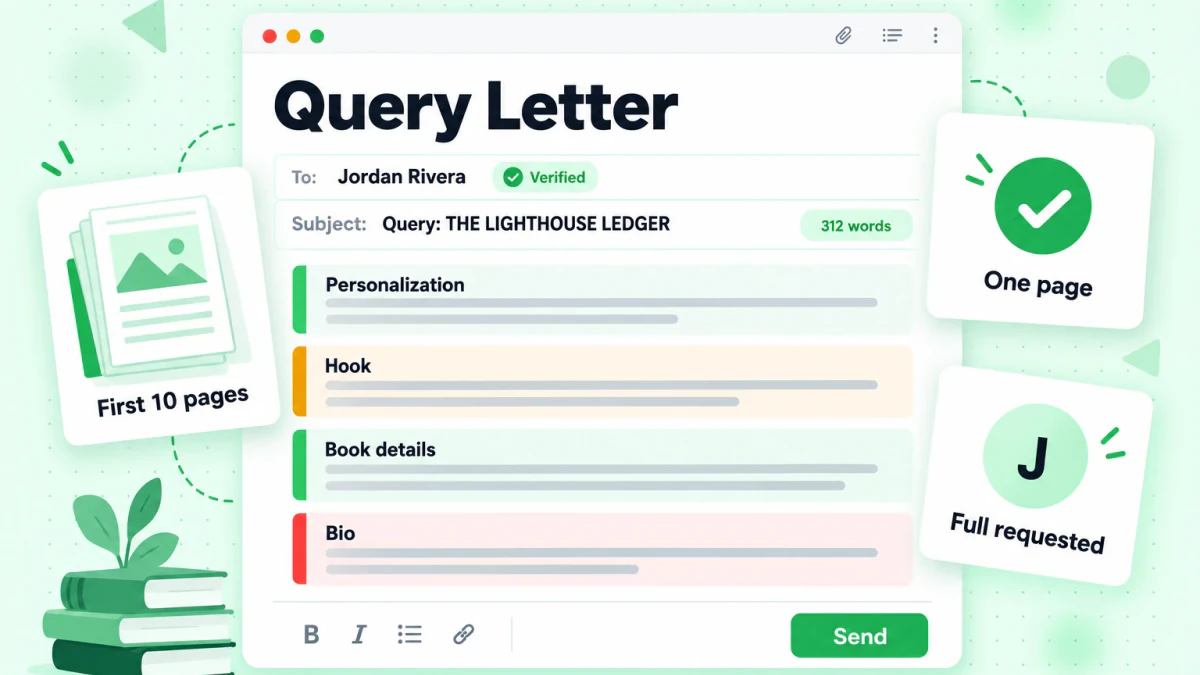
What is a query letter?
A query letter is the standard first contact between an unrepresented author and a literary agent. It does one job: make the agent want to read your pages. It is not a synopsis of the whole book, not a cover letter listing everything you've written, and not a sales letter about how many copies the book will sell. For most writers it is the first step in how to get a book published the traditional way.
Agents receive far more queries than they can take on, so most read each query letter quickly and decide in the first few lines whether to keep going. That is why the format is so consistent across the industry. When every query letter follows the same structure, an agent can find the genre, the word count and the story's core conflict in seconds, and spend their attention on whether the story itself is right for them.
Most queries today are emails or online query forms, not printed letters. The format below works for both: in a form, each part goes into its own field; in an email, the parts run in order in the body of the message.
Query letter vs synopsis vs book proposal
Writers often confuse three submission documents:
| Document | Length | What it covers | When you need it |
|---|---|---|---|
| Query letter | About 250 to 400 words | Hook, setup and stakes, book details, bio | Every submission to an agent |
| Synopsis | Usually 1 to 2 pages | The whole plot, including the ending | When an agent's guidelines ask for one |
| Book proposal | Often 20 pages or more | Overview, outline, market, platform, sample chapters | Most nonfiction books |
The query letter never gives away the ending. The synopsis always does. A nonfiction query letter pitches the proposal, which is then sent along with it or on request.
Query letter format
The query letter format agents expect has five parts. The order of the middle parts can vary, but almost every successful query letter contains all five.
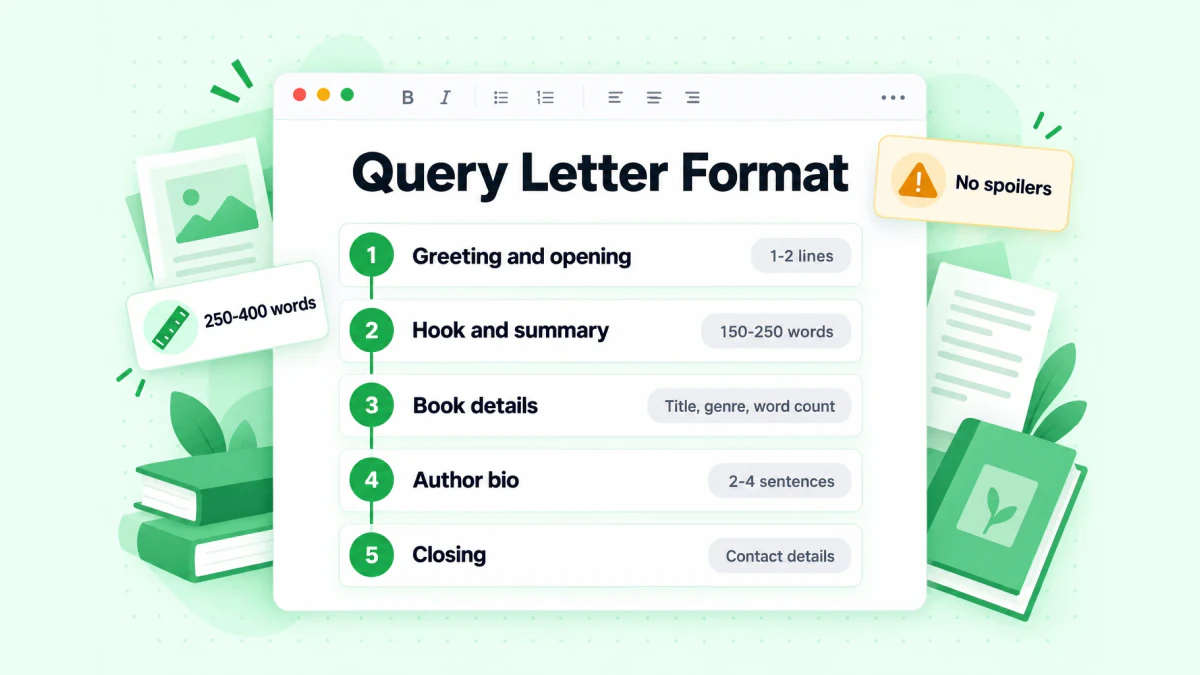
The diagram above shows the query letter format as blocks: personalization, hook, book details, bio and closing. Here is what goes into each.
1. The greeting and personalized opening
Address the agent by name, spelled correctly: "Dear Ms. Rivera" or "Dear Jordan Rivera." Never "Dear Sir or Madam" or "Dear Agent." Then give one sentence on why you are querying this agent specifically: a book they represent, something on their wish list, an interview where they said they want stories like yours, or a pitch event where they requested pages. Keep it short and true. If you have no real connection, a simple "I'm seeking representation for my novel and saw on your agency page that you're looking for upmarket mysteries" is enough.
Some agents prefer that you lead with the hook and put the personalization later. Either order is fine.
2. The hook and story summary
This is the heart of the query letter, usually 150 to 250 words written like the copy on the back of a book. For fiction, it answers four questions:
- Who is the main character, and what makes them specific?
- What do they want, and what happens to set the story in motion?
- What stands in their way?
- What happens if they fail? The stakes.
Write in third person, present tense, in the voice of the book. Focus on the main character and one central conflict; leave out subplots, secondary characters and backstory. End on the choice or danger the character faces, not on the ending.
For nonfiction, the hook explains the book's big idea, the problem it solves, who it is for and why now.
3. The book details
One short paragraph with the facts an agent needs to place the book:
- Title (many writers put it in capital letters)
- Genre and age category, such as adult literary fiction, young adult fantasy or narrative nonfiction
- Word count, rounded to the nearest thousand
- Comparable titles: one or two recent books, usually published within the last few years, that share your book's audience or appeal
- Series potential, if it applies, mentioned briefly: "a standalone with series potential"
Word count matters because it is the quickest signal that you know your market. A debut adult novel far longer or shorter than its category's usual range is a common reason to decline. Bookeen's guide to how many words are in a novel lists typical lengths by genre.
4. The author bio
Two to four sentences. Include anything relevant to the book or to your writing: publishing credits, awards, a degree in the subject, professional experience that informs the story, or a platform such as an email newsletter or podcast. For fiction, "I live in Ohio, where I work as a nurse" is a perfectly good bio if you have no credits. For nonfiction, the bio carries much more weight, because publishers want to know why you are the person to write this book and how you will reach readers. A video channel counts as platform too: some nonfiction authors build one by turning short tips from the book into vertical videos with a YouTube Shorts maker, which writes the script and adds narration and captions.
If you write under a pen name, sign the query with your real name and mention the pen name in the bio; Bookeen's guide to choosing a pen name explains how that works in contracts.
5. The closing
Thank the agent, say what you've included (for example, the first ten pages pasted below, if the guidelines ask), and sign off with your name, email address, phone number and a website or social profile if you have one. That's it. Don't add a second pitch, a list of other manuscripts or a deadline.
How long should a query letter be?
How long should a query letter be? About 250 to 400 words, which fits on one page. That is long enough for a short opening, a 150 to 250 word story summary, the book details and a brief bio, and short enough to read in a minute. If yours runs past 400 words, cut the summary first: drop subplots, secondary characters and setting details until only the main character, the conflict and the stakes are left.
Query forms sometimes enforce a character limit on each field. Write the full query letter first, then paste each part into the matching field. A complete query letter sample like the ones below is easier to adapt to a form than one written field by field.
Query letter examples
The two query letter examples below are invented for this guide. The authors, books, agents and comparable titles are all made up. In a real query, use real, recently published comparable titles and the agent's real name.
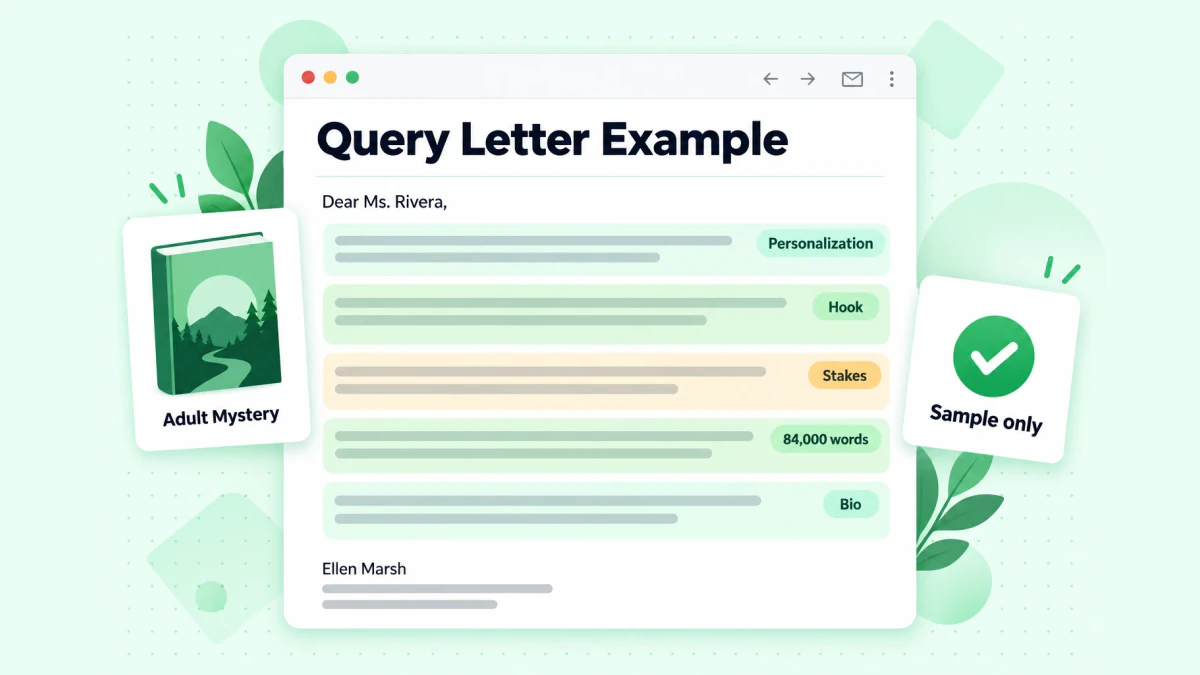
The annotated query letter example above shows how the parts fit together in an email. Here are the full texts.
Query letter example: fiction
Subject: Query: THE LIGHTHOUSE LEDGER (Adult Mystery, 84,000 words)
Dear Ms. Rivera,
I'm querying you because your wish list mentions cozy mysteries with a strong sense of place, and THE LIGHTHOUSE LEDGER is set in a fishing town where everyone knows everyone's business.
When retired bookkeeper Nora Quist inherits her late brother's bait shop on the Maine coast, she expects to sell it by summer. Then she finds his second set of books: a ledger of cash payments to half the town council, and an entry for the night he drowned. The police call his death an accident. The council wants the shop sold quickly. And the only person who can read her brother's shorthand is the harbormaster, who was the last person to see him alive.
As the town's annual regatta approaches, Nora must decide whether to take the buyer's generous offer and go home, or follow the ledger to whoever was willing to kill to keep it closed, before someone decides she knows too much.
THE LIGHTHOUSE LEDGER is a complete adult mystery at 84,000 words, the first in a planned series. It will appeal to readers of SALT AND SECRETS by Imaginary Author and THE HARBOR CLUB by Example Writer.
I spent thirty years as an auditor before turning to fiction, and my short stories have appeared in two regional anthologies. I live in Portland, Maine.
Per your guidelines, the first ten pages are pasted below. Thank you for your time and consideration.
Sincerely,
Ellen Marsh
ellen@example.com | 555-0100
Why this query letter works: the personalization is one honest sentence; the hook introduces a specific character, a concrete discovery and a ticking clock; the stakes are clear without revealing the ending; the book details are complete; and the bio links the author's career to the story.
Query letter example: nonfiction
Subject: Query: THE TEN-MINUTE GARDEN (Practical Nonfiction, proposal available)
Dear Mr. Okafor,
I read in your recent interview that you're looking for practical lifestyle books by authors with an engaged audience, which is why I'm reaching out about THE TEN-MINUTE GARDEN.
Most people who start a vegetable garden give up by July. They don't lack interest; they lack time. THE TEN-MINUTE GARDEN is a week-by-week plan for growing food in ten minutes a day, built around small beds, containers and a simple schedule that fits a full-time job. Each chapter covers one month, with tasks, troubleshooting and a short harvest recipe.
I'm a certified master gardener and have taught community gardening classes for twelve years. My weekly gardening newsletter has 18,000 subscribers, with an average open rate above 50%, and my workshops have reached more than 3,000 home gardeners.
The complete proposal and two sample chapters are ready. The book will appeal to readers of practical, time-saving home guides.
Thank you for considering it.
Best regards,
Marcus Lee
marcus@example.com | 555-0101
In a nonfiction query letter the platform does much of the work. Note that the subscriber count and open rate are specific numbers: an agent can only weigh a platform that you describe precisely, and a newsletter list that you've kept clean is one of the most persuasive platforms a nonfiction author can show. If you don't have one yet, see how to start a newsletter.
Query letter template
Use this query letter template as a starting point, then rewrite every line in your own voice. It follows the same query letter format as the query letter examples above. A query that reads like a filled-in form is easy to spot.
Subject: Query: TITLE (Genre, word count)
Dear [Agent's name],
[One sentence on why you are querying this agent: a book they represent, their wish list, an event, a referral.]
[Hook: your main character, in one specific line. What happens to change their world.]
[Conflict: what they want, what stands in the way, and how it gets worse.]
[Stakes: the choice they must make, or what they will lose if they fail. Stop before the ending.]
TITLE is a complete [genre and age category] novel at [word count] words. It will appeal to readers of [comparable title] by [author] and [comparable title] by [author].
[Bio: two to four sentences. Relevant credits, experience or platform.]
[What you've included, per the guidelines.] Thank you for your time and consideration.
[Your name]
[Email] | [Phone] | [Website]
How to write a query letter, step by step
Knowing the query letter format is half the work. Here is how to write a query letter that actually gets requests, from first draft to the version you send.
- Finish and revise the book first. For fiction, query only a complete, polished manuscript. Agents who like the query letter will ask for pages right away.
- Write a one-sentence logline. If you can't summarize the main character, conflict and stakes in one sentence, the summary paragraph will wander. A logline is the seed of your hook.
- Draft the summary long, then cut. Write 400 words about the story, then cut to 200. Remove every name except the main character and, at most, two others.
- Find two real comparable titles. Look for recent books with your audience, ideally not huge bestsellers that every writer names.
- Write the bio last and keep it relevant.
- Read it aloud and fix anything that sounds like a book report instead of back-cover copy.
- Get feedback from writers who haven't read the book. If they can't tell you who the story is about and what's at stake, revise. Sites like Query Shark, where an agent critiques real query letters in public, show the same mistakes being fixed again and again.
- Tailor the opening for each agent, and check each agent's guidelines for what to include with it.
Jane Friedman's guide on how to write a query letter is another thorough reference, especially for nonfiction and memoir.
Common query letter mistakes
Most rejected queries fail for a handful of reasons:
- Querying an unfinished or unrevised book.
- Opening with rhetorical questions ("What would you do if you lost everything?") instead of a character.
- Summarizing the whole plot, including the ending. That belongs in a synopsis.
- Too many names and subplots. The agent should only have to track the main character and the central conflict.
- Claims instead of story: "the next bestseller," "perfect for a film," "my family loved it."
- Missing book details, especially word count or genre.
- A word count far outside the genre's range.
- Generic greetings or the wrong agent's name, a sign of a copy-and-paste batch.
- Attachments the guidelines didn't ask for. Many agents delete emails with unexpected attachments unread.
- Querying an agent who doesn't represent your genre. Check their current list on the agency site or on Manuscript Wish List.
- Sending to a dead address. If the email bounces, the agent never sees it, and you may wait months for a reply that can't come.
How to send a query letter to a literary agent
A query letter for literary agents only works if it reaches the agent's inbox, in the form the agent asked for. This is where querying overlaps with good email practice, and where BillionVerify helps. If you're still building your agent list, our guide on how to get a literary agent covers where to find agents and how to track replies.
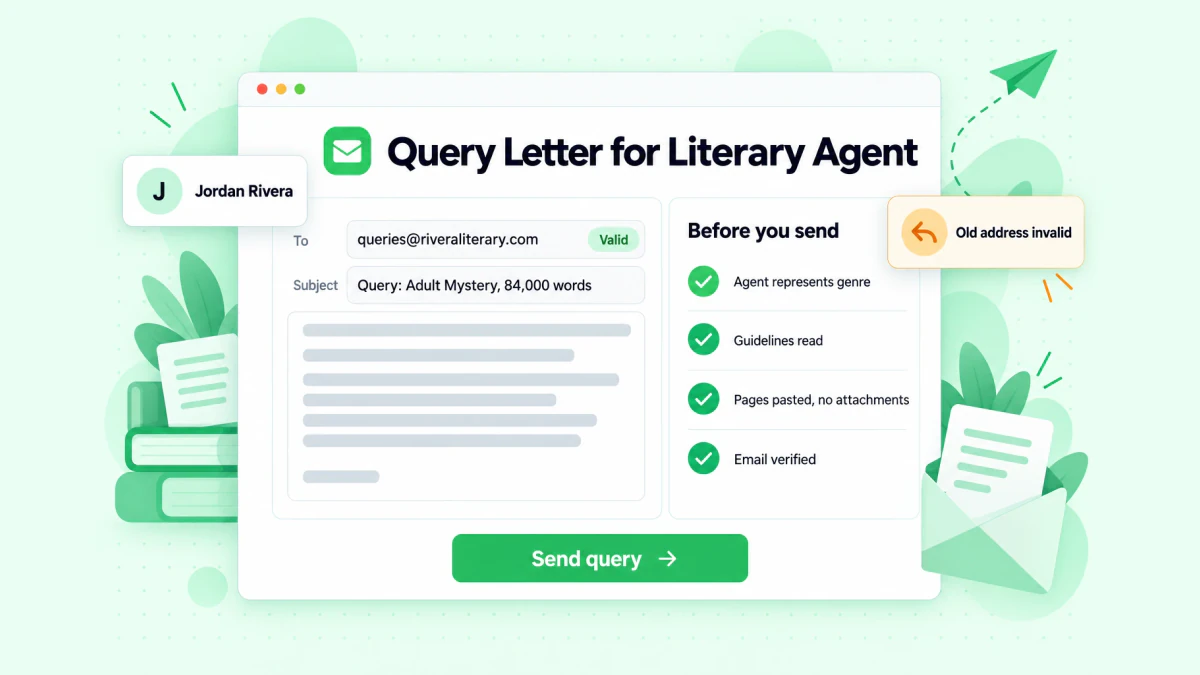
The compose window above shows a query letter for a literary agent ready to send: verified address, personalized greeting, sample pages pasted in, no attachments. Before you hit send, work through this checklist.
Use the submission method on the agency website
Many agents now take queries only through a query form or query manager. If the guidelines link to a form, use the form, and don't email the agent as well. If they take email queries, copy the exact address from the agency's own website, often a shared inbox such as queries@ or submissions@. Never guess an address from a name pattern, and be wary of addresses copied from old interviews or forums. SFWA's Writer Beware also tracks people who pose as agents, so check that an agent and agency are legitimate before you send them your work.
Verify the email address before sending
Agents change agencies, and agencies retire old inboxes. Before each batch of queries, verify every email address on your list. BillionVerify's email address verification checks the syntax, the domain and its MX records, and runs a live SMTP mailbox check, then flags disposable and role addresses. For a whole spreadsheet of agents, upload it as a CSV to bulk email verification.
How to read the results for querying:
- Valid: the mailbox accepts mail. Send.
- Invalid: the address or domain doesn't exist. Don't send; look up the agent's current agency and submission method.
- Catch-all: the agency's domain accepts mail for any address, so the specific mailbox can't be confirmed. Send only if you copied the address from the agency's own site. The catch-all verifier explains this result in detail.
- Role: a shared inbox like queries@. For queries this is often correct, so keep it.
- Unknown: the receiving server didn't answer clearly. Try again later.
Verification protects more than one query. If you send dozens of queries from a personal email account and several bounce, inbox providers may start treating your mail as suspicious. Google's email sender guidelines list low bounce and spam rates among the signals that keep mail out of spam folders, and the same logic applies to the agents' inboxes you're writing to.
Format the email itself
- Subject line: follow the guidelines. If none are given, use the subject format from the query letter template above.
- Body: paste the query letter as plain text, followed by any sample pages the guidelines ask for. Don't attach files unless asked.
- One agent per email. Never CC or BCC several agents.
- Send from an address you check often, with a professional display name.
Send in batches
Query 8 to 12 agents at a time rather than your whole list. If a batch brings no requests for pages, revise the query letter or the opening pages before sending the next one. BillionVerify's guide to cold email personalization covers the same principle from the sales side: a short, specific, personal opening beats a long generic one.
How to follow up on a query letter
Response times vary from days to several months, and many agents don't reply at all to queries they decline. Before you follow up, check the agent's guidelines:
- "No response means no": don't follow up. Treat silence after the stated window as a pass.
- A stated response window: if it has passed, send one short nudge by replying to your original email, so the full query is right there.
- Requested pages: if the agent requested a partial or full manuscript, a polite check-in after their stated reading time, or after about eight to twelve weeks, is fine.
- An offer of representation: tell every agent who still has your query or pages, and give them a deadline of about one to two weeks to respond.
A follow-up is three or four lines: the title, when you sent it, what you sent, and thanks. If you need help with subject lines, BillionVerify's guide to follow-up email subject lines has patterns that adapt well to querying.
Keep a simple tracker with each agent's name, agency, submission method, email verification status, date sent, materials sent, response window and outcome. QueryTracker offers a free tracker, or a spreadsheet works just as well. Log every bounce the moment it arrives, and re-verify the rest of the list before your next batch.
FAQs
What is a query letter?
A query letter is a one-page pitch, usually sent by email or an online form, that asks a literary agent or publisher to read your book. It includes a short personalized opening, the hook, the key facts about the book, and a brief author bio.
How long should a query letter be?
A query letter should be about 250 to 400 words, or one page. Most of that is the story summary, typically 150 to 250 words. If your query letter is longer, cut subplots and secondary characters first.
What is the correct query letter format?
The standard query letter format is a personalized greeting, a hook and story summary, a paragraph of book details, a short bio, and a closing with your contact details. Follow each agent's guidelines where they differ.
Where can I find query letter examples?
You can find query letter examples in this guide, which includes an invented fiction query letter example and a nonfiction query letter example, and on critique sites such as Query Shark, where an agent reviews real queries. Use query letter examples to study structure, not to copy wording.
Should a query letter include the ending?
No, a query letter should not include the ending. It should end on the main character's central choice or the stakes. The ending belongs in a synopsis, which some agents request alongside the query letter.
Can I send the same query letter to every agent?
You can send the same core query letter to every agent, but tailor the greeting and opening line to each one, and adjust what you include to match each agent's guidelines. Always send one email per agent, never a group email.
How do I write a query letter for a literary agent?
To write a query letter for a literary agent, open with one line on why you chose that agent, then give the hook, the book details and a short bio, in about 250 to 400 words. Check the agent's guidelines for what to paste below the query letter, such as the first five or ten pages.
Do I need to verify an agent's email address before querying?
You should verify an agent's email address before querying if it didn't come straight from the agency's current website. Addresses go stale when agents move agencies. A quick check with an email verifier such as BillionVerify tells you whether the mailbox can receive mail, so your query letter doesn't bounce unseen.
What if a literary agent asks for a query letter and a synopsis?
If a literary agent asks for a query letter and a synopsis, send both exactly as the guidelines say, usually pasted into the email or into separate fields of a query form. The query letter pitches the book; the synopsis summarizes the full plot, ending included, in one or two pages.