


To start a newsletter as an author, decide who it is for and what you will send, choose a newsletter platform, set up a signup form with a reason to join, put that link in your books, website and social profiles, and send on a schedule you can keep. Then protect the list: verify addresses as they come in, remove bounces, and stop mailing people who never open. A newsletter you start this way becomes the one channel where you can reach readers directly when a book comes out, without an algorithm in between.
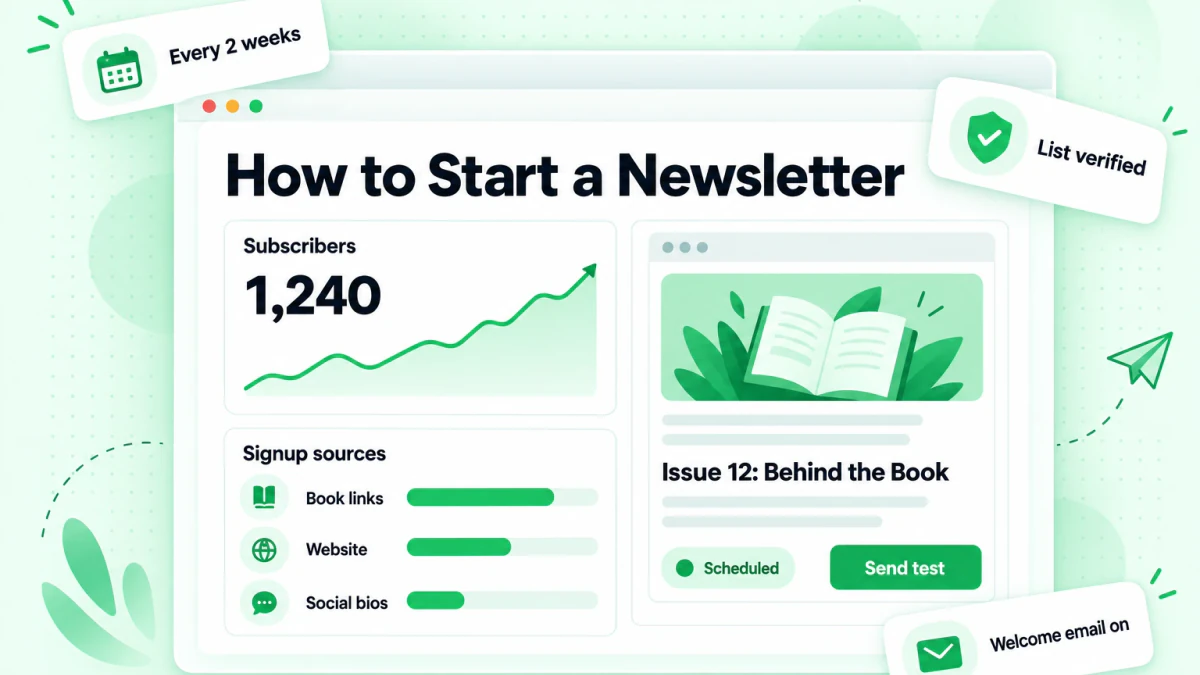
This guide on how to start a newsletter is written for writers: novelists, nonfiction authors, and people who are still writing their first book. It covers the setup, how to build an email list from zero, where newsletter content comes from when you already make videos or podcasts, how often to send, how to use email marketing for books without annoying anyone, and how to keep the list healthy so your emails keep reaching the inbox.
Why Every Author Needs a Newsletter
An author newsletter is an email you send regularly to readers who asked to hear from you. It is the most reliable book marketing channel most authors have, for three reasons.
You own the list. Social platforms decide who sees your posts, and they change those rules without notice. An email list is a set of people who gave you their address. If you move to a different newsletter platform, you export the list and take it with you.
Email sells books. When a new book comes out, the readers who liked your last book are the most likely buyers, and email reaches them on launch day. Retailer rankings respond to sales concentrated in a short window, which is exactly what a launch email to an engaged list produces. The newsletter is one part of a wider plan for how to sell books, alongside retailers and publishers.
It builds your platform. Agents and publishers, especially for nonfiction, ask about an author's platform: how many readers you can reach directly. A growing newsletter with good open rates is a concrete answer. For fiction it matters less in a query, but it matters a great deal once the book is out. If you are working out how to get a literary agent, a newsletter you have kept for a year is evidence that readers want to hear from you.
How to build a personal brand with a newsletter
How to build a personal brand as an author comes down to being recognizably yourself, in one place, consistently. A newsletter is well suited to that. Each issue shows readers what you care about, how you think and what you are working on, and it arrives on a schedule they can rely on. Over a year, fifty issues say more about who you are as a writer than any bio. The Wikipedia overview of personal branding describes the general idea; for an author, the practical version is simple: pick the two or three topics you want to be known for, and keep coming back to them in your newsletter, your books and your public talks.
How to Start a Newsletter in Nine Steps
Here is the full process. Each step has its own section below.
- Define the reader and the promise. Who is the newsletter for, and what will they get?
- Choose a newsletter platform. One that fits how you want to publish and grow.
- Set up your sender identity. Name, from address, domain authentication, legal footer.
- Create a signup form and a lead magnet. A clear page and a reason to join.
- Put the link everywhere readers find you. Books, website, social bios, talks.
- Write a welcome email. The first email sets expectations and gets the first reply.
- Pick a schedule. Monthly, fortnightly or weekly, and keep to it.
- Plan your content sources. Your videos, podcasts, notes and drafts.
- Keep the list clean. Verify addresses, remove bounces, re-engage or remove the inactive.
Define the reader and the promise
Before you choose software, write one sentence: "This newsletter is for [readers] who want [what], and it arrives [how often]." For example: "For readers of cozy mysteries who want early chapters, behind-the-scenes notes and first news of new books, once a month." For nonfiction: "For small-business owners who want one practical bookkeeping tip a week from the author of [book]." That sentence becomes your signup page headline, your welcome email and the test for every issue. If an idea does not fit the promise, it belongs somewhere else.
Choose a Newsletter Platform
The first practical decision in how to start a newsletter is the platform. A newsletter platform hosts your list, your signup forms and your sending. They fall into two broad groups, and the right choice depends on how you want the newsletter to work.
| Type | Examples | Good for |
|---|---|---|
| Publishing-first platforms | Substack, Beehiiv, Ghost | Writers who want a public archive of issues, a simple setup and the option of paid subscriptions |
| Email marketing platforms | Kit, MailerLite, Mailchimp | Authors who want detailed signup forms, automated sequences, tags and segments, for example by series or genre |
Whichever you pick, check these before you commit:
- Signup forms and landing pages. You need at least one hosted signup page you can link to from a book.
- Welcome automation. The ability to send an automatic welcome email, or a short welcome sequence, to every new subscriber.
- Tags or segments. So you can email readers of one series about that series, or send a launch email only to people who have not bought yet.
- Custom domain sending. Sending from your own domain, authenticated with SPF and DKIM, rather than from the platform's shared domain.
- List export. A full export of your subscribers as a CSV file. If you cannot export your list, you do not really own it.
- Pricing as you grow. Most platforms price by subscriber count or take a share of paid subscriptions. Model the cost at 1,000 and 10,000 subscribers, not just at zero.
Do not spend weeks on this decision. Moving later is possible as long as you can export your list, and the habits you build (sending regularly, growing the list, writing well) carry across platforms.
Set Up Your Sender Identity
Your sender identity is how inbox providers decide whether to trust your email. Get it right before the first issue.
- From name. Your author name, exactly as it appears on your books.
- From address. An address on your own domain, such as hello@ or news@ your author domain, is the most durable choice. It survives a platform change and builds its own sending reputation.
- Authentication. Add the SPF and DKIM records your platform gives you to your domain's DNS, and add a DMARC record. Google's email sender guidelines require SPF or DKIM for everyone sending to Gmail and all three for senders above 5,000 messages a day, and ask senders to keep spam complaints below 0.3%. Yahoo publishes similar sender best practices.
- Unsubscribe and address. Every marketing email needs a clear unsubscribe link and, in the US, a valid postal address under the CAN-SPAM Act. A PO box works. The CAN-SPAM Act guide covers the requirements in plain language.
- Opt-in mode. Double opt-in asks new subscribers to confirm by clicking a link. It grows the list a little more slowly, but it filters out typos, fake addresses and people who signed up someone else. For a new author list, it is usually worth it.
Before your first send, run an email deliverability test to confirm the authentication records are in place.
How to Build an Email List as an Author
How to build an email list from zero is the question most authors get stuck on. The answer is a clear reason to join, offered everywhere readers already meet you, and repeated for months. There is no single big source; there are many small ones.
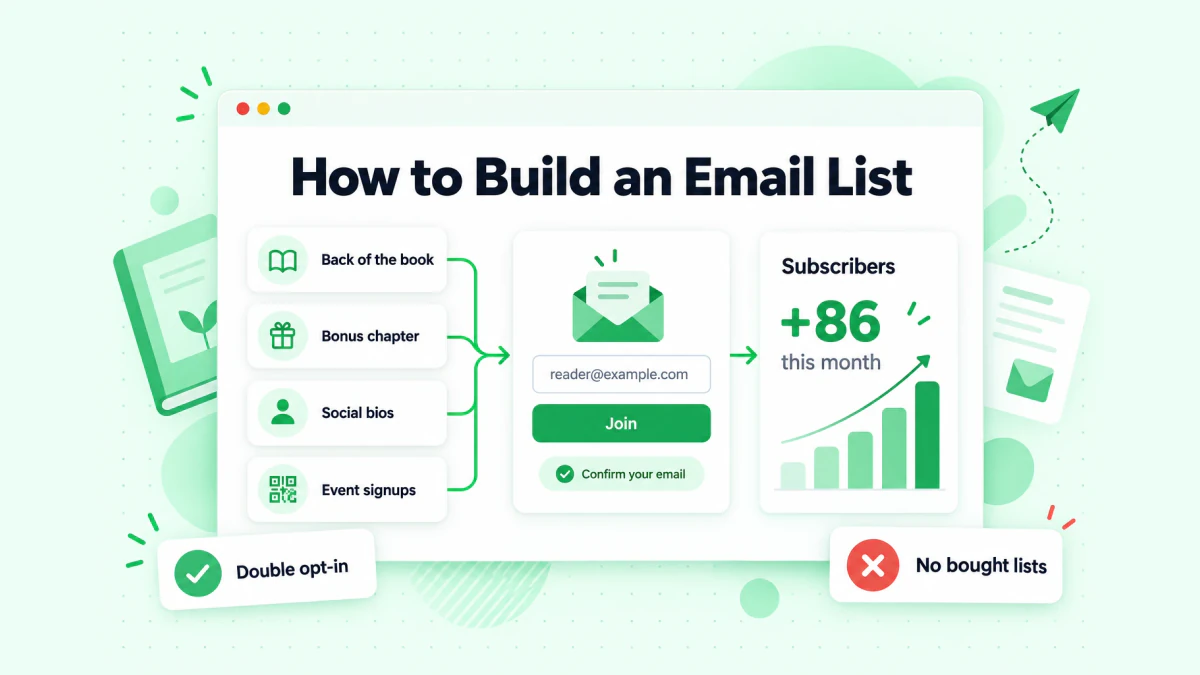
How to build an email list as an author, source by source:
- A lead magnet. Something useful or enjoyable that readers get when they subscribe. For fiction: a bonus chapter, a short story set in your world, a character guide, or an early look at the next book. For nonfiction: a checklist, a template, a workbook or a chapter summary. The best lead magnet is something only readers of your books would want, because it attracts the right subscribers.
- Links inside your books. Put a short invitation and a link to your signup page in the front matter and at the end of every ebook, where a reader who just finished the story is most likely to want more. In print, use a short, easy-to-type URL.
- Your author website. A signup form on the home page and a dedicated newsletter page. If you have only one page, make the signup form the main call to action.
- Social media bios. Link the signup page, not just your website, from every profile. Mention the newsletter in posts when you have something specific to offer, such as a new bonus chapter. Short vertical videos work well here: an article to video tool can turn a past issue into a narrated clip with captions that ends on your signup link.
- Events, signings and talks. A signup sheet or a QR code on a table card. Paper signups bring typos, so check those addresses before importing them.
- Podcast and video appearances. When you are a guest, mention the lead magnet and give the short URL.
- Author cross-promotions. Authors in the same genre often recommend each other's newsletters or join group promotions. Choose partners whose readers would genuinely enjoy your books.
Never buy a list or import addresses that did not opt in to your newsletter. Purchased lists contain dead addresses and spam traps, the people on them did not ask to hear from you, and the complaints and bounces can damage your sending reputation before your first real reader opens an email. The email list building guide goes further into signup forms and growth tactics.
Write a welcome email that gets a reply
Your welcome email has the highest open rate you will ever see, so use it. Deliver the lead magnet, say what the newsletter is and how often it comes, and ask one easy question: "What was the last book you loved?" Replies tell you about your readers, and they are a positive signal to mailbox providers that people want your email.
What to Write in an Author Newsletter
An author newsletter works best when every issue gives readers something they could not get elsewhere: early news, the story behind the story, useful ideas from your field, or a recommendation they trust. A simple structure for each issue is one main piece, one short update and one recommendation. If you want a header image for each issue, an AI image generator can make one from a short description of the scene, so the newsletter has a consistent look without stock photos.
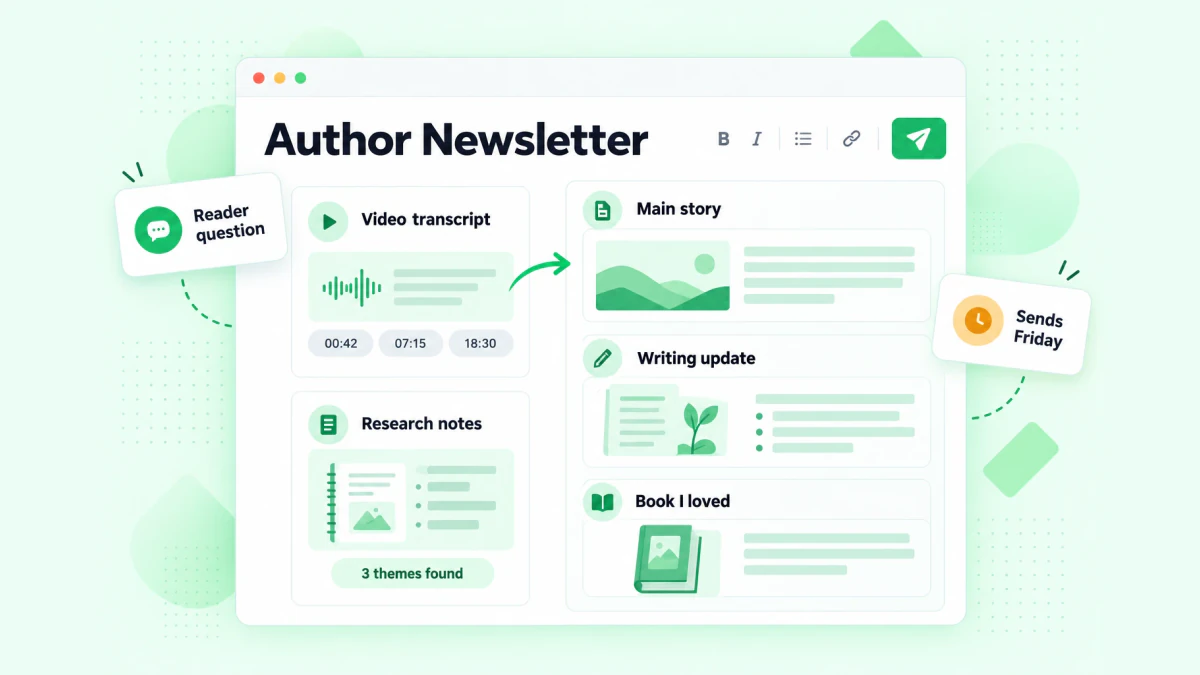
Ideas that work for an author newsletter:
- Behind the book. The research, the place that inspired a scene, a deleted chapter.
- Progress updates. Where the next book stands, with a short excerpt.
- Useful ideas. For nonfiction authors, one practical idea per issue from your subject area.
- Reading recommendations. Books you loved, including books by other authors in your genre.
- Reader questions. Answer one question from a reader each issue.
- News. Cover reveals, preorders, launch dates, events, translations and audiobook releases.
Turn your videos and podcasts into newsletter issues
Many authors already make content in another format: YouTube videos, livestreams, podcast episodes, conference talks, interviews. That material is a ready source of newsletter issues, once it is in text. transcript.im turns a YouTube video, a TikTok, an Instagram Reel or an uploaded video into a timestamped transcript, and its podcast transcript generator does the same for an episode you upload as an MP3 or M4A file. You can export the transcript as TXT, run a summary to see the structure of a long conversation, and copy the passages you want to quote.
From there, a transcript becomes an issue in three passes:
- Find the one idea. Read the summary and pick the single strongest point from the episode or video. One issue, one idea.
- Cut and rewrite. Spoken language is loose. Keep the best lines as quotes and rewrite the rest as short written paragraphs.
- Add the link. End with a link to the full video or episode for readers who want more.
Use NotebookLM to find themes across your material
When you have a lot of material, such as a year of podcast transcripts, your research notes and your drafts, NotebookLM (renamed Gemini Notebook in July 2026, as Google's announcement explains) helps you see the themes across it. You add the files as sources, ask questions such as "Which topics have I come back to most often?" or "Where do I disagree with myself between episode 3 and episode 20?", and every answer cites the passage it came from, so you can check it against your own words.
Two details from Google's help page on adding sources matter here: a notebook on the free tier holds up to 50 sources, and one source can hold up to 500,000 words. Combine related transcripts into a few files, one per season or per topic, rather than adding each episode separately. The guide to NotebookLM and bulk transcripts on transcript.im walks through that workflow step by step. Treat NotebookLM's answers as a map of your material; the issue itself should still be written by you.
How Often to Send
Consistency matters more than frequency. Readers forget a newsletter that arrives at random, and mailbox providers trust a sender with a steady rhythm more than one that goes silent for six months and then sends three emails in a week.
| Cadence | Works well for | Watch out for |
|---|---|---|
| Monthly | Novelists writing between releases | Going so long between issues that readers forget they subscribed |
| Every two weeks | Most authors | Needing a reliable content source |
| Weekly | Nonfiction authors with a teaching angle; authors who repurpose video or podcast content | Burning out; check that each issue still has one real idea |
Pick the cadence you can keep for a year, and put the next three send dates in your calendar. If you have to skip, send a short note rather than disappearing.
Email Marketing for Authors: Selling Books Without Spamming
Email marketing for authors works when the newsletter has earned trust between launches. If nine issues out of ten give readers something they value, the tenth can ask them to buy, and it will not feel like an ambush.
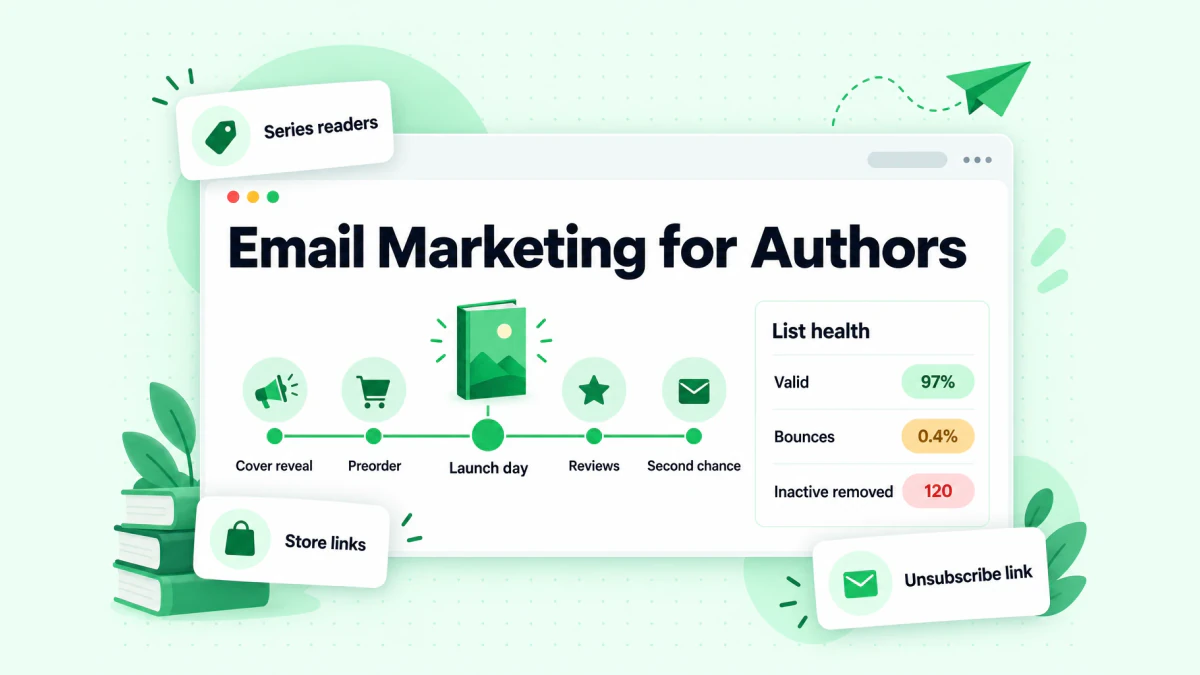
Email marketing for books usually follows a launch sequence like this:
| When | Goal | |
|---|---|---|
| 6 to 8 weeks before | Cover reveal | Build anticipation, invite replies |
| 4 weeks before | Preorder open, with an excerpt | Collect preorders |
| Launch day | The book is out, with links to every store | Concentrate sales in the launch window |
| 1 week after | Thank you, plus a request for honest reviews | Reviews on retailer pages |
| 4 weeks after | A behind-the-book story, for those who have not bought yet | A second chance to buy, with new reasons |
A few rules keep this effective:
- Segment when you can. Send the "you haven't bought it yet" email only to subscribers who did not click the launch links, if your platform supports it. Tag readers by series so that a sequel announcement goes to readers of book one first.
- Give the cover reveal something to watch. A short book trailer made with an AI video generator from your book description and cover gives readers a reason to click, and the same clip works on social media.
- Link every major store. Readers buy where they already buy. One link per store, clearly labelled.
- Keep the ask clear. One main call to action per email.
- Do not hide the unsubscribe. A reader who leaves is better than a reader who reports spam.
Keep Your Email List Clean
A clean email list is what keeps your newsletter in the inbox. Addresses go bad all the time: people change jobs, abandon old accounts and mistype addresses in signup forms. Every email to an address that no longer exists produces a bounce, and a list with many bounces and many silent subscribers tells mailbox providers that you do not maintain it.
Here is what list hygiene looks like for an author newsletter:
Verify at signup. Typos in the address field (gmial.com, hotmial.com) and throwaway addresses are the most common bad entries. Double opt-in catches many of them. If your signup form supports it, a real-time check through an email validation API rejects an invalid address before it reaches your list. Ready-made newsletter and ESP workflows connect verification to common platforms.
Verify every imported list before the first send. Event signup sheets, an export from an old platform, addresses collected years ago: run them through bulk email verification before importing. BillionVerify checks syntax, the domain's mail servers and the mailbox itself over SMTP, without sending an email, and returns a status for each row:
| Status | What it means for a newsletter | Action |
|---|---|---|
| Valid | The mailbox exists and accepts mail | Import |
| Invalid | The address or domain does not exist | Do not import |
| Disposable | A temporary inbox service | Do not import; the address will stop working |
| Role | A shared address such as info@ or admin@ | Import only if that person actually signed up |
| Catch-all | The domain accepts any address, so the mailbox cannot be confirmed | Import, and watch for bounces after the first send |
| Unknown | The server did not answer clearly | Recheck later before deciding |
Clean on a schedule. Remove hard bounces after every send; most platforms do this automatically. Every few months, run email list cleaning on the whole list to catch addresses that have gone bad since they joined. More detail on spotting disposable email addresses is on that page.
Re-engage, then remove, the inactive. Subscribers who have not opened in six months or more drag down engagement. Send them a short "Do you still want these emails?" message, and remove those who do not respond. The email re-engagement strategies guide has examples. A smaller list of people who open your email is worth far more than a large list that ignores it.
From Newsletter to Book
A newsletter you keep for a year is also a body of writing. Fifty issues on one subject, edited and arranged, can be the first draft of a book: a collection of essays, a practical guide, or a companion to your novels. The issues that got the most replies show you which chapters readers want most. Bookeen's guide on how to create an ebook covers turning a collection of writing like this into a finished ebook, and your newsletter is then the first place to announce it. If your issues and notes are spread across many files, the guide on how to create an ebook with NotebookLM shows how to pull them into an outline first.
Your First 90 Days
The first 90 days decide whether a newsletter becomes a habit. Here is how to start a newsletter and keep it going through its first three months:
| Weeks | What to do |
|---|---|
| 1 | Write the reader-and-promise sentence; choose a platform |
| 1 to 2 | Set up sender identity, domain authentication and the signup page |
| 2 | Create the lead magnet and the welcome email |
| 2 to 3 | Add the signup link to your books, website and social bios |
| 3 | Verify any existing contacts and import only the valid ones |
| 3 to 4 | Send the first issue, even to a small list |
| 4 to 12 | Send on schedule; add one new signup source each month; review opens and replies after each issue |
FAQs
How do you start a newsletter as an author?
You start a newsletter as an author by choosing a newsletter platform, setting up a signup page with a lead magnet, linking it from your books, website and social profiles, and sending issues on a fixed schedule. Authenticate your sending domain before the first issue and keep the list clean from the start.
What should an author newsletter include?
An author newsletter should include one main piece readers cannot get elsewhere, such as a behind-the-book story, an excerpt or a practical idea, plus a short update and a recommendation. Book news and launch announcements fit in naturally once readers value the regular issues.
How do authors build an email list from zero?
Authors build an email list from zero with a lead magnet, signup links in the front and back of every book, a signup form on their website, links in social bios, and mentions in talks and interviews. Growth is slow at first; consistent promotion across many small sources is what works.
How often should an author send a newsletter?
An author should send a newsletter on a schedule they can keep for at least a year, most often every two weeks or monthly. Weekly works for authors with a steady content source, such as a podcast or a video channel.
Is email marketing for authors still worth it?
Yes, email marketing for authors is still one of the most direct ways to sell books, because a newsletter reaches readers without depending on a social platform's algorithm. A launch email to an engaged list concentrates sales in the launch window.
Should I verify my newsletter list?
Yes, verify your newsletter list whenever you import addresses you did not collect through a confirmed signup, and clean the whole list every few months. Verification removes invalid and disposable addresses before they bounce and protects your sender reputation.
Can I turn my podcast or YouTube videos into a newsletter?
Yes, you can turn podcast episodes or YouTube videos into newsletter issues by transcribing them, picking the strongest idea from each, and rewriting it as a short written piece with a link back to the original. A transcript tool such as transcript.im does the transcription step.