


How to get a book published comes down to six steps: finish and revise the manuscript, decide between traditional publishing and self-publishing, build a list of literary agents or publishers that take your kind of book, write a submission package, send it to each one the way they ask, and track every reply until you get an offer. Most traditional book deals start with a literary agent, but some book publishers accept unsolicited manuscripts directly. This guide covers both routes, plus the part most writers skip: making sure every submission email reaches a real inbox, so a bounced address or a typo doesn't cost your book its one chance with the reader who would have said yes.
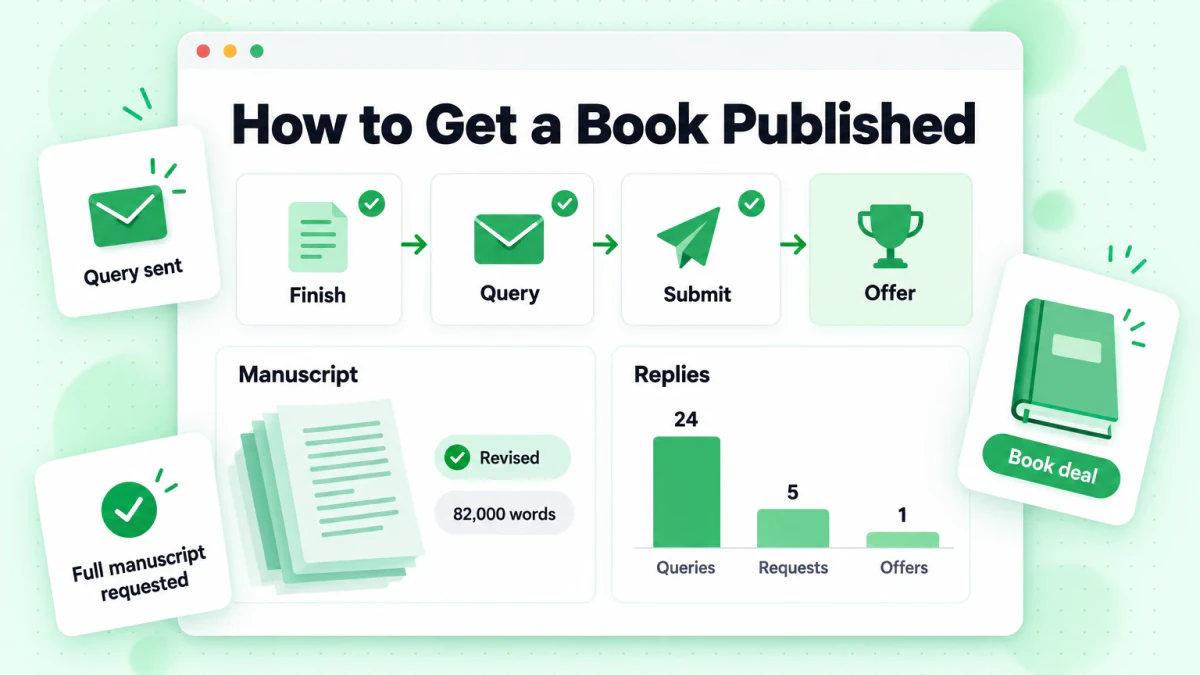
How to get a book published: the short answer
If you want a book on bookstore shelves with a publisher paying you an advance, the usual path is:
- Finish the book (fiction) or write a book proposal (most nonfiction).
- Query literary agents who represent your genre. An agent who loves the book offers representation.
- Your agent submits the book to editors at publishing houses. An editor who wants it makes an offer.
- You sign a publishing contract, receive an advance against royalties, and the publisher edits, designs, prints, distributes and markets the book.
The second path skips the agent: you submit directly to publishers accepting unsolicited manuscripts, usually smaller presses, university presses and certain imprints with open submission programs. The third path is self-publishing, where you are the publisher. All three are covered below.
Step 1: Finish and revise the book before anyone sees it
The fastest way to waste your best agents and editors is to submit too early. You usually get one chance with each one, and most will not look at a revised version of a book they have already declined.
Fiction and memoir: finish the whole book
Agents and editors expect a complete, revised book manuscript for novels and most memoirs before you query. If someone asks for the full book and you don't have one, the conversation usually ends there.
Before you submit, check the basics:
- Length fits the genre. A debut that is far longer or shorter than its category is an easy reason to decline. Bookeen's guide to how many words are in a novel breaks typical word counts down by genre.
- The opening pages are the strongest pages. Many agents ask for the first five to fifty pages with your query, so those pages do most of the selling.
- Someone other than you has read it. Beta readers, a critique group or a freelance editor will catch the problems you can no longer see.
- It is formatted the standard way. A common manuscript format is 12-point type, double spacing, one-inch margins, numbered pages and your name and title in the header. Follow each agent's or publisher's own guidelines where they differ.
Nonfiction: write a book proposal
Most nonfiction is sold on a proposal plus one or two sample chapters, not a finished manuscript. A proposal typically includes an overview, a chapter-by-chapter outline, a description of the target reader, a list of comparable titles, a marketing section and your author platform: why readers will listen to you, and how you can reach them. Publishers weigh platform heavily for nonfiction, which is why an email newsletter with real subscribers is one of the strongest things a nonfiction author can bring to the table.
Step 2: Choose how to get your book published
Before you build a submission list, decide which route fits the book. There are three real ways to get a book published, plus one to avoid.
| Route | Who pays for production | How you get in | Typical trade-offs |
|---|---|---|---|
| Traditional publishing with an agent | The publisher, who pays you an advance | Query agents, who pitch the book to editors | Access to the biggest book publishers; slow; a commission comes out of book earnings |
| Direct submission to publishers | The publisher | Submit to book publishers that accept unagented work | No agent commission; fewer publishers; you negotiate the contract yourself |
| Self-publishing | You | Publish through retail and print-on-demand platforms | Full control and higher royalty share; you handle editing, design and marketing |
| Hybrid and vanity presses | Usually you, in part or in full | You pay the press | Ranges from legitimate services to scams; read every contract carefully |
A fourth row deserves a warning. A "publisher" that asks you to pay to be published is not a traditional publisher. Some hybrid presses are legitimate service companies, but vanity presses make their money from authors, not from selling books to readers. Real traditional publishers pay you. SFWA's Writer Beware tracks publishing scams, fake agents and impersonators, and it is worth searching before you sign anything.
If you decide to publish the book yourself, Bookeen's guide on how to self-publish a book walks through editing, formatting, cover design and distribution, and its breakdown of how much it costs to publish a book helps you budget. Once a book is out, by either route, how to sell books covers retail platforms, outreach and email marketing. The rest of this guide focuses on the traditional route.
How to get a publisher for your book through a literary agent
The most common answer to how to get a publisher for your book is: get a literary agent first. The largest book publishers rarely read submissions from unrepresented authors. A literary agent knows which editors are acquiring what, submits your book to them, negotiates the contract and manages the business side of your career. In return, they take a commission on what the book earns, commonly 15% on domestic sales. A legitimate one is paid from your book's earnings, never by upfront reading fees. Our guide on how to get a literary agent goes deeper into finding, pitching and tracking agents.
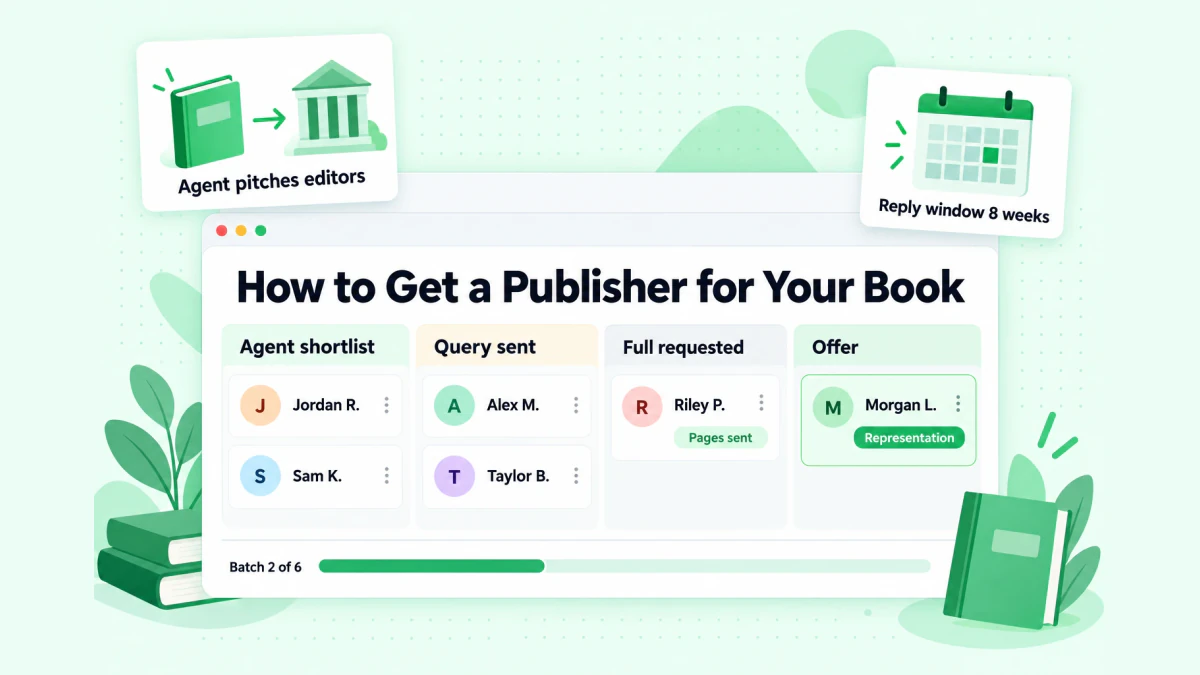
The picture above is the pipeline in miniature: research agents, send queries, answer requests for pages, and wait for an offer of representation. Each stage filters out most submissions, which is why the size and quality of your agent list matters so much.
Build an agent list of 30 to 100 names
Good lists are specific. You want people who represent your genre and age category right now, not someone who sold one similar book ten years ago. Places to find them:
- Acknowledgments pages of recent books like yours. Authors almost always thank their agent by name.
- Agency websites, which list each agent's current wish list, submission method and closed or open status.
- Databases and trackers such as QueryTracker, which list agents by genre and let you log your own submissions.
- Industry deal reports and interviews, where agents talk about what they want to see.
- Conferences and pitch events, where you can meet agents and get a direct invitation to submit.
For each agent, record their name, agency, genres, submission method (email, a form or a query manager), what to include, stated response time and whether "no response means no." Note the exact submission email address only from the agency's own site or the agent's official listing. Never guess an address from a name pattern.
Send queries in small batches
Don't query your whole list at once. Send the book to 8 to 12 names, wait to see what happens, and revise if you get no requests. If a batch of ten queries produces zero requests for pages, the query or the opening pages need work, and you still have dozens of names left to try with the improved version. Mix a few dream picks into each batch rather than spending them all first.
The query letter in brief
A query letter is a one-page pitch, usually 250 to 400 words, with a short personalized opening, a hook and story summary, the book's title, genre, word count and comparable titles, and a short author bio. It is the single most important document in your submission; our guide to the query letter covers the format, two full examples and a template.
Publishers accepting unsolicited manuscripts
An unsolicited manuscript is one a publisher did not request, sent by an author without an agent. Many large houses don't read them at all, and the stack of unread submissions at the houses that do is known as the slush pile. Still, publishers accepting unsolicited manuscripts exist in every market, and for some genres they are a real path to a contract.
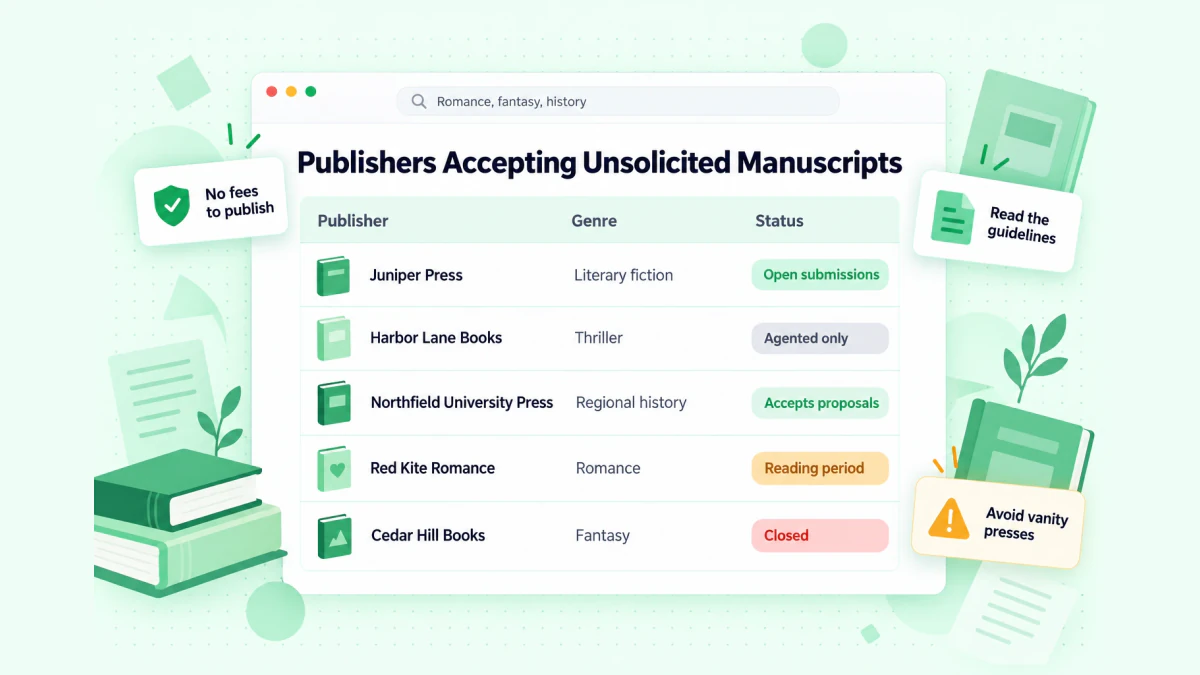
Where to look:
- Small and independent publishers. Many accept direct submissions year-round or in reading periods.
- University presses, which publish scholarly and regional nonfiction and often accept proposals directly from authors.
- Genre imprints with open programs. Category romance is the best known: Harlequin, for example, says on its submission manager that its series romance lines accept unagented submissions, with guidelines for each line.
- Open submission windows. Some imprints that normally require an agent open for a few weeks a year. They announce these windows on their websites and social accounts.
Small presses and university presses work from real offices, so most of them are listed on Google Maps. A Google Maps scraper such as MapLeads can export the publishers in a city or region with their websites, phone numbers and emails. Treat that export as a starting list: check each press's guidelines before you add it to your submission list, and verify every address before you send.
Before you submit to any publisher directly, check four things. The publisher should pay authors and charge nothing to publish. Its recent books should be available from normal retailers. Its guidelines should say exactly how to submit. And it should not appear in any warnings at Writer Beware. Harlequin itself warns that scammers impersonate its staff by email, which is a good reminder to check that a reply really comes from the publisher's domain before you send anything back.
How to submit a manuscript to publishers and agents
Whatever route you choose, how to submit a manuscript to publishers comes down to following the guidelines exactly. Agents and editors receive far more submissions than they can read, and ignoring the instructions is the easiest reason to decline.
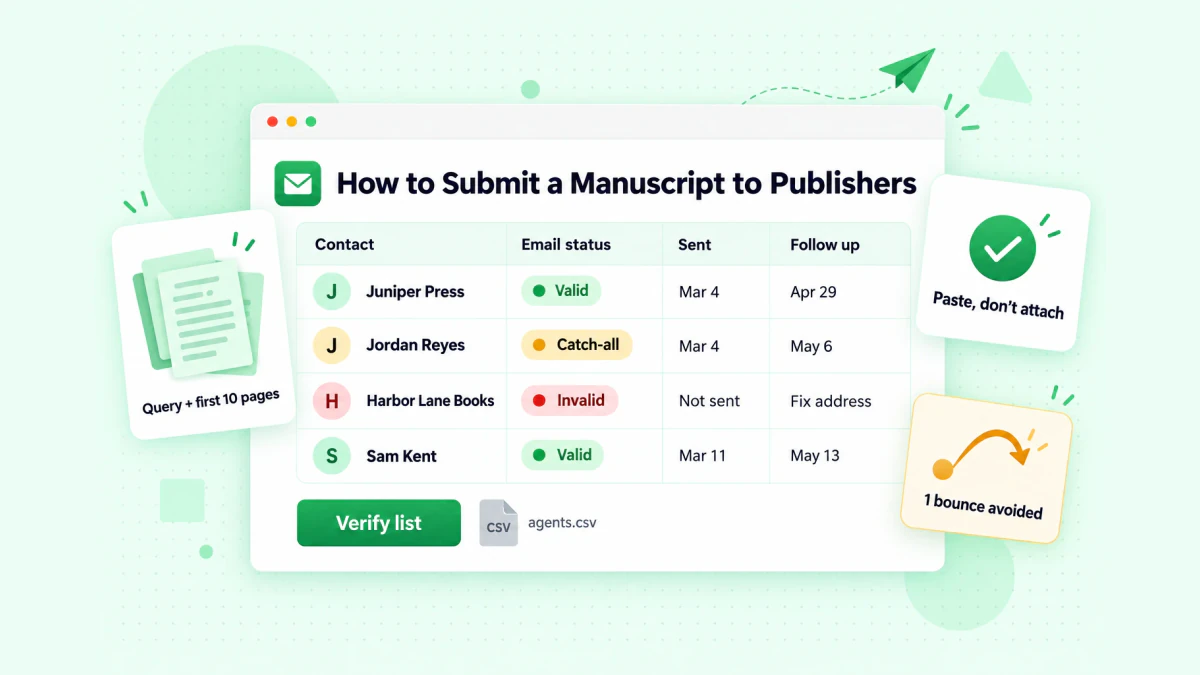
A clean submission process looks like the tracker above: every target has a submission method, a verified contact, a sent date and a follow-up date. Here is the process step by step.
1. Read each set of guidelines, every time
Guidelines change. An agency that took email queries last year may now use a query form; a publisher may have closed to submissions. Check the agency or publisher website on the day you submit, not the day you built your list.
2. Use the method they ask for
If an agency uses a query form or an online submission manager, use it, and don't send an email as well. If they ask for email queries, use the exact address on their site. Many agencies use a shared submissions inbox like submissions@ or queries@, which is the right destination even though it isn't a personal address.
3. Paste, don't attach, unless told otherwise
For email queries, agents usually want the query and sample pages pasted into the body of the email, because attachments from unknown senders are a security risk. Attach files only when the guidelines say to, in the format they specify.
4. Write a subject line they can sort
Use the format the guidelines give. If there is none, "Query: TITLE (Genre, word count)" is clear and easy to filter. If an agent asked for your manuscript after a pitch event, say so in the subject line.
5. Send one query per agent, one agent per email
Never put several agents in the To or CC field, and never send a mass email with every address visible. Personalize each email with the recipient's name, spelled correctly, and one line on why you chose them for this book. Most agencies say that a no from one person is a no from the whole agency, so check the agency policy before querying a colleague there.
6. Allow simultaneous submissions unless told otherwise
Querying several agents at once is normal and expected. Some publishers that accept unagented manuscripts ask for exclusive submissions; respect that, or skip them.
Verify every agent and publisher email before you hit send
This is the step most querying guides leave out, and it is where BillionVerify comes in. Agent lists go stale quickly. Agents move between agencies, agencies merge or close, and assistants who handled the queries inbox leave. Addresses copied from an old blog post, a forum thread or a database that hasn't been updated may no longer exist.
A bounced query costs you more than one email:
- You lose the submission without knowing it. If you don't notice the bounce, you wait weeks for a reply that can never come, and you may assume a silent no.
- Your sender reputation suffers. Inbox providers watch how often your messages bounce. A personal Gmail or Outlook account that suddenly sends dozens of emails, several of them to dead addresses, looks more like spam than an author. Google's email sender guidelines list authentication and low bounce and spam rates among the things that keep mail out of the spam folder.
- A typo can send your manuscript to a stranger. A misspelled domain can deliver to the wrong organization, or to nobody.
How to verify an agent's email address
Before each batch, run your list through an email verifier. BillionVerify checks each address in layers: syntax, domain, MX records, a live SMTP mailbox check, and flags for disposable and role addresses. You can verify an email address one at a time while you research, or upload your whole agent spreadsheet as a CSV with bulk email verification and get every row back with a status and a reason.
Read the results with publishing in mind:
| Result | What it means | What to do |
|---|---|---|
| Valid | The mailbox exists and accepts mail | Send |
| Invalid | The address or domain doesn't exist | Don't send. Check the agency website for a current address or a query form |
| Catch-all | The domain accepts every address, so the specific mailbox can't be confirmed | Send only if the address comes straight from the agency's own site |
| Role | A shared address like submissions@ or queries@ | Keep it. For queries, a shared inbox is often exactly where the agency wants you to write |
| Unknown | The receiving server didn't give a clear answer | Retry later before deciding |
Two nuances matter for authors. First, many small agencies and presses run their email on domains that accept all mail, so a catch-all result is common and not a reason to drop a carefully researched contact; the catch-all verifier explains how to read that signal. Second, verification tells you whether a mailbox can receive mail, not whether the agent is open to queries. Always check open or closed status on the agency site too.
Keep your agent list clean between batches
Querying can take months. Re-verify the remaining names before each new batch, remove addresses that have turned invalid, and log any hard bounce the moment it happens. If you're working through a long list, email list cleaning removes duplicates and sorts the rest into send, review and retry groups. And if a query ever bounces, BillionVerify's guide to hard bounce emails explains what the bounce message is telling you.
How to follow up on a query or submission
Silence is normal in publishing. Many agents reply within four to twelve weeks; some never reply to queries they decline. Follow up with care:
- Queries: if the agent's guidelines say "no response means no," don't follow up. If they give a response window and it has passed, one short, polite nudge is fine. Reply to your original email so they have the full query.
- Requested manuscripts: if an agent requested a partial or full manuscript, a check-in after eight to twelve weeks (or after their stated window) is reasonable.
- Offers: if one agent offers representation, email every other agent who has your query or manuscript, tell them you have an offer, and give them a deadline, usually one to two weeks, to respond. This is standard practice and often speeds up other replies.
Keep follow-ups short: the title, the date you sent it, what you sent, and a one-line thank you. BillionVerify's guide to follow-up email subject lines has patterns you can adapt, and its cold email follow-up guide covers timing for outreach in general.
Track every reply in one place
A spreadsheet or a query tracker keeps you from querying the same agent twice, missing a request for pages or forgetting to notify agents when you get an offer. Useful columns:
| Column | Example |
|---|---|
| Agent and agency | Jordan Reyes, Example Literary |
| Submission method | Email to queries@ |
| Email status | Valid, verified before sending |
| Materials sent | Query + first 10 pages |
| Date sent | March 4 |
| Response window | 8 weeks, no response means no |
| Status | Full requested |
| Next action | Check in after May 15 |
The agent and agency names above are invented examples. Record rejections too, including any personal feedback. If several agents mention the same issue, such as pacing or a slow opening, that is your revision note before the next batch.
What happens after you get an offer
Once you have an agent, they will usually suggest revisions, then prepare a submission list of editors and pitch the book. When an editor wants the book, they take it to their acquisitions team, and the publisher makes an offer: an advance, royalty rates, rights, delivery dates and format plans. Your agent negotiates the contract with you. If you're submitting without an agent, consider having the contract reviewed by a publishing attorney or through an author organization such as the Authors Guild, which offers contract review to members.
From signing to publication, a traditionally published book often takes one to two years: editing, copyediting, cover design, typesetting, printing and a marketing plan built around the release date. That timeline is the trade-off for a publisher's distribution and budget.
How to get a book published if traditional publishing says no
Rejection is part of every published author's history. If a full round of queries brings no offers:
- Revise and re-query with a stronger query letter and opening pages, to agents you haven't contacted yet.
- Submit directly to small publishers accepting unsolicited manuscripts in your genre.
- Write the next book. Many authors sign with an agent on their second or third manuscript, and the earlier book sometimes sells later.
- Self-publish, especially in genres where readers buy heavily in ebook. Bookeen's guide on how to create an ebook shows how to turn a finished manuscript into a sellable ebook. As your own publisher you also need cover concepts and promotional images; Potto's AI image generator creates them from a text prompt and reference images.
Whichever path you take, start building a reader email list now; our guide on how to start a newsletter walks through it. Publishers ask about it, agents notice it, and it is the one marketing channel you own when the book comes out.
FAQs
How do you get a book published for the first time?
To get a book published for the first time, finish and revise the manuscript, then query literary agents who represent your genre, or submit directly to publishers accepting unsolicited manuscripts. First-time authors are signed every year; what matters most is a polished manuscript, a strong query letter and a well-researched list of agents.
How do I get a publisher for my book without an agent?
You get a publisher without an agent by submitting directly to book publishers that accept unagented work: small and independent publishers, university presses and genre imprints with open submission programs. Read each publisher's guidelines, submit only through the method they list, and never pay a publisher to publish your book.
Which publishers accept unsolicited manuscripts?
Publishers accepting unsolicited manuscripts are mostly small presses, university presses and some genre imprints, such as Harlequin's series romance lines. Policies change often, so confirm on the publisher's own website that they are currently open before you submit.
How do I submit a manuscript to publishers?
Submit a manuscript to publishers exactly as their guidelines say: usually a query or cover letter, a synopsis and sample pages through a submission form or an email address listed on their site. Verify the email address first, paste rather than attach unless asked, and send one submission per email.
How long does it take to get a book published?
Getting a book published traditionally often takes two to three years end to end: several months to a year or more to find an agent, months for your agent to sell the book, and one to two years from contract to release. Self-publishing can take weeks once the manuscript is edited.
Do I need to copyright my book before submitting it?
You don't need to register copyright before submitting a manuscript. In the United States, your work is protected by copyright as soon as it is written down, and legitimate agents and publishers don't steal manuscripts. Registration has legal benefits later; your publisher often handles it.
Should I verify an agent's email address before querying?
Yes, verify an agent's email address before querying, especially if it came from a database, forum or old interview. Agents change agencies and inboxes get retired. A verifier such as BillionVerify tells you whether the mailbox can receive mail, so your query doesn't bounce silently and hurt your sender reputation.
Is it OK to query many agents at the same time?
Yes, querying several agents at the same time is standard, unless an agent or publisher asks for an exclusive submission. Send personalized emails one at a time, in batches of about 8 to 12, and tell everyone who has your manuscript if you receive an offer.