


There are three ways to sell books, and most authors who sell steadily use more than one. You can list the book in online stores and sell copies yourself, you can sell the book to a traditional publisher who sells the copies for you, or you can build a list of readers and sell to them directly by email. Stores give you reach, publishers give you distribution and an advance, and an email list gives you the one channel you own. This guide explains how to sell books through each route, what each one asks of you, and why every route ends up depending on email.
It is written for authors with a finished or nearly finished book: novelists, nonfiction writers, coaches and course creators who turned their method into a book. If you are still writing, the Bookeen guide on how to create an ebook covers the path from idea to file. When the book exists, come back here.
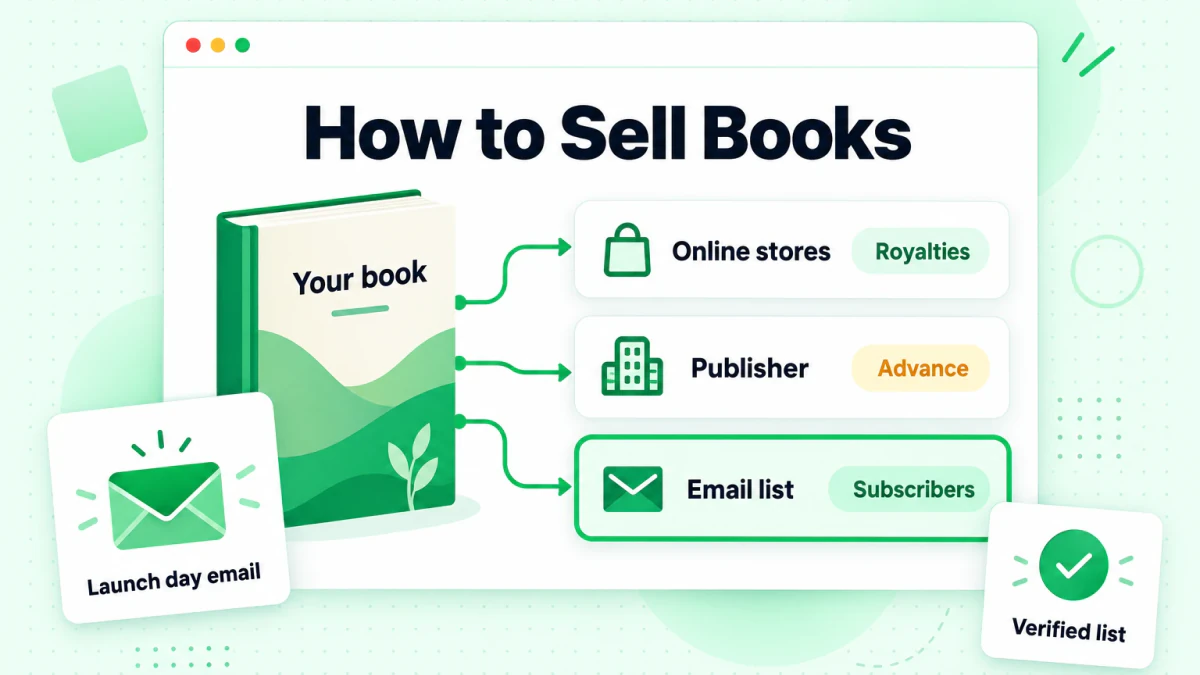
How to Sell Books: The Three Routes at a Glance
Before choosing, look at what each route actually means for you as the author.
| Route | How the book reaches readers | What you control | What you need | How you get paid |
|---|---|---|---|---|
| Online stores (self-publishing) | You upload ebook and print files to Amazon KDP and other stores | Price, cover, description, timing | Finished files, a cover, a store account | A royalty share per copy sold |
| Traditional publisher | A publisher buys the rights, edits, prints and distributes the book | Much less: the publisher decides price, cover and timing | A literary agent or a direct submission, a strong manuscript | An advance, then royalties after the advance earns out |
| Direct to readers by email | You tell your subscribers about the book and link to where they can buy it, or sell from your own site | Everything: message, timing, offer | A list of subscribers who asked to hear from you | Store royalties, or the full price if you sell directly |
The routes are not exclusive. A self-published author still needs readers to come to the store page, and the strongest source of those readers is a list of subscribers. A traditionally published author is asked by the publisher about their platform, and an email list is the part of a platform that a publisher can actually count. And getting a traditional deal starts with emails to agents and editors. So whichever way you sell books, plan for email.
How to Sell Books Online Through Stores
Selling online through stores is the fastest way to make a book available. You prepare the files, upload them, write the book description, set the price, and the store handles payment and delivery. This section is an overview; the details of each store are covered in dedicated guides.
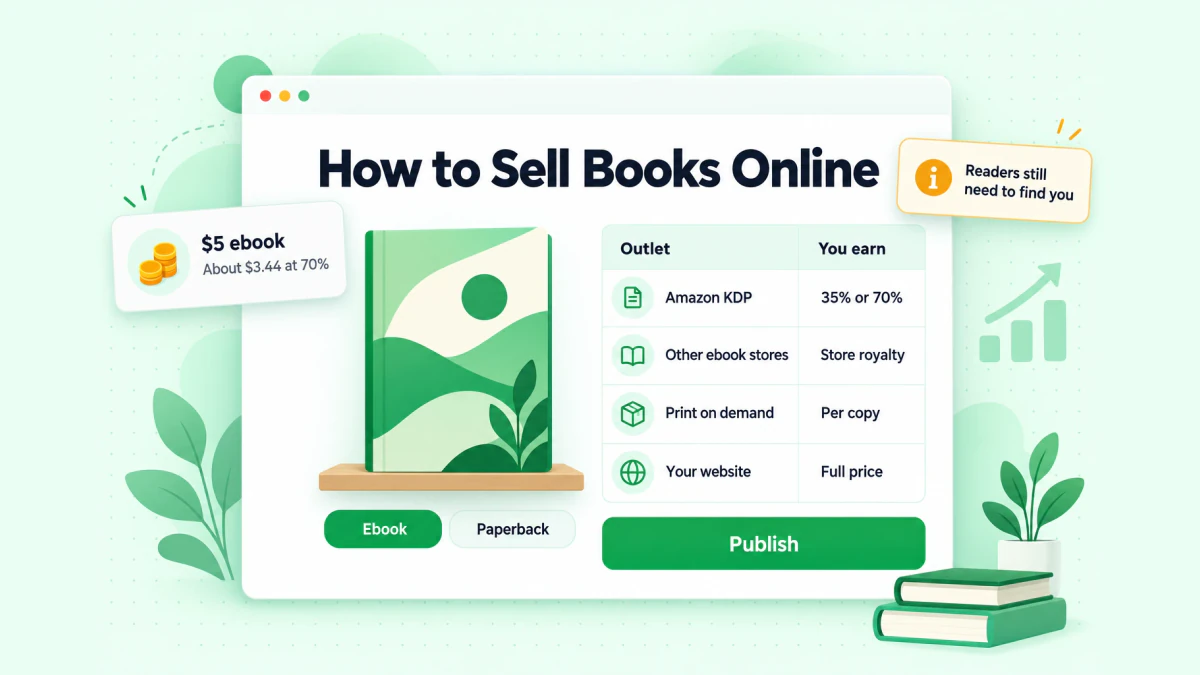
When you look at how to sell books online, you are choosing between four kinds of outlet:
- Amazon KDP. The largest store for both ebooks and print-on-demand paperbacks. For ebooks, KDP offers a 35% and a 70% royalty option; the 70% option applies to eligible books sold in specific territories and deducts a delivery cost based on file size (Amazon KDP: eBook royalties). If you enroll an ebook in KDP Select, a 90-day program for Kindle ebooks, it is automatically included in Kindle Unlimited and becomes eligible for Amazon's free book promotions and Kindle Countdown Deals; read the program terms before enrolling, because they limit where else you can sell the ebook. The step-by-step upload is covered in Bookeen's guide on how to publish a book on Amazon.
- Other ebook stores. Apple Books, Kobo, Google Play Books and Barnes & Noble reach readers who do not buy from Amazon. Bookeen's guide on where to sell ebooks compares them.
- Print on demand. A printer produces each copy when it is ordered, so there is no stock to store. KDP offers it for paperbacks and hardcovers, and other print services distribute to bookstores and libraries.
- Your own website. You can sell an ebook file directly through a shop or payment page on your site. You keep more per sale, but you handle delivery and customer questions. Bookeen's guide on how to sell ebooks online covers direct sales.
A worked example makes the store math concrete. On a $5 ebook sold under KDP's 70% option to a reader in an eligible territory, the royalty is 70% of the list price without VAT, minus the delivery cost; Amazon's help page puts the average delivery cost at $0.06 per unit. That is roughly $3.44 per copy before tax. Under the 35% option, the same $5 book earns $1.75. Store royalties are only part of the decision, though. The store gives you a shelf; it does not give you shoppers. Readers still have to find your page, and that is where marketing, and especially email, comes in.
What a store listing needs to sell:
- A cover that reads at thumbnail size. Most shoppers see your book as a small image in a list.
- A description that opens with the reader's problem or the story's hook, not with your biography.
- Categories and keywords that match how readers search. Pick the narrowest category where your book honestly fits.
- Reviews. Early readers from your own list are the most reliable source of first reviews, as long as you ask for honest ones and follow the store's review rules.
- A price that fits the genre. Look at what comparable books in your category cost and stay within that range for a launch.
How to Sell a Book to a Traditional Publisher
The second meaning of how to sell a book is selling the book itself, the rights to publish it, to a publishing house. In this route the publisher pays you an advance against future royalties and takes on editing, design, printing, distribution and much of the store placement. The full submission process is covered in our guide on how to get a book published.
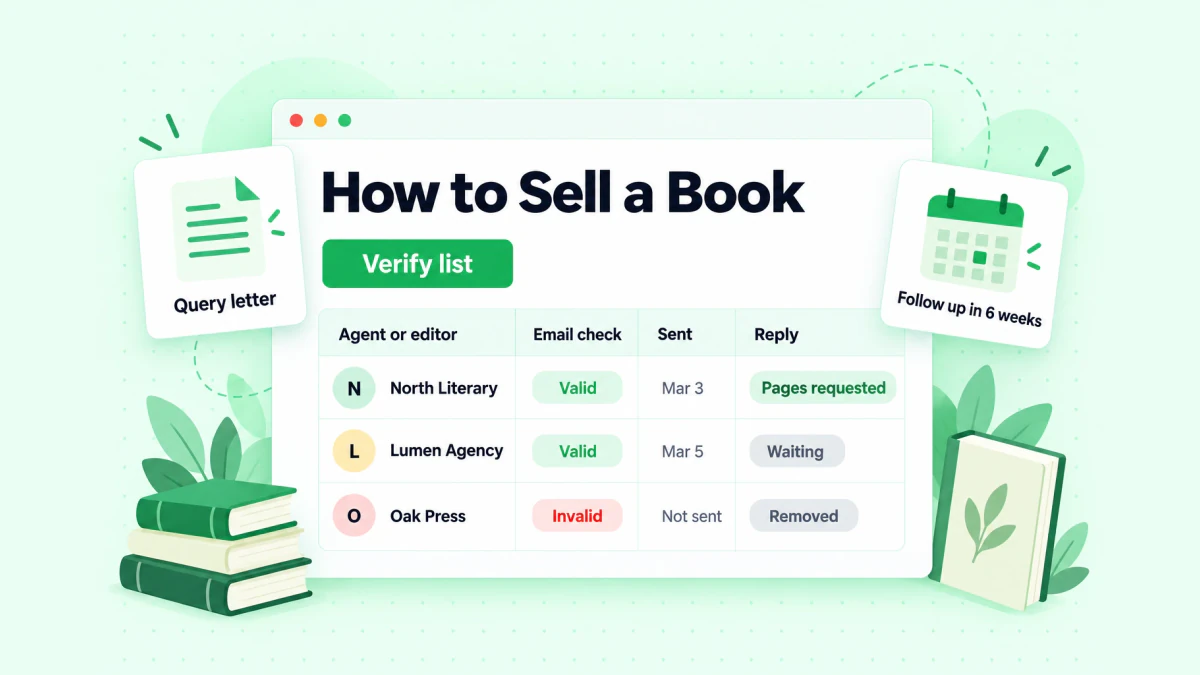
The usual path has four stages:
- Finish and revise the manuscript. For fiction, most agents expect a finished book. For nonfiction, a book proposal with sample chapters is usually what you submit.
- Find a literary agent, or a publisher that accepts direct submissions. Large publishers mostly accept manuscripts through literary agents, who submit your book to editors and negotiate the contract. Smaller and independent presses often accept submissions from authors directly; check each publisher's submission page for its current rules. Our guide on how to get a literary agent covers building and working an agent list.
- Query. You send a query letter, a one-page pitch, usually by email, to each agent or editor on your list, following their submission guidelines exactly.
- Negotiate. If an agent offers representation and then a publisher makes an offer, the contract sets the advance, the royalty rates and the rights you grant. Organizations such as the Authors Guild publish resources on author contracts.
Querying is an email outreach project, and it fails for the same reasons any outreach fails. Agents change agencies, editors leave publishers, and submission addresses get retired. If you send to an old address, your carefully personalized query bounces, or worse, it disappears into an inbox nobody reads, and you wait months for a reply that will never come. A few habits make querying work:
- Build the list from the source. Take agent and editor addresses from the agency's or publisher's own submission page, and note the date you checked it.
- Verify every address before you send. Run the list through an email verification check. It confirms the syntax, the domain, the mail server and, where the server allows it, the mailbox itself, so you can remove dead addresses before they cost you a query.
- Send in small batches. Query five to ten agents, wait for responses, and revise the letter if nothing comes back. A mass send to 200 agents burns your list and teaches you nothing.
- Personalize each letter. Name the agent, mention a book they represent or a wish they posted, and follow their requested format.
- Track everything. A spreadsheet with the agent, the address, the date sent, the materials requested, the follow-up date and the response saves you from double-querying or missing a request for pages.
The general principles of good outreach email, from subject lines to follow-up timing, are the same ones covered in the BillionVerify cold email outreach guide. The difference is tone: a query is a professional submission, not a sales pitch, and agents' own guidelines always come first.
How to Sell Your Book to Your Own Readers by Email
The third route is the one you own. When people ask how to sell your book without depending on an algorithm, the answer is an email list: readers who gave you their address because they want to hear from you. A store can change its ranking, a social platform can change its feed, but a subscriber list moves with you from book to book.
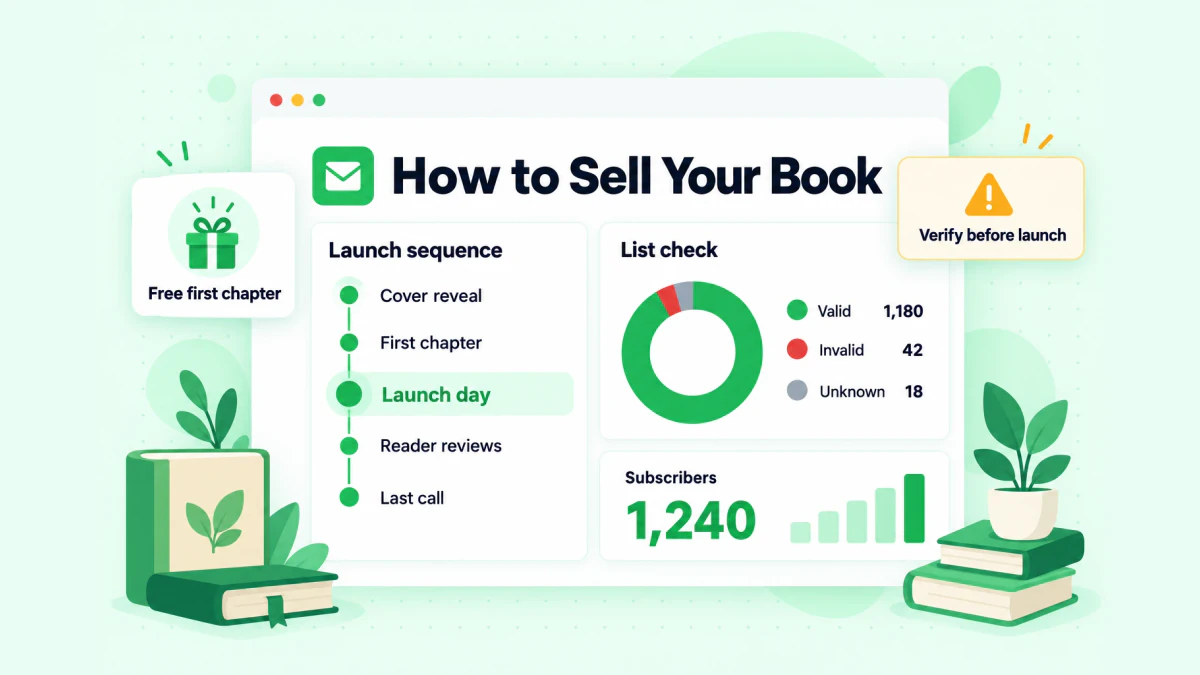
Email helps you sell books for three simple reasons:
- It reaches the people most likely to buy. Subscribers already know your writing or your work.
- It concentrates sales. A launch email that sends many readers to the store in the same week can help a new book get noticed in the store's charts and recommendations.
- It compounds. Every book you publish grows the list, and every list member is a likely buyer of the next book.
The basic system has four parts: a reason to subscribe, a place to collect addresses, a regular email, and a launch sequence when a book comes out.
Give readers a reason to subscribe
Nobody joins a list called "Newsletter." Offer something specific, often called a reader magnet or lead magnet:
- The first chapter of the book, before release
- A bonus scene, a deleted chapter or a short story set in the same world
- A checklist, worksheet or template from a nonfiction book
- A reading guide for book clubs
Collect addresses in the places readers already see you
- The back of every book. A link at the end of the ebook, right after the last chapter, reaches readers at the moment they finished and liked it.
- Your website. One clear signup form on the home page and on each book page.
- Social profiles. A link in your bio to the signup page, and occasional posts about what subscribers get. If your reader magnet is a sample chapter, PDF to video on Potto turns the PDF into a narrated video with captions, a quick way to preview it in a post.
- Events. Readings, workshops and conferences, with a sign-up sheet or QR code. Type those addresses in carefully: handwritten addresses are where typos come from.
Write a regular email
Pick a rhythm you can keep, such as one email every two weeks or once a month; if you are starting from zero, our guide on how to start a newsletter covers platforms, signup forms and content ideas. Share what you are working on, a book recommendation, a behind-the-scenes note, or a short piece of useful content for nonfiction readers. A list that hears from you regularly remembers who you are when the book launches. A list that hears from you once a year treats the launch email as spam.
Keep sending reputation in mind
Mailbox providers decide whether your email lands in the inbox. Gmail's email sender guidelines require all senders to set up SPF or DKIM authentication and keep the spam rate reported in Postmaster Tools below 0.3%, and senders of more than 5,000 messages a day to Gmail must also meet additional requirements, including one-click unsubscribe for marketing messages. Most newsletter platforms handle the technical setup for you, but list quality is your responsibility, and that is where verification comes in.
Keep Your Book List Clean: Verify Before You Send
A list of readers degrades on its own. People change jobs and lose their work address, abandon old inboxes, and mistype their address on a signup form. Some sign up with throwaway addresses to grab the free chapter. If you send a launch email to a list full of dead addresses, the bounces tell mailbox providers that you do not manage your list, and more of your email starts landing in spam, including the email to the readers who wanted it.
The fix is simple: verify the list before important sends, and verify new addresses as they come in.
| Result type | What it means | What to do with it before a launch |
|---|---|---|
| Valid | The mailbox exists and accepts mail | Send |
| Invalid | The mailbox or domain does not exist, or the address is malformed | Remove |
| Disposable | A temporary inbox service | Remove or keep out of launch sends |
| Role address | A shared address such as info@ or sales@ | Keep only if it fits why you collected it, for example a bookstore or library contact |
| Catch-all | The domain accepts every address, so the mailbox cannot be confirmed | Send with care, watch engagement |
| Unknown | The mail server did not give an answer this time | Retry later rather than treating it as valid or invalid |
BillionVerify checks each address for syntax, domain and MX records, and the mailbox itself over SMTP, and reports flags such as disposable, role, catch-all and free webmail beside the verdict. For a whole list, email list cleaning takes a pasted list or a CSV file, removes duplicates and returns a reason for every decision. For large files, bulk email verification runs CSV and Excel files with progress and filtered downloads. To stop bad addresses at the door, the email validation API checks an address when a reader types it into your signup form.
When to verify a book list:
- Before every launch. The launch email is the one that matters most.
- After importing an old list. Addresses from a previous platform, an event sign-up sheet or a list you have not mailed in six months or more.
- Before agent or editor outreach. Every address on your query list.
- Continuously at signup, if your form supports a verification check.
A Book Launch Email Sequence You Can Copy
The launch is where all the work on the list pays off. Here is a five-email sequence that works for fiction and nonfiction. Adjust the timing to your release date.
| When | Purpose | Example subject line | |
|---|---|---|---|
| 1. Announcement | 4 weeks before release | Reveal the cover and the release date | The cover for my new book is here |
| 2. Sample | 2 weeks before | Share the first chapter or a key idea | Read the first chapter before anyone else |
| 3. Launch day | Release day | The book is out, with links to every store | It's out today |
| 4. Social proof | 3–5 days after | Share early reader reactions and remind people who missed it | What early readers are saying |
| 5. Last call | 7–10 days after | Final reminder of any launch price, then ask for reviews | Last day for the launch price |
The announcement and launch-day emails work better with something subscribers can watch and share. Potto's AI video generator turns a prompt, a link or a document into a narrated 1080p MP4 with captions and music, which is enough for a short book trailer you can embed as a thumbnail link in the email and post on your social profiles.
A short launch-day email template:
Subject: It's out today
Hi [first name],
[Book title] is out today. It is the book I [one sentence about why you wrote it].
You can get it here: [store link 1] · [store link 2] · [your site]
If you read it and it helps you, an honest review on the store page is the best way to help other readers find it.
Thank you for being here from the start, [Your name]
Three rules for the sequence: send to a verified list, include a link to every store where the book is available, and make unsubscribing easy. A reader who leaves your list is cheaper than a reader who marks your launch email as spam.
How to Sell My Book When I Have No Audience Yet
"How do I sell my book with no followers and no list?" is the most common question new authors ask. The honest answer is that you start the list now, even if it is small, and you use the stores and outreach to grow it.
A 90-day plan for a first book:
- Weeks 1–2: Set up the basics. A one-page website or author page, a signup form, a reader magnet and a welcome email that delivers it.
- Weeks 3–6: Put the signup link everywhere. In the back of the book, in your social bios, in your email signature and on every guest post or podcast you appear on.
- Weeks 3–8: Reach out to people who already have readers. Book bloggers, newsletter writers, podcast hosts and community organizers in your genre or subject. Build a short list, verify the addresses, send personal emails, and follow up once. For local sales, add the independent bookstores and libraries near you: they are listed on Google Maps, and a Google Maps scraper such as MapLeads exports their websites and emails so you can pitch a reading or ask them to stock the book.
- Weeks 6–10: Write regularly. Send your subscribers something useful every two weeks, even when the list is under 100 people.
- Weeks 10–12: Launch to the list. Use the five-email sequence above and ask your first readers for honest reviews.
A list of 300 engaged readers who open your emails can sell more copies at launch than thousands of followers who never see your posts. Small and clean beats big and stale.
Common Mistakes When Selling Books
- Relying on the store to find readers. Uploading the book is the start of selling, not the end.
- Buying an email list. Purchased lists are full of people who never asked to hear from you and addresses that bounce. They damage your sending reputation and can break the rules of your email platform.
- Mass-querying agents. Two hundred identical queries sent on one day get fewer requests than twenty personal ones, and an outdated address list wastes the best version of your letter.
- Never cleaning the list. Old addresses pile up between books. Verify before every launch.
- Emailing only when you have something to sell. Readers who only hear from you at launch stop opening.
- Pricing outside the genre's range. A launch price far above comparable books makes shoppers hesitate; a price far below can signal low quality.
How to Sell Books FAQs
How to sell books as a new author?
To sell books as a new author, list the book in the stores where readers already shop and start an email list from day one. Use a reader magnet to grow the list, then launch the book to your subscribers with a short email sequence.
What is the best way to sell books online?
The best way to sell books online is to combine store listings with your own email list. Stores like Amazon handle payment and delivery, while email brings readers to your store page at launch, when concentrated sales matter most.
How do I sell a book to a publisher?
To sell a book to a publisher, you usually find a literary agent by sending query letters, and the agent submits your manuscript to editors. Some smaller presses accept submissions directly from authors; follow each publisher's submission guidelines.
How can I sell my book without a big following?
You can sell your book without a big following by building a small, engaged email list and reaching out to people who already have readers, such as book bloggers and podcast hosts. A few hundred subscribers who open your emails can drive a solid launch.
Why do authors need an email list?
Authors need an email list because it is the only channel they own. Store rankings and social feeds change, but subscribers move with you from book to book, and they are the most likely buyers of every new release.
Should I verify my email list before a book launch?
Yes. Verify your email list before a launch so bounces from dead addresses do not hurt your sending reputation. Remove invalid and disposable addresses, and retry unknown results before the send.
Should I verify agent and editor email addresses before querying?
Yes. Verify agent and editor addresses before querying, because agents move between agencies and submission addresses change. A verified address means your query reaches an inbox someone reads.
How much do authors earn per ebook on Amazon?
On Amazon KDP, authors earn 35% or 70% of the ebook's list price without VAT, depending on the royalty option and the reader's territory, and the 70% option subtracts a per-copy delivery fee. A $5 ebook earns about $3.44 at 70% and $1.75 at 35%.
Start With a Clean List
Whichever route you choose, the people you write to decide how well you sell books: readers at launch, agents and editors during querying, bloggers and hosts during promotion. Make sure every one of those emails reaches a real inbox. Run your reader list and your outreach list through BillionVerify email verification before your next send, and keep new signups clean as the list grows.