


Email marketing for coaches can return $36 to $42 for every $1 spent (email marketing ROI guide for coaches), but a big list without consent signal and hygiene just turns into bounce damage. That's the trap in a coaches email list. Sellers can point to 147,633 verified contacts or even 400K+ coaching contacts worldwide (coach list database benchmarks), yet the practical benchmark for a usable list still sits around 20% to 35% open rates with 2.5% to 5% click rates in coaching-focused guidance (coach list deliverability benchmarks).
The right question isn't how many coach emails you can buy. It's which coaches you can reach, why they'll recognize you, and whether each address is clean enough to protect sender reputation. That's why sourcing, verification, and segmentation matter more than raw volume, especially if you want a list that keeps performing instead of degrading after the first send.
Why Most Coaches Email Lists Fail Before The First Send
A large coaches email list can look impressive and still break on contact. The failure usually starts before the first campaign goes out, because the list carries weak consent signals, outdated records, and sources that never matched the outreach goal in the first place. A seller can point to broad coaching databases, but if the contacts came from generic scraping or stale directories, the list is already carrying risk before your ESP sees it.
Size doesn't fix weak intent
A coaches email list built from broad directories often mixes cold contacts, role accounts, old records, and people who never asked to hear from you. That gap shows up fast once you send. Mailbox providers care about bounce patterns, complaints, and engagement, not the size of the file, so a list that looks full in a spreadsheet can still underperform in the inbox. Coaching-focused guidance still points to healthy open rates in the 20% to 35% range, with click rates around 2.5% to 5%. If a source cannot realistically support that kind of response, the problem sits in the list quality, not the subject line.
Practical rule: if a list source cannot explain where each address came from, assume you will spend more time suppressing bounces than booking calls.
I have seen this happen with purchased coaching databases that were untouched for months. Coaches change domains, move roles, stop using old inboxes, and disappear from the address you bought. A list like that does not just lose accuracy, it trains mailbox providers to expect poor sends from your domain. Once that reputation slips, even a strong offer has to fight uphill for inbox placement.
A usable list has to survive the first campaign
A list can look healthy in a sales deck and still fail in practice. If it is not segmented by source or relationship stage, your welcome message, nurture sequence, and sales email all hit the same inbox with the same tone. That weakens response and drives attrition because people at different stages need different asks. The market already has enough contact data. What is scarce is data that is clean enough and specific enough to earn inbox placement.
The better standard is simple. Check whether the source suggests permission, confirm whether the address still works, and make sure the segment matches the message. That is the line between a coaches email list that supports outreach and one that burns deliverability on the first send.
Sourcing High Intent Coaching Contacts Without Buying Trouble
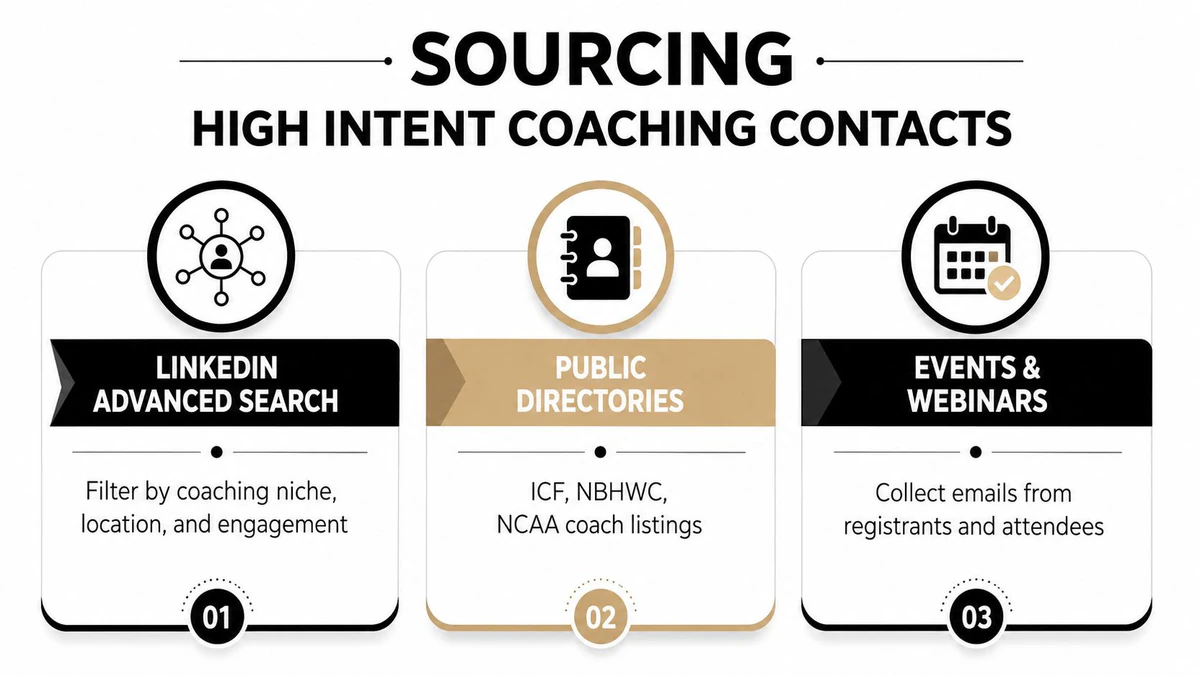
The cleanest way to build a coaches email list is to source from places where the audience already signals context. LinkedIn, public directories, events, and owned lead magnets all tell you something different about intent. The trick is matching the source to the niche, then capturing that source in your CRM so the list can be segmented later.
Use the source that matches the coach type
Business, life, and fitness coaches usually leave clearer footprints on LinkedIn, podcast guest pages, association sites, and event attendee pages. That's useful because each source carries a different consent signal. A podcast guest list suggests public visibility. An event registration list suggests explicit sign-up. A LinkedIn profile suggests discoverability, not permission, so it needs more careful outreach and tagging.
College athletics is a different case. Athletics departments publish staff directories with head coaches, assistants, recruiting coordinators, and operations staff, and building a coach email list there means collecting contact details across roughly 1,700 schools, not trying to guess hidden inboxes (college athletics staff directory guidance). That's a sourcing project, not a scraping fantasy.
For coaches outside athletics, a specific lead magnet works better than a generic newsletter prompt. The strongest acquisition pattern is a resource tied to one pain point, a dedicated landing page, and consistent distribution across owned and borrowed channels (lead magnet guidance for coaches). Webinar-style workshops can also convert at 5% to 15%, and they're worth repurposing into evergreen opt-ins rather than one-off events (lead magnet and webinar guidance).
Keep the consent signal attached to the contact
If you source from a directory, event page, or guest appearance, store that origin as a source tag. If you use email lookup for sales teams for enrichment, keep enrichment separate from acquisition so you don't confuse a found address with an opted-in one. That distinction matters later when you decide who can receive a promotional sequence and who should get a softer re-introduction.
A useful way to think about sourcing is simple. Use direct opt-in channels for the highest intent. Use public source channels for discovery and relationship building. Use enrichment only after you've documented the origin and the outreach reason.
A directory contact can be real, but real doesn't mean ready.
If you want a related process outside the coaching niche, the automation logic in this guide on automation tactics for gym owners shows how owned and borrowed channels can work together without leaning on generic purchased data.
Cleaning and Verifying Every Address With BillionVerify
Bad data is expensive because it wastes sends, damages reputation, and hides the performance of your message. That's why verification has to happen before campaigns, not after complaints start rolling in. BillionVerify is a professional email verification service built to solve one problem, bad email data costs businesses money.
What layered verification actually catches
A proper verification pass is more than a quick format check. At minimum, it should confirm whether the domain has valid mail handling, whether the mailbox looks deliverable, and whether the address sits in a risky category like disposable or role-based. That layered process is what helps teams decide which contacts are safe to mail, which ones need extra review, and which ones should be suppressed.
In coaching lists, this matters because the contact pool often comes from mixed sources. Some addresses came from opt-ins. Some came from public directories. Some were enriched later. If you send them all the same message, you lose the ability to protect the cleanest records from the weakest ones.
How to use verification without slowing growth
The best workflow is operational, not theoretical. Verify at signup when possible, clean bulk CSVs before import, and use real-time API checks to stop bad records from entering the CRM in the first place. If you're managing a growing coaches email list, that keeps the list cleaner every week instead of forcing a quarterly rescue project.
A practical stack also returns useful metadata in structured form, so your team can segment by risk instead of just yes or no. That matters because some addresses are technically reachable but still carry higher delivery risk. Catch-all domains are the obvious example. They don't always fail, but they deserve different treatment from clearly verified inboxes.
Operational takeaway: verify before the campaign, not after the bounce report. Once reputation drops, the cleanup is slower than the mistake.
The same logic applies whether you're working from CSV uploads, a CRM sync, or a form integration. You're not just checking addresses. You're building a cleaner path to inbox placement, and that protection compounds every time the list grows.
Where verification fits in a coaching workflow
If your list is coming from a lead magnet or webinar funnel, verify at the point of capture and again before a promotional send. That's especially useful for workshop registrants and downloaded resources, because those sources create real interest but don't guarantee email quality. The goal isn't perfection. It's reducing uncertainty before it hits sender reputation.
If the list already exists, clean it before you do anything else. Then suppress obvious risks, separate high-confidence records from catch-alls, and route the rest into a lighter engagement track. That's how a coaches list becomes a manageable asset instead of a black box.
Segmenting Your Coaches Email List for Relevant Outreach
A clean coaches email list still wastes effort if every contact gets the same sequence. One segment may be ready for a consult, another may only need proof, and a third may be a poor fit for the offer. Relevance comes from routing decisions, not from sending harder.
Tag by behavior, source, and relationship stage
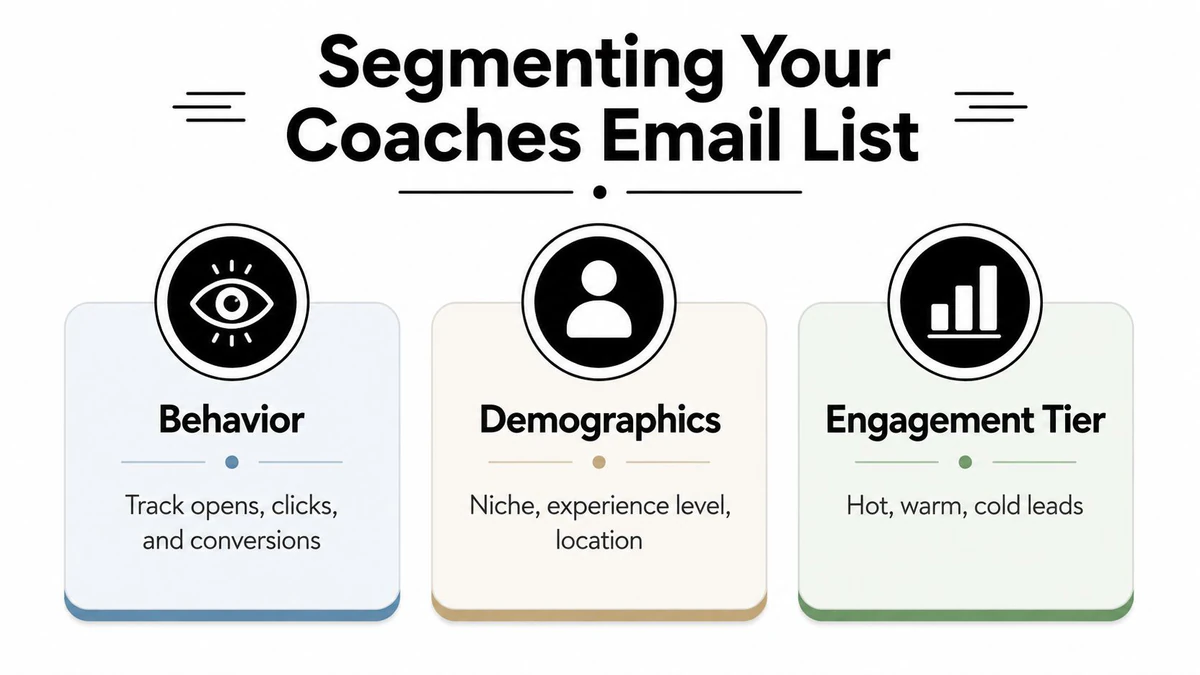
A technical segmentation workflow for a coaches email list is to tag subscribers by behavior like opens, clicks, and downloads, source like lead magnet, webinar, podcast, or LinkedIn, and relationship stage like prospect, current client, or past client, then route them into different content tracks (segmentation workflow for coaches). That base model works because it follows what people did, not what a team assumes about them.
Behavior tags help with timing. Source tags give the next email context. Relationship-stage tags shape tone and offer. A prospect should get different language from a past client because the next logical action is different. One needs trust-building and proof. The other may need an upsell, a reactivation note, or a referral request. For a practical checklist of how to set up this logic, see BillionVerify segmentation tips.
Keep the tag set simple enough that the team will use it. A long taxonomy with twenty edge-case labels looks smart in a CRM and breaks the second someone forgets to apply one field. Clean routing beats ornate naming.
Route each segment into a different message
A single campaign to the whole list usually leaves money on the table. HubSpot and Mailchimp users often see stronger engagement when the same offer is framed differently for colder contacts, webinar attendees, and past clients, because the same subject line does not fit every stage. Broad blasts flatten relevance, and once people stop opening, the next send reaches a colder audience.
The better pattern is to keep the core offer stable and change the message by segment. A cold podcast subscriber may need proof and education before a call to action. A webinar attendee may need a short follow-up with one clear next step. A past client can receive a direct re-engagement note tied to the next logical offer, with less explanation and more specificity. The list stays the same. The campaign logic does the work.
Route by intent, not by convenience. If someone clicked pricing, they belong in a different path from someone who only opened a newsletter. If a contact downloaded a lead magnet but never booked, that record needs a nurture branch, not the same sequence as a past client ready for a renewal or referral ask.
If CRM fields are set up well, this is straightforward in HubSpot, Salesforce, Mailchimp, or Klaviyo. Tags feed the send logic, the send logic shapes response, and the response tells you which segment deserves the next offer. One list can support several campaign outcomes, but only if the routing reflects behavior, source, and relationship stage instead of treating every contact the same.
Staying Compliant and Landing in the Inbox Every Time
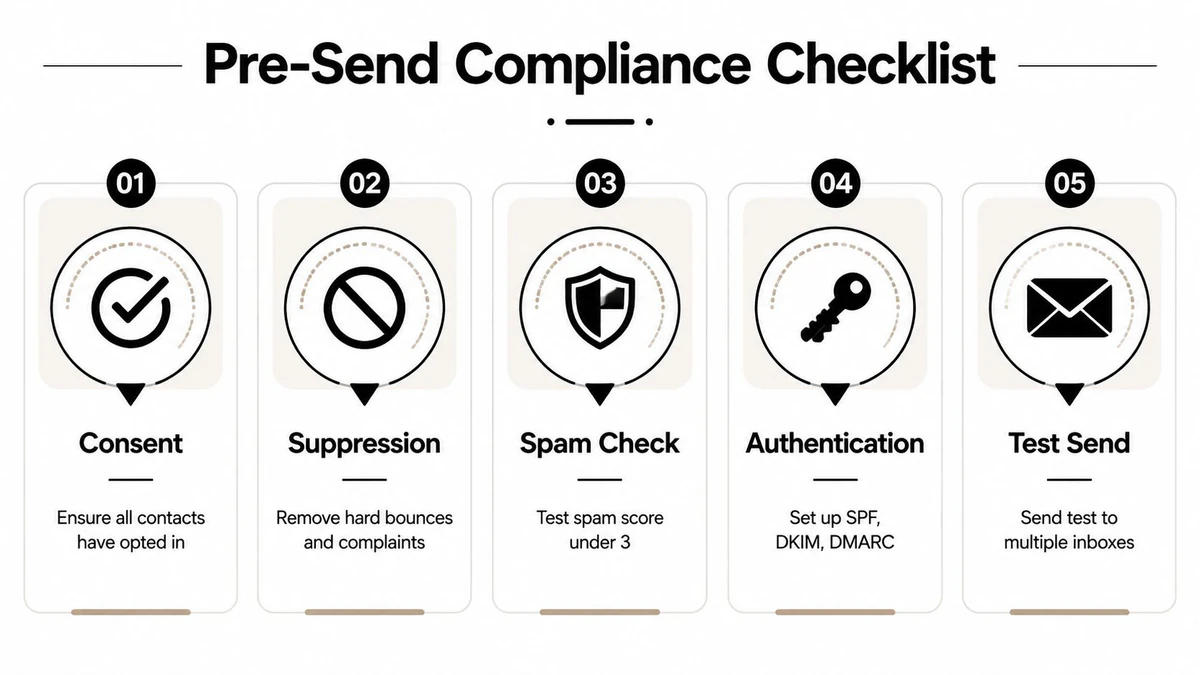
A coaching list can look healthy on paper and still fail at send time if consent, hygiene, and authentication are weak. I've seen clean-looking exports turn into inbox problems because the records were collected loosely, the suppression file was stale, or the domain setup never matched the sending pattern. The right routine starts before the campaign goes out, with consent review, suppression checks, authentication, and inbox testing.
Treat suppression like a daily control, not a cleanup task
Hard bounces, complaints, and unsubscribes should stay out of the sending pool. They belong on suppression immediately, and they need to be removed every time a new send is prepared. Disposable addresses and role accounts deserve the same treatment, because they often point to weak intent or a mailbox that will not behave like a real prospect.
Authentication has to match the same standard. SPF, DKIM, and DMARC alignment help mailbox providers trust the message and the domain behind it. If a domain is new, warm it up slowly and keep volume modest until engagement steadies. That is basic protection for the sender reputation you are trying to preserve.
Use verification and send infrastructure together
The cleanest setup is to verify addresses before they enter the CRM, then keep the bad data out with form checks or API gating. Teams usually connect verified records to tools like SendGrid, Mailchimp, HubSpot, and similar platforms through Zapier, Make, or direct API flows. That stops fake signups before they pollute the list and drag down future sends.
For a closer look at the operational side of consent and data handling, privacy in email marketing gives the right frame. For coaching lists, that matters because source quality and permission signals vary a lot from one contact path to another.
Test before scale
A disciplined send should always include an inbox test across a few mailboxes, then a check on whether the audience, subject line, and segment match. If the list is verified and the message still underperforms, the problem is usually not the data anymore. It is the mismatch between the offer and the people receiving it.
A tighter compliance process can change the numbers in ways that matter operationally. One coaching team I worked with saw complaint rates fall after suppression hygiene was tightened, and another improved inbox placement after DMARC alignment matched the sending domain to the actual mail stream. Those fixes do not get attention like a big list buy, but they protect deliverability and make the next campaign easier to trust.
The A five-step pre-send compliance checklist for email marketing including consent, suppression, spam check, authentication, and testing. is the kind of routine that keeps a coaches email list usable, because it forces the team to check consent, remove bad records, and test the send before reputation gets hit.
Turning a Verified Coaches List Into Consistent Clients
A strong coaches email list is not a static asset. It gets more useful as the source tags, verification status, and engagement history stack up over time. That's why the gap in the market is still not “how do I email coaches?” but which coaches, from which source, and with what consent signal (coach list quality gap analysis).
The math only works when the list stays clean
The coaching ROI model is already clear. A healthy list can generate $5 to $15 per subscriber per month, and list growth of 10% to 20% net per month is a strong target when hygiene is maintained (coaching list performance model). If you let bad records pile up, those numbers become meaningless because deliverability and response both slide.
A simple send can still matter. On a 500-subscriber list, the coaching model says a campaign at 35% open rate, 5% click-through rate, and 8% conversion rate on clickers could produce about 2 new clients worth $6,000 if each client is worth $3,000 (coaching campaign model). That's the outcome to optimize for, not the vanity of list size.
Keep the message short and the next step obvious
Recruiting-email guidance is useful here because it favors clear identifying details and a direct action item. Short, personalized intros and a specific next step work better than long introductions that bury the ask. If your subject line, opening line, and call to action all match the segment, you'll usually see stronger response than with a generic broadcast.
For teams trying to connect that tactic to the broader funnel, what full funnel marketing is is a useful lens. It helps explain why a coaches list should support awareness, nurture, and conversion instead of acting like a one-step blast channel.
BillionVerify copywriting tips matter here because the list only earns revenue when the message is worth opening. Clean data protects deliverability, but the copy still has to ask for a clear action.
Start with the current list. Verify it, suppress the risky records, and tag every contact by source and stage. Then send one segment at a time and let the engagement data shape the next round. That's the cleanest path to compounding list value.
If your coaches email list is underperforming, the fastest fix is usually data quality, not a new sequence. BillionVerify helps teams verify addresses, remove risky records, and protect sender reputation before the next campaign goes out. Visit BillionVerify to clean your list and build from contacts you can trust.