



Email marketing success doesn't happen by accident. The highest-performing campaigns are built on proven best practices that have been refined through years of testing and optimization. This comprehensive guide presents 27 actionable strategies that will transform your email marketing results, from subject line optimization to advanced segmentation techniques.
Why Best Practices Matter in Email Marketing
Following email marketing best practices isn't just about checking boxes—it's about maximizing the return on every email you send. With inbox competition fiercer than ever, the difference between mediocre and exceptional results often comes down to execution details.
The Cost of Ignoring Best Practices
Poor email marketing practices lead to tangible consequences:
- Lower deliverability: Emails landing in spam folders instead of inboxes
- Reduced engagement: Declining open and click rates over time
- Damaged reputation: ISPs flagging your domain as problematic
- Wasted resources: Budget spent on emails that never get read
- Lost subscribers: People unsubscribing due to poor experiences
The Compound Effect of Excellence
Conversely, implementing best practices creates a positive feedback loop. Higher engagement signals to email providers that your content is wanted, improving deliverability. Better deliverability means more people see your emails, increasing opportunities for engagement. This virtuous cycle compounds over time, making best practices an investment that pays dividends indefinitely.
List Building Best Practices (1-5)
Your email list is the foundation of your email marketing success. These practices ensure you're building a list that drives results.
1. Always Use Permission-Based List Building
Never purchase email lists or add people without their explicit consent. Permission-based marketing isn't just ethical—it's essential for deliverability and engagement.
Why It Matters:
- Purchased lists contain people who never asked to hear from you
- Recipients mark unsolicited emails as spam
- High spam complaints destroy sender reputation
- Many purchased addresses are invalid or spam traps
Best Practice Implementation:
- Use clear opt-in forms on your website
- Implement double opt-in to confirm subscriber intent
- Never add email addresses from business cards without permission
- Document consent for compliance purposes
2. Verify Email Addresses at Point of Collection
Catching invalid emails before they enter your list prevents deliverability problems from the start.
Why It Matters:
- Typos and fake emails enter your list through signup forms
- Invalid addresses bounce, hurting sender reputation
- Disposable emails never convert to customers
- Spam traps can infiltrate your list
Best Practice Implementation:
- Integrate real-time email verification API into signup forms
- Use email verification to validate emails as they're entered
- Block disposable email domains automatically
- Verify syntax and domain validity instantly
3. Create Compelling Lead Magnets
Give people a reason to subscribe beyond "join our newsletter." Valuable lead magnets dramatically increase signup rates.
Effective Lead Magnet Types:
- Ebooks and guides: In-depth content on topics your audience cares about
- Templates and checklists: Ready-to-use tools that save time
- Free tools: Calculators, generators, or analyzers
- Exclusive content: Reports, research, or early access
- Discounts: First-purchase incentives for e-commerce
Best Practice Implementation:
- Align lead magnets with your products or services
- Create specific magnets for different audience segments
- Test different offers to find what converts best
- Deliver promised value immediately after signup
4. Optimize Signup Form Placement and Design
Where and how you present signup forms directly impacts conversion rates.
High-Converting Placement Options:
- Above the fold on your homepage
- Within relevant blog content
- Exit-intent popups for leaving visitors
- Dedicated landing pages for campaigns
- Website footer (always visible)
Design Best Practices:
- Keep forms simple—name and email only when possible
- Use clear, benefit-focused headlines
- Include social proof (subscriber count, testimonials)
- Make the CTA button stand out visually
- Ensure mobile responsiveness
5. Set Clear Expectations During Signup
Tell subscribers exactly what they'll receive and how often. Mismatched expectations lead to unsubscribes and spam complaints.
What to Communicate:
- Content type (tips, promotions, news, etc.)
- Email frequency (daily, weekly, monthly)
- Exclusive benefits for subscribers
- Easy unsubscribe promise
Best Practice Implementation:
- Include frequency information near signup forms
- Send a welcome email confirming their subscription
- Provide preference options when possible
- Honor stated frequency commitments
Content and Copywriting Best Practices (6-12)
Great content is the heart of email marketing success. These practices help you create emails people actually want to read.
6. Write Subject Lines That Demand Opens
Your subject line is the most critical element of your email. A great email with a poor subject line will never be read.
Subject Line Best Practices:
- Keep it under 50 characters for mobile optimization
- Lead with the most important words
- Create curiosity without being clickbait
- Use numbers when appropriate (7 tips, 50% off)
- Personalize when it adds value
- A/B test different approaches consistently
Proven Subject Line Formulas:
- Question format: "Are you making this email mistake?"
- How-to format: "How to double your open rates"
- List format: "5 ways to improve deliverability"
- Urgency format: "Last day for 40% off"
- Personalized format: "[Name], your weekly digest is here"
7. Optimize Preview Text Strategically
Preview text (preheader) appears after the subject line in inbox views. Don't waste this valuable real estate.
Preview Text Best Practices:
- Complement—don't repeat—your subject line
- Add context that encourages opens
- Include calls-to-action when appropriate
- Keep it under 100 characters for full visibility
- Avoid default text like "View in browser"
8. Write for Scanners, Not Readers
Most people scan emails rather than reading word-by-word. Structure your content accordingly.
Scannable Content Techniques:
- Use short paragraphs (2-3 sentences max)
- Include descriptive subheadings
- Employ bullet points for lists
- Bold key phrases and important points
- Use white space generously
- Place critical information at the beginning
9. Focus on Benefits Over Features
Your subscribers care about what's in it for them. Lead with benefits, then support with features.
Feature vs. Benefit Examples:
Feature: "Our software processes 10,000 emails per second"
Benefit: "Verify your entire list in minutes, not hours"
Feature: "24/7 customer support"
Benefit: "Get help whenever you need it, day or night"
Best Practice Implementation:
- Start with the subscriber's problem or desire
- Explain how your solution addresses it
- Use "you" and "your" more than "we" and "our"
- Include specific, tangible outcomes when possible
10. Include One Clear Call-to-Action
Every email should have one primary goal. Multiple CTAs dilute focus and reduce conversions.
CTA Best Practices:
- Use action-oriented language (Start, Get, Download, Join)
- Make buttons visually prominent
- Place CTAs above the fold when possible
- Repeat important CTAs at the end of longer emails
- Use first-person language ("Start my free trial")
CTA Button Design:
- Use contrasting colors that stand out
- Ensure buttons are large enough to tap on mobile
- Add white space around CTAs for visibility
- Make the action clear and specific
11. Personalize Beyond First Name
While using subscriber names is good, deeper personalization drives significantly better results.
Advanced Personalization Techniques:
- Reference past purchases or browsing behavior
- Segment content based on subscriber interests
- Customize recommendations based on preferences
- Acknowledge subscriber milestones (anniversaries, achievements)
- Adjust content based on engagement level
Best Practice Implementation:
- Collect preference data during and after signup
- Track behavioral data across touchpoints
- Use dynamic content blocks for personalization
- Test personalized vs. generic versions
12. Maintain Consistent Brand Voice
Your emails should sound like they come from the same brand, creating familiarity and trust.
Brand Voice Elements:
- Tone (formal, casual, friendly, authoritative)
- Vocabulary (technical terms, simple language)
- Personality (humorous, serious, inspiring)
- Values (what you emphasize and prioritize)
Best Practice Implementation:
- Create email copywriting guidelines
- Develop templates with approved voice examples
- Review emails for consistency before sending
- Train team members on brand voice standards
Design and Technical Best Practices (13-18)
How your emails look and function directly impacts engagement. These practices ensure your emails perform well across all devices and email clients.
13. Design Mobile-First
With over 40% of emails opened on mobile devices, mobile optimization isn't optional—it's essential.
Mobile-First Design Principles:
- Use single-column layouts for easy scrolling
- Make fonts large enough to read (minimum 14px body, 22px headings)
- Size tap targets appropriately (minimum 44x44 pixels)
- Keep email width under 600 pixels
- Use responsive templates that adapt to screen size
Mobile Testing Checklist:
- Preview on actual mobile devices
- Test on both iOS and Android
- Check image sizing and alt text display
- Verify links and buttons are tappable
- Ensure text is readable without zooming
14. Optimize Images for Email
Images enhance emails but require careful optimization to work well.
Image Best Practices:
- Compress images to reduce file size
- Use appropriate formats (JPEG for photos, PNG for graphics)
- Keep total email size under 100KB when possible
- Always include descriptive alt text
- Don't rely on images alone—many clients block them by default
Alt Text Guidelines:
- Describe the image content clearly
- Include relevant context or calls-to-action
- Keep alt text concise but informative
- Don't start with "Image of" or "Picture of"
15. Test Across Email Clients
Emails render differently across Gmail, Outlook, Apple Mail, and other clients. Testing prevents embarrassing display issues.
Testing Best Practices:
- Use email testing tools to preview across clients
- Test on desktop and mobile versions of each client
- Check both light and dark mode rendering
- Verify links work correctly
- Test plain-text versions as well as HTML
Common Rendering Issues to Watch:
- CSS support varies dramatically between clients
- Background images may not display in Outlook
- Some clients strip certain HTML elements
- Font fallbacks may not render as expected
16. Ensure Email Accessibility
Make your emails accessible to subscribers with disabilities. It's both ethical and expands your potential audience.
Accessibility Best Practices:
- Use semantic HTML structure
- Provide sufficient color contrast (4.5:1 minimum)
- Include meaningful alt text for all images
- Use descriptive link text (not "click here")
- Structure content with proper heading hierarchy
- Ensure emails work with screen readers
17. Implement Proper Email Authentication
Authentication protocols verify your identity and protect against spoofing, improving deliverability.
Required Authentication Records:
SPF (Sender Policy Framework):
- Specifies which servers can send email on your behalf
- Prevents spammers from using your domain
DKIM (DomainKeys Identified Mail):
- Adds a digital signature to verify email authenticity
- Ensures email content hasn't been altered
DMARC (Domain-based Message Authentication):
- Tells receiving servers how to handle authentication failures
- Provides reporting on authentication attempts
18. Maintain Clean HTML Code
Bloated or broken HTML causes rendering issues and can trigger spam filters.
HTML Best Practices:
- Use table-based layouts for email (not CSS grid/flexbox)
- Inline CSS styles for better compatibility
- Avoid external stylesheets
- Keep HTML simple and clean
- Validate code before sending
- Remove unnecessary tags and attributes
Deliverability Best Practices (19-23)
Getting your emails to the inbox is fundamental to email marketing success. These practices maximize deliverability.
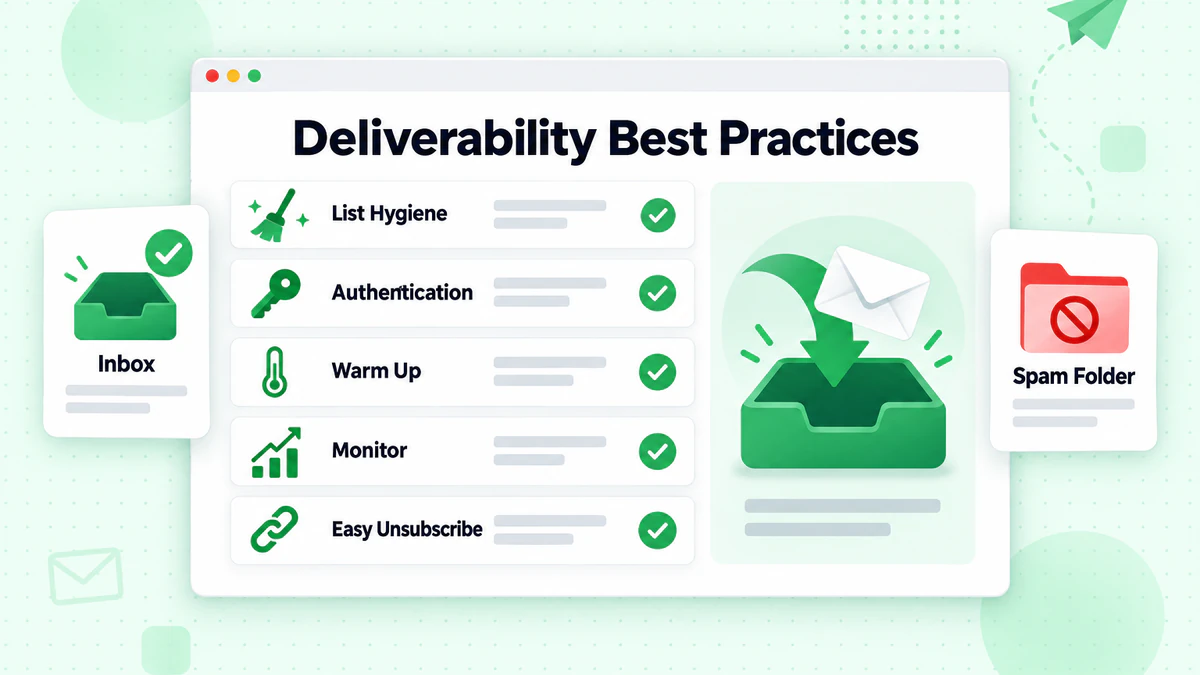
19. Maintain List Hygiene Regularly
Clean lists perform better. Regular maintenance prevents deliverability degradation.
List Hygiene Actions:
- Remove hard bounces immediately
- Re-engage or remove inactive subscribers
- Verify email addresses periodically
- Honor unsubscribes promptly
- Monitor for spam trap hits
Recommended Schedule:
- Real-time: Remove hard bounces
- Monthly: Review and remove soft bounces after multiple attempts
- Quarterly: Run full list through email list cleaning
- Bi-annually: Re-engagement campaigns for inactive subscribers
20. Monitor and Protect Sender Reputation
Your sender reputation determines inbox placement. Protect it vigilantly.
Reputation Factors to Monitor:
- Bounce rates (keep hard bounces under 2%)
- Spam complaint rates (keep under 0.1%)
- Engagement metrics (opens, clicks, replies)
- Blacklist status
- Authentication pass rates
Reputation Protection Strategies:
- Send consistently (avoid sudden volume spikes)
- Target engaged subscribers primarily
- Make unsubscribing easy to prevent spam reports
- Use email verification to prevent bounces
- Segment by engagement for re-engagement campaigns
21. Warm Up New Sending Domains and IPs
New domains and IP addresses have no reputation. Warm them up gradually to build trust.
Warm-Up Best Practices:
- Start with small volumes to engaged subscribers
- Increase volume gradually over 4-8 weeks
- Monitor deliverability metrics closely
- Pause and troubleshoot if issues arise
- Use dedicated IPs for high-volume senders
Sample Warm-Up Schedule:
- Week 1: 50-100 emails/day to most engaged subscribers
- Week 2: 200-500 emails/day
- Week 3: 1,000-2,000 emails/day
- Week 4+: Continue doubling until reaching full volume
22. Segment Sending Based on Engagement
Not all subscribers deserve equal attention. Prioritize engaged subscribers for better deliverability.
Engagement-Based Segmentation:
- Highly engaged: Opened/clicked in last 30 days—send most frequently
- Engaged: Opened/clicked in last 90 days—send regularly
- Lapsing: No engagement in 90-180 days—send re-engagement campaigns
- Inactive: No engagement in 180+ days—consider removal
Benefits of Engagement Segmentation:
- Higher overall engagement rates
- Better sender reputation
- Lower spam complaints
- Improved deliverability for all sends
23. Use Email Verification Consistently
Email verification isn't a one-time task—it should be integrated throughout your email marketing operations.
Where to Implement Verification:
- Signup forms (real-time API verification)
- Before importing new lists
- Before major campaign sends
- As part of regular list maintenance
- For re-engagement campaign recipients
Email Verification Integration Points:
- Real-time API for form validation
- Bulk verification for list cleaning
- Catch-all detection for risky domains
- Disposable email blocking
- Spam trap identification
Optimization Best Practices (24-27)
Continuous improvement separates good email marketers from great ones. These practices drive ongoing optimization.
24. A/B Test Systematically
Testing removes guesswork and reveals what actually works for your audience. Learn more in our email A/B testing guide.
What to Test:
- Subject lines (length, tone, personalization)
- Preview text variations
- Send times and days
- CTA button design and copy
- Email length and format
- Personalization elements
A/B Testing Best Practices:
- Test one variable at a time
- Use statistically significant sample sizes
- Run tests for adequate time periods
- Document results and build a knowledge base
- Implement winners and continue testing
25. Analyze Performance Data Deeply
Surface-level metrics only tell part of the story. Dig deeper for actionable insights.
Beyond Opens and Clicks:
- Click-to-open rate (engagement quality)
- Conversion rates by segment
- Revenue per email sent
- Unsubscribe reasons
- Forward/share rates
- Device and client breakdown
Analysis Best Practices:
- Compare performance against benchmarks
- Track trends over time, not just individual campaigns
- Segment analysis by audience characteristics
- Correlate email engagement with downstream actions
- Use data to inform content strategy
26. Automate Strategically
Automation multiplies your effectiveness while ensuring timely, relevant communications.
Essential Automated Sequences:
- Welcome series for new subscribers
- Abandoned cart recovery for e-commerce
- Re-engagement campaigns for lapsing subscribers
- Post-purchase follow-ups
- Milestone and anniversary emails
- Lead nurturing sequences
Automation Best Practices:
- Map out the full subscriber journey
- Set appropriate delays between automated emails
- Include exit conditions to prevent over-communication
- Review and update automation content regularly
- Monitor automation performance metrics
27. Learn from Unsubscribes and Complaints
Negative feedback provides valuable insights for improvement.
Unsubscribe Data Collection:
- Offer a simple unsubscribe reason survey
- Track unsubscribe rates by campaign type
- Monitor which segments unsubscribe most
- Note timing patterns in unsubscribes
Acting on Feedback:
- Adjust frequency if "too many emails" is common
- Improve content relevance if engagement drops
- Review segmentation if irrelevance is cited
- Evaluate overall strategy if unsubscribes spike
Implementing Best Practices: Your Action Plan
Knowing best practices is one thing—implementing them is another. Here's a prioritized action plan:
Immediate Actions (This Week)
- Audit current email verification: Ensure you're validating emails at signup
- Review authentication settings: Confirm SPF, DKIM, and DMARC are configured
- Check mobile rendering: Test recent emails on mobile devices
- Analyze recent performance: Identify your biggest improvement opportunities
Short-Term Actions (This Month)
- Implement list hygiene routine: Set up regular email list cleaning
- Optimize signup forms: Improve placement, copy, and lead magnets
- Develop testing program: Start systematic A/B testing
- Create engagement segments: Separate active from inactive subscribers
Ongoing Actions (Continuous)
- Monitor deliverability metrics: Track bounce rates, complaints, and inbox placement
- Test and optimize: Run regular A/B tests on key elements
- Refine segmentation: Continuously improve targeting based on data
- Update automation: Keep automated sequences fresh and relevant
Conclusion
Email marketing best practices aren't arbitrary rules—they're proven strategies that drive measurable results. By implementing these 27 practices, you'll build a stronger email program that delivers more opens, clicks, and conversions while protecting your sender reputation.
Remember that excellence in email marketing is a journey, not a destination. Start with the fundamentals—list hygiene, email verification, and basic optimization—then progressively implement more advanced practices as your program matures.
The most successful email marketers treat best practices as minimum standards, not maximum achievements. They continuously test, learn, and improve, always seeking the next optimization that will move their metrics higher.
Ready to implement email marketing best practices with a verified, deliverable list? Start with BillionVerify to ensure your emails reach real subscribers who want to hear from you.