


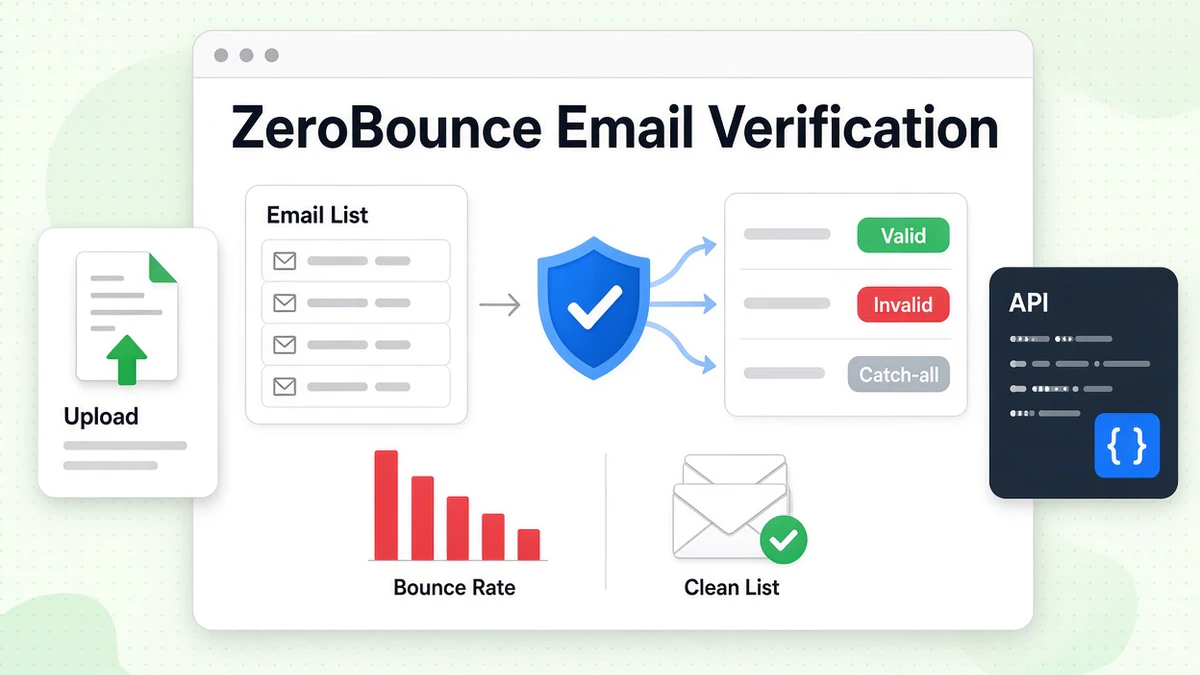
ZeroBounce is a platform for checking email addresses and tracking deliverability. You upload a list or call an API. ZeroBounce sorts each address into a status before you send.
This guide covers what ZeroBounce is and how it works. It also covers features, the API, integrations and a short price outline. Every fact comes from zerobounce.net, as listed on its site in October 2026.
We are not affiliated with ZeroBounce. BillionVerify sells a competing service. For that reason, a full section compares the two products.
Key facts (checked October 2026):
- ZeroBounce, also typed as Zero Bounce, was founded in 2017 by Liviu Tanase and is based in Santa Barbara, California, per its About page.
- ZeroBounce lists more than 650,000 customers in over 200 countries, per its Facts listing.
- ZeroBounce bills zero credits for an unknown result, per the FAQ on its pricing screen.
- The Terms of Freemium grant every free account 100 validation checks each month.
- ZeroBounce's calculator quoted $129 for 10K checks and $649 for 100K.
- BillionVerify sells 10K credits for $10 and 100K for $80 as packs paid once, per its pricing table.
What Is ZeroBounce?
ZeroBounce checks email addresses before you mail them. The aim is fewer hard bounces and a safer sender reputation. The site calls the product "an email validation and deliverability platform."
The brand is a single word, but the logo shows two. So many people search for zero bounce instead. Both spellings land on zerobounce.net.
Hertza LLC is the legal entity, according to its Facts listing. The company says it has checked over 60 billion addresses.
Zero Bounce or ZeroBounce?
Zero Bounce with a space is simply a second spelling. The company itself writes ZeroBounce as a single word. A search for either form leads to the same product and the same pricing.
What ZeroBounce does
The About section names three product lines:
- Email Validation: a bulk file checker plus a real-time API.
- ZeroBounce ONE: a monthly bundle that adds warmup, DMARC monitoring and inbox tests.
- Email Warmup: seed-based warming for new or idle sending domains.
Most readers start with the first line. The other two grew out of it.
Who uses ZeroBounce
The About section lists HubSpot, Sephora, Unilever, Coca-Cola, Samsung and Airbnb as customers. Its services copy says the main users are marketers and any business that sends mass mail.
Sales teams use it too. They run exported contacts through email verification ahead of outreach.
How Does ZeroBounce Email Verification Work?
ZeroBounce email verification runs on two routes. You can upload a file in the browser. You can also call the API from your own code.
Its guide gives a simple rule. Call it from sign-up forms that need an answer at once. Use uploads for lists that you clean every few weeks.
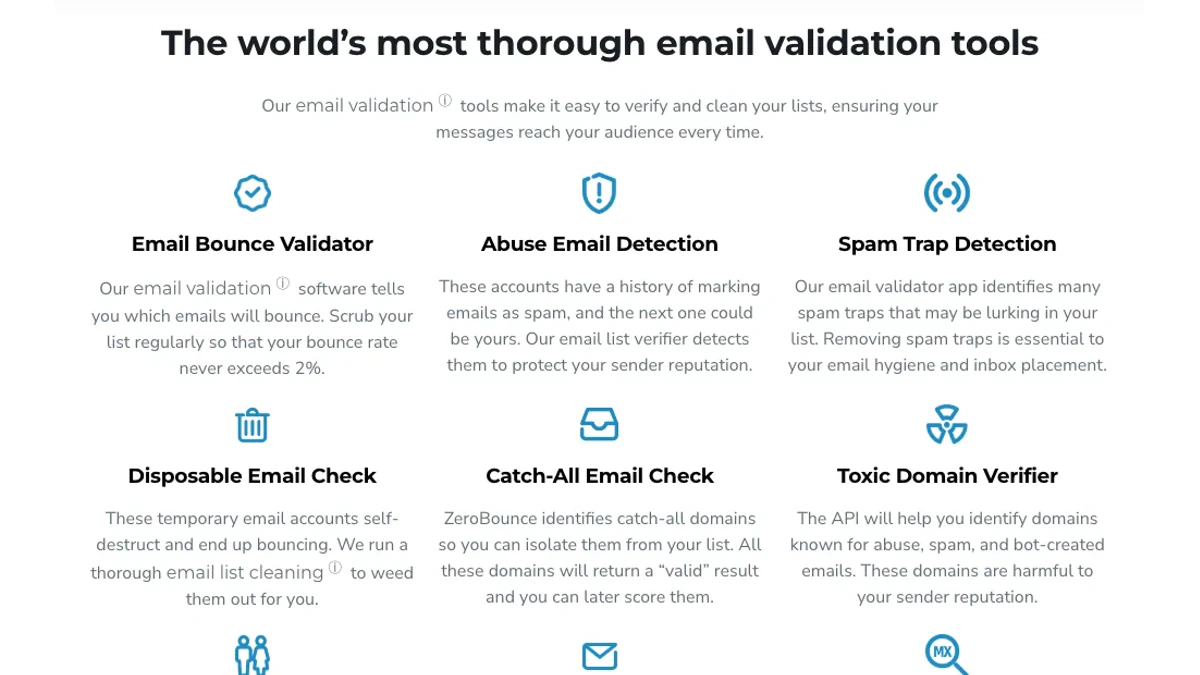
Screenshot: the tools grid on ZeroBounce's email validation listing.
Single email verification
The homepage has a verifier box for single checks. Per its docs, you need no account for it. Paste a mailbox and press Verify.
The result reads valid, or it flags the entry as toxic or disposable. It suits a quick test, not a full list.
Bulk email verification by upload
A bulk run follows a short path:
- Create an account and confirm your own address.
- Upload a .csv, .txt, .xls or .xlsx file of up to 500 columns and 1 GB.
- Pick the column that holds the addresses.
- Wait for processing to end, then press Download.
- Open the zip with the key that ZeroBounce emails to you.
A trial run takes up to 100 contacts. After that, the smallest purchase is a 2K pack.
Duplicates and malformed rows are dropped before anything is counted. They cost nothing. Processing time depends on the domain mix. Gmail and Outlook lists finish sooner than lists of rare domains.
The download splits your list into separate files by status. You get a file for valid, invalid, catch-all, spam trap, abuse, do-not-mail and unknown cases. An overview PDF sits in the same zip.
Real-time email verification with the API
The single-address endpoint is /v2/validate. It takes an email, an optional IP and your key. A timeout setting runs from 3 to 60 seconds. A slow mail server then returns unknown.
A second endpoint, /v2/validatebatch, checks several inputs per call. Per the docs, large batches take longer to return.
Default, US and EU endpoints exist. The US endpoint processes data on American servers.
What Verify+ adds
Yahoo and AOL disable idle accounts, yet those accounts can still look valid. ZeroBounce built an optional add-on for this gap. During a check it sends a real message and reads the bounce. The text calls the add-on no-cost.
How Does ZeroBounce Cut Your Bounce Rate?
A bounce is a message the receiving server refuses. Each bounce hurts your standing with inbox providers. A verifier exists to push hard bounces toward zero.
Hard bounce and soft bounce
A hard bounce is permanent. The mailbox does not exist, or the domain cannot receive mail. A soft bounce is temporary. The inbox is full, or the server is down.
ZeroBounce maps its statuses onto these two kinds of bounce. Invalid results are the hard bounce risks. Greylisted and timed-out ones sit under unknown, which is closer to a soft bounce risk.
The 2% target
The tools copy tells senders to scrub lists so that the bounce rate never tops 2%. That is a ZeroBounce guideline, not a rule from inbox providers. It matches the common view that a rate under 2% is healthy.
As a rule of thumb, a rate above 5% is a warning and above 10% is an emergency. Check your sending platform's own limits too.
Where the bounce checker fits
ZeroBounce names a tool the Email Bounce Validator. It tells you which addresses will bounce. Run email verification before each send, not after the damage.
The reference also points to SMTP bounce codes. They explain why a message bounced, which helps when a "valid" address still fails because your own IP is listed.
What Do ZeroBounce Results Mean?
Email verification results come back as a status from a set of seven. The docs describe every status and add sub-statuses for detail.
| Status | Meaning in ZeroBounce's docs |
|---|---|
| valid | Safe to mail. Sub-statuses include alias, alternate and gold. |
| invalid | Mailbox not found, bad syntax, typo or missing DNS. |
| catch-all | The server accepts any recipient, so the mailbox is unconfirmed. |
| spamtrap | Believed to be a trap address. Do not mail it. |
| abuse | A person known to report mail as spam. |
| do_not_mail | Role-based, disposable, toxic and similar risky types. |
| unknown | The check could not finish. Causes include greylisting and timeouts. |
Accept-all versus catch-all
This is the most useful detail in the reference. ZeroBounce keeps a list of accept-all domains that have a record of delivering. Those come back as valid, with an accept_all sub-status.
Other domains that take any recipient get the plain catch-all label. For them the docs say real deliverability "cannot be confirmed."
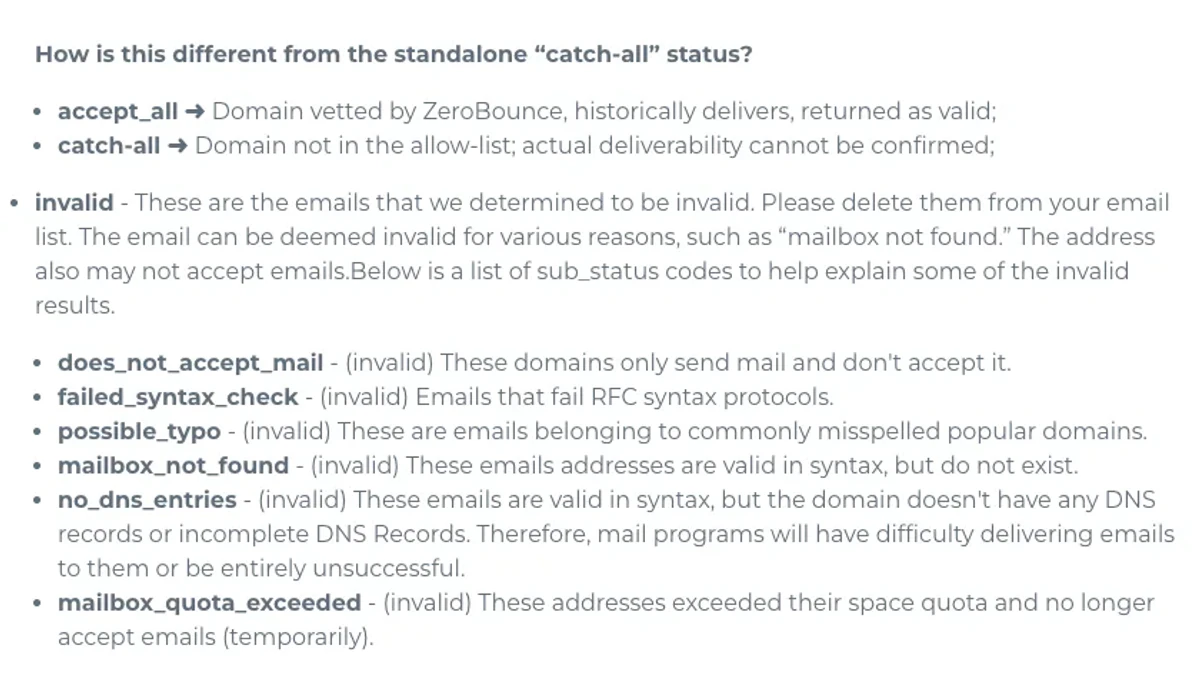
Screenshot: the v2 status codes reference in the ZeroBounce docs.
Role mailboxes such as info@ and sales@ land in do_not_mail. The docs call them real mailboxes, but not worth mailing in most cases.
Unknown status
Anti-spam systems, greylisting, timeouts and dead servers all produce unknowns. ZeroBounce advises resubmitting them. Greylisted ones often pass on a second try.
Unknowns cost zero, and any credit taken is returned.
Which ZeroBounce Features Go Beyond Verification?
The platform grew past plain email verification. Several tools now sit around the core checker.
AI Email Scoring
Scoring rates a contact from 1 to 10. It targets catch-all addresses, where no probe can prove the mailbox exists. The score estimates the chance of real engagement.
Each scored contact costs an extra credit. The docs add that the accuracy guarantee does not cover scoring.
Activity Data
Activity Data appends a contact's last known activity. The value is a window of 30, 60, 90, 180 or 365 days, or older. It helps you rank contacts by recent engagement.
Email Finder and Domain Search
Email Finder takes a name and a company domain. It returns a verified work address. Domain Search lists contacts at a single company. Every successful Finder query uses 20 credits.
Deliverability tools
The bundle adds the rest:
- Email Warmup with seed mailboxes
- Inbox placement tests
- Server tests for SPF, DKIM, DMARC and DNS
- Blacklist monitoring across 200+ lists
- DMARC monitoring with daily report roll-ups
These matter if you run your own sending domains. Email verification alone does not cover them.
What Are the ZeroBounce API and Integrations?
The API
The v2 interface handles individual lookups, batches, file upload and file progress. It also exposes balance and usage calls. A Postman collection is yours to import at no cost.
Wrappers exist for 16 languages, including Python, PHP, Java, Node, Go and C#. A sandbox mode lets you test with sample inputs such as valid@example.com and catch_all@example.com. Test calls still need your key.
Allowlist and blocklist rules let you force an outcome for chosen mailboxes or domains.
A single rule needs a note. The quickstart bars use inside a third-party product or platform without prior approval. Approved use brings extra commercial terms and a minimum commitment.
Integrations
The integrations directory showed 95 entries. Connection types are Direct, Zapier, Make, N8N, Workato and Albato.
Visible cards include HubSpot, Klaviyo, Mailchimp, ActiveCampaign, Salesforce, Constant Contact, WordPress and ChatGPT. Categories run from CRM and ESP to forms, e-commerce and cold outreach.
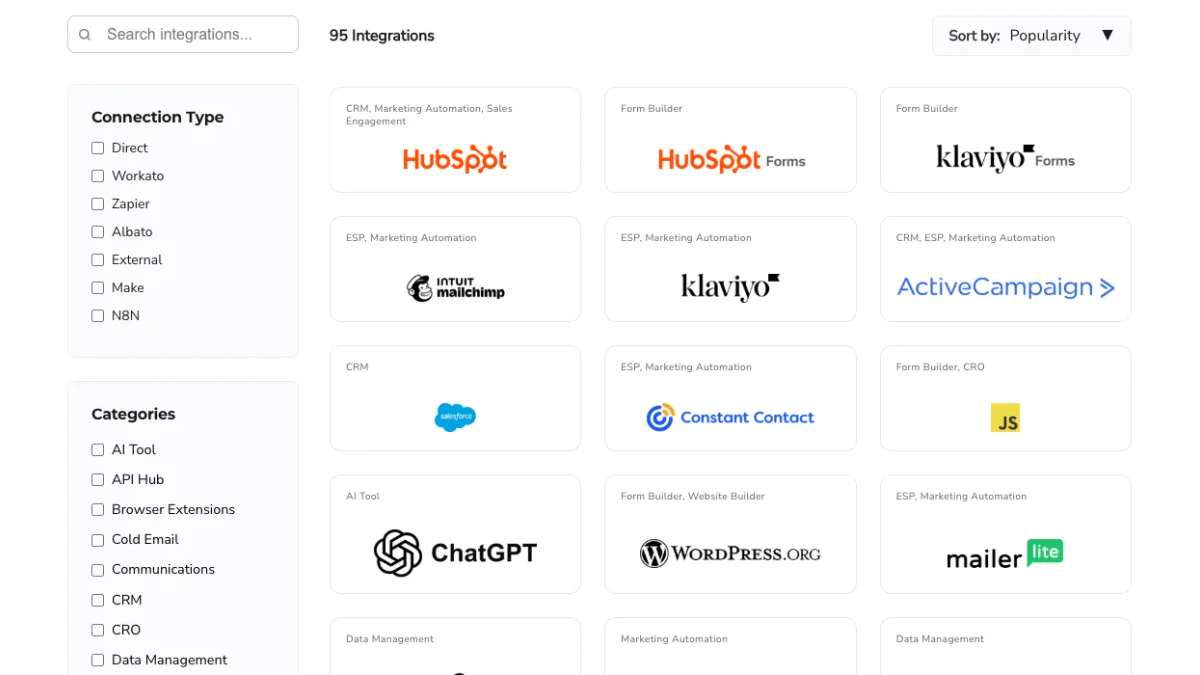
Screenshot: ZeroBounce's integrations directory.
ZeroBounce Pricing in Brief
ZeroBounce sells email verification in three ways. A separate guide goes deeper. This section gives only the outline.
Free tier. A starter account receives 100 checks every month. The site asks you to sign up with a business domain. Those refill monthly and do not roll over.
Prepaid packs. The smallest order is a 2K pack. The price per credit falls as the order grows. At 10K the calculator quoted $0.0129 each. At 100K the quote fell to $0.00649 each.
Monthly bundle. The ONE plan is $99 monthly, or $79 monthly when billed yearly. It includes 10K monthly validations and the extra tooling above.
A check costs a single credit. Scoring adds another. Duplicates, unknowns and removed rows all bill zero.
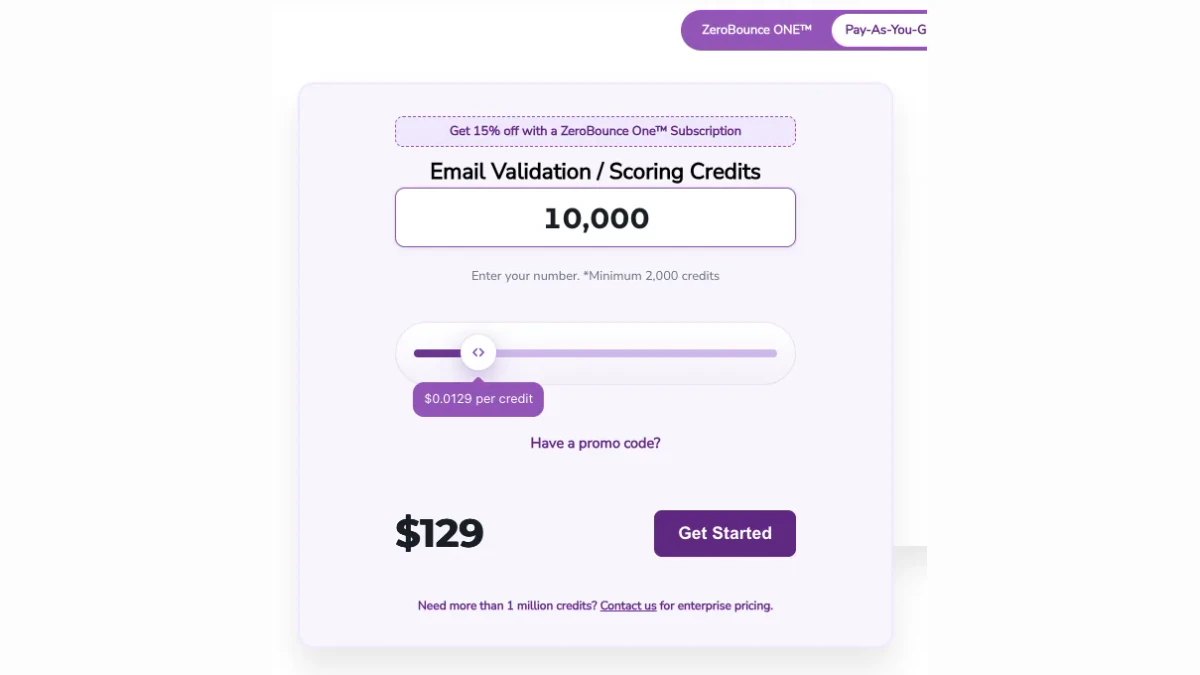
Screenshot: the credit calculator on ZeroBounce's pricing screen.
Expiry rules appear in several forms on the site. Per the docs, credits never lapse while a subscription is active. Other balances can lapse two years after the last payment. Read the current terms before any big purchase.
How Does the ZeroBounce Login Work?
The ZeroBounce login sits at the top right of every page. Press Log In to open the member sign-in screen. Sign Up Free is beside it.
New users follow the docs. Register, click the link in the confirmation email, then sign in. Your balance shows at the top right.
Your key lives inside the account. If you lose it, repeat the ZeroBounce login and open the developer section. A separate docs entry explains how to secure the account.
For access trouble, ZeroBounce lists 24/7 email support at support@zerobounce.net. Its status site is status.zerobounce.net.
Is ZeroBounce Legit? Audits, Reviews and Data Rules
Is ZeroBounce legit as a company?
Yes. ZeroBounce is a real company with a street address, a named founder and published audits. These facts come from its Facts and About pages.
| Check | What the site states |
|---|---|
| Founded | 2017, Santa Barbara |
| SOC 2 Type 2 | Certified since March 22, 2022 |
| ISO/IEC 27001:2022 | Certified by A-LIGN |
| Privacy | GDPR, CCPA and Data Privacy Framework participant |
| Health data | HIPAA-ready, BAA available |
| Payments | PCI compliant |
| Files | Deleted within 30 days of upload |
Is ZeroBounce legit with your data?
ZeroBounce erases uploads after 30 days, and you may remove them sooner. Reviews point the same way. The Facts listing shows 4.7 on G2 from 1,370+ reviews, 4.8 on Trustpilot from 2,136+ and 4.8 on Capterra from 598+. Those are the company's own figures, so open each review site to confirm them.
The company also publishes an accuracy guarantee with a refund formula. Treat any single number with care. Mail servers throttle and greylist, so results vary by domain. The unknown status in the docs reflects this.
A practical check is simple. Read the audits, skim the reviews, then test a small list before you commit.
ZeroBounce vs BillionVerify: A Deep Comparison
This section compares two email verification services. BillionVerify is our product. Its figures come from our own pricing and product pages. The ZeroBounce figures come from the pages cited above.
Billing and allowances
| Item | ZeroBounce | BillionVerify |
|---|---|---|
| Valid and invalid results | 1 credit each | 1 credit each |
| Unknown results | Zero charge | Zero charge |
| Rechecks | Resubmit unknowns for a credit refund | Free within 24 hours |
| Free tier | 100 checks a month, business domain asked | 20 credits each day you use the account, up to 600 a month |
| Allowance | Refills monthly, no rollover | Never expires, no card needed |
Both services bill zero for unknowns. That is not a difference. The gap lies in rechecks and in the free tier.
Catch-all handling
ZeroBounce marks vetted accept-all senders as valid and flags the rest as catch-all. It sells scoring to rank what remains.
BillionVerify reports catch-all as its own class. It never counts a catch-all address as valid. You decide what to do with that group, and you do not pay extra to see it.
An illustration from BillionVerify's bounce checker page.
File limits and verification checks
| Item | ZeroBounce | BillionVerify |
|---|---|---|
| Upload limit | 1 GB, 500 columns | No row limit, 20 GB per file |
| Checks | Mailbox, domain and syntax tests, plus risk flags | Syntax, DNS, MX, SMTP, disposable, role and trap detection |
Price at two volumes
Both columns are single purchases at list price. ZeroBounce lowers its rate as volume grows, so the scale matters.
| Volume | ZeroBounce prepaid | BillionVerify one-time |
|---|---|---|
| 10K | $129 | $10 |
| 100K | $649 | $80 |
Subscriptions follow the same pattern. The bundle starts at $99 a month for 10K validations. BillionVerify's Business plan costs $16 a month for 20K checks. Its Premium plan costs $64 a month for 100K.
The base rate at BillionVerify is $1 per 1,000 credits. The lowest rate, on the Titan annual plan, is $0.00014 per email.
Integrations, API and compliance
ZeroBounce lists 95 integrations and wrappers in 16 languages. Our side lists 25+ integrations. It adds a REST API, a native MCP server for agents like Claude and Cursor, and a free WordPress plugin.
On compliance, ZeroBounce publishes its audit reports and an ISO certificate. We document GDPR terms and sign a DPA. You can download your original file for a day, and results stay available during the retention period.
Where ZeroBounce is stronger
- It bundles warmup, inbox placement, DMARC and blacklist tools in a single plan.
- It lists SOC and ISO audits plus HIPAA readiness.
- It offers AI scoring and Activity Data.
- It has 24/7 live support and a longer integration list.
Where BillionVerify fits better
- The cost per check is lower at both volumes above.
- The daily allowance renews on active days.
- Uploads have no row cap.
- Catch-all stays a separate class, not a flagged valid.
For the full side-by-side, see our ZeroBounce comparison page. An older post covers the same pair in another format.
Who Should Use ZeroBounce, and What Are the Limits?
ZeroBounce suits teams that want email verification and deliverability tools under one roof. It fits senders who run their own domains and need warmup or DMARC reports.
The limits are plain:
- Prepaid orders have a minimum size.
- The free account asks for a business domain.
- Files above 1 GB need splitting.
- The API cannot be embedded in outside products without approval.
- Expiry rules differ by account and plan.
- Greylisted cases bill nothing but need a second pass.
Email verification checks addresses, not people. If you only hold an address and want to know who owns it, try a reverse email lookup. If your list also holds phone numbers, a phone number verification tool handles those.
ZeroBounce FAQs
What is ZeroBounce?
ZeroBounce is a service that verifies email addresses and monitors deliverability. Each address gets a verdict such as valid, invalid or unknown. The company dates from 2017 and sits in California.
What does ZeroBounce email verification check?
ZeroBounce email verification tests syntax, domain records and the mailbox itself. It also flags disposable domains, role accounts, abuse reporters and spam traps. A separate Verify+ add-on covers disabled Yahoo accounts.
Is ZeroBounce free?
ZeroBounce offers 100 checks per month at zero cost. They refill each month. Beyond that, you buy a pack or take the bundle.
How much does ZeroBounce cost?
ZeroBounce prepaid orders have a floor of 2K, and its bundle runs $99 monthly. Its calculator priced 10K checks at $129. A separate pricing guide covers the details.
Does ZeroBounce charge for unknown results?
ZeroBounce never bills an unknown outcome, so it charges zero for those. The pricing FAQ confirms it. Removed duplicates are free as well.
Is ZeroBounce legit?
ZeroBounce is legit by the usual tests, with published audits. It reports SOC audits since 2022 plus ISO 27001. Public review sites rate it near 4.8. Try a trial batch first.
Is Zero Bounce the same as ZeroBounce?
Zero Bounce and ZeroBounce are the same company. The brand writes its name as a single word. Its logo splits the name in two, which explains the second spelling.
Where is the ZeroBounce login?
The ZeroBounce login is the Log In link in the site header. It opens the account sign-in form. New users register first and confirm their email.
Does ZeroBounce have an API?
ZeroBounce has a REST API with single, batch and file endpoints. SDKs cover 16 languages. Embedding the API in a product you sell needs approval.
How does ZeroBounce handle catch-all emails?
ZeroBounce returns domains from its allow-list as valid, with a sub-status. Other open domains stay catch-all. Scoring then ranks that group on a ten-point scale.
How long does ZeroBounce keep uploaded data?
ZeroBounce keeps an uploaded file for up to a month. You can delete it sooner. The company emails a notice before the file goes.
How does ZeroBounce compare with BillionVerify?
BillionVerify costs less per check at 10K and 100K and has no row cap. ZeroBounce offers a wider toolkit and a longer list of audits. Both bill zero credits for unknown results.