



Success in international sales roles gets oversimplified. People talk about cultural fluency, local etiquette, and time-zone discipline, and all of that matters. But global revenue usually gets won or lost much earlier, at the point where a rep's list is cleaned, verified, segmented, and ready to send. If the data is weak, even the best opener, the best demo, and the best localization won't save the sequence.
That's why the most practical way to think about international selling is as a data-quality discipline first and a relationship discipline second. Teams that treat verification as part of the sales operating model protect inbox placement, reduce wasted effort, and build cleaner pipelines across regions. BillionVerify is built around that problem, bad email data costing businesses money, and that framing fits global outbound better than the usual “just personalize more” advice.
The strongest international teams don't only translate messages, they validate the contacts behind them, separate risky records from high-confidence ones, and push clean data into CRM and sequencing tools before outreach starts. They also use market signals from the field to adjust where sourcing breaks down, which is especially important in cross-border work where one region's list quality can look very different from another's. That's the edge in modern international sales roles, and it starts with email hygiene.
1. Validating Email Lists and Detecting Disposable Addresses Across International Markets
International prospecting breaks down fast when teams assume a list is usable just because it looks complete. Every market has different naming patterns, domain habits, and lead sources, and that creates room for disposable inboxes, temporary signups, and stale addresses to slip through. A list that performs well in one country can create avoidable waste in another if it is not checked before outreach starts.
The practical fix is simple: verify the data before it enters a sequence. A service like BillionVerify helps teams check regional formats, detect disposable addresses, and confirm whether a mailbox is likely to accept mail. That matters most when the list came from partners, imports, or older campaigns, because those sources usually hide the highest share of bad records.
For teams that manage recipient lists in Sendvo, the same discipline applies. Clean source data is what keeps every downstream step usable, from segmentation to send scheduling. If the list is messy at the start, the rest of the workflow just distributes the problem faster.
What works in practice
The cleanest process is usually the simplest one. Split lists by region first, then verify them in batches so you can spot market-specific problems instead of averaging everything together. That makes it easier to see where sourcing is weak, where disposable email patterns show up, and where list cleanup needs to be stricter before the next send.
Once the list is verified, separate risky records from higher-confidence contacts and keep those groups distinct in your CRM or sequencing tool. That reduces wasted sends and gives sales reps a clearer view of which prospects are worth immediate effort. It also prevents one bad source from lowering the quality of an otherwise healthy regional file.
1. Validating Email Lists and Detecting Disposable Addresses Across International Markets
International prospecting gets messy fast because every market has its own mix of naming conventions, domain habits, and lead sources. A list that looks clean in one country can still hide disposable inboxes, temporary signups, and stale addresses that drag down outreach across the board. That is why list validation needs to happen before the first sequence goes out, while the data is still easy to fix.
BillionVerify is a professional email verification service built to solve one problem, bad email data costs businesses money. In international sales, that matters because a tool that checks regional formats, detects disposable addresses, and verifies against actual mail servers helps teams avoid wasting outreach on contacts that were never going to convert. If you are working with inherited lists or partner-sourced data, the bulk email verification workflow is the right place to start when you need to verify email lists in bulk.
What works in practice
The cleanest process is usually the simplest one. Segment lists by region first, then verify them in batches so you can spot market-specific quality problems instead of averaging everything together. That approach makes it easier to see where sourcing is weak, where disposable email patterns are common, and where you need tighter controls in your capture process.
A few habits make a real difference:
- Upload CSVs instead of manual entry: This is the fastest way to process inherited international lists without introducing new errors.
- Export with regional metadata: That helps sales teams build geo-targeted sequences from the start.
- Review disposable reports by source: If one channel keeps producing junk, cut it off early.
- Use workflow automation: Sales ops teams can connect verification to Zapier or Make and stop flagged addresses before they reach the CRM.
When lists are cleaner, reps spend less time chasing dead ends and more time working actual buying accounts. For teams that manage recipient lists in Sendvo, the same discipline applies, clean source data is what keeps every downstream step usable. Teams that want a faster pass on older files can also use a bounce email checker tool before they launch a new sequence.
Practical rule: If a market consistently produces weak addresses, fix the source before you add more volume.
2. Reducing Bounce Rates and Protecting Sender Reputation in Multi-Region Email Campaigns
International campaigns can fail for reasons that look small on the surface. One bad send in one region can weaken sender trust more broadly, especially when teams are launching parallel outreach across multiple ISPs and language markets. The issue isn't just bounce rate, it's the compounding effect of poor deliverability on your future sends.
A useful reference point is the broader sales labor market itself, which still matters even when growth is modest. The U.S. Bureau of Labor Statistics projects only 1% employment growth for wholesale and manufacturing sales representatives from 2023 to 2033, yet still expects nearly 150,000 openings each year because of replacement needs, and in the broader sales occupation group it projects about 1.8 million openings per year on average over 2024 to 2034 (BLS projections summarized here). That kind of structural churn is exactly why teams can't afford to lose reputation through preventable bounce problems.
How strong teams protect inbox placement
The most reliable approach is to verify lists before campaign launch, then recheck them close to send time if the list is old or heavily modified. For international work, that timing matters because one region's bounce pattern can differ from another's based on sourcing quality, local domain behavior, and recency.
The bounce email checker tool fits naturally into that workflow because it gives sales teams a pre-campaign control point instead of a post-mortem. Use it to filter out invalids, then monitor bounce reports by geography so you can see whether a specific region is producing fragile data. If you're sending from multiple territories at once, a whitelabel portal can help sales leaders track territory-level reputation without forcing every rep into a separate manual process.
A strong operational rule is simple.
Verify the list first, then schedule the campaign. If the list changes late, verify it again.
That sounds basic, but it's exactly where many global programs slip. Teams that keep reputation clean don't just get fewer bounces, they also recover faster from regional blocks because they've separated data problems from messaging problems.
3. Segmenting International Prospect Lists by Email Quality and Deliverability Confidence
Not every prospect deserves the same outreach intensity. That's especially true in international sales roles, where sourced data often comes from different vendors, local partners, events, and inbound forms. A list with mixed quality creates mixed results, and mixed results make it harder for managers to know whether the problem is targeting, messaging, or data.
The better move is to classify contacts by confidence level before the team starts sequencing. BillionVerify supports that through deliverability scoring and status classification, which lets reps and ops teams split international lists into tiers and apply different motions to each one. That kind of segmentation is far more useful than treating all “verified” contacts as equal.
Tiered outreach beats one-size-fits-all sending
A practical tiering model usually starts with three groups, high-confidence, moderate-confidence, and risky. High-confidence contacts can go into your normal outbound motion. Moderate-confidence records get lighter touches or extra review. Risky records should be held back until someone checks them manually or removes them entirely.
That approach is especially useful when list quality varies by source. An enterprise team might use one channel for partner-sourced records, another for event captures, and another for outbound prospecting. Those sources don't perform the same way, so they shouldn't be handled the same way either. Exporting the quality score into HubSpot, Salesforce, or another CRM makes the segment visible on the contact record, which helps managers coach against list quality instead of guessing.
The email hygiene for marketers mindset works here too, even if the user is a sales team rather than a marketing team. Clean lists are not just about fewer bounces. They're about better routing, more honest pipeline expectations, and cleaner reporting by market.
High-confidence lists deserve aggressive outreach. Risky lists deserve scrutiny, not automation.
4. Detecting and Removing Role-Based Email Accounts from International Outreach Lists
Role-based addresses are easy to overlook because they look legitimate at first glance. Info, support, sales, and admin inboxes often show up in prospect lists, especially when enrichment is thin or sourcing teams rely too heavily on public domains. In international sales, those addresses are a warning sign because they usually mean the rep does not yet know the actual buyer.
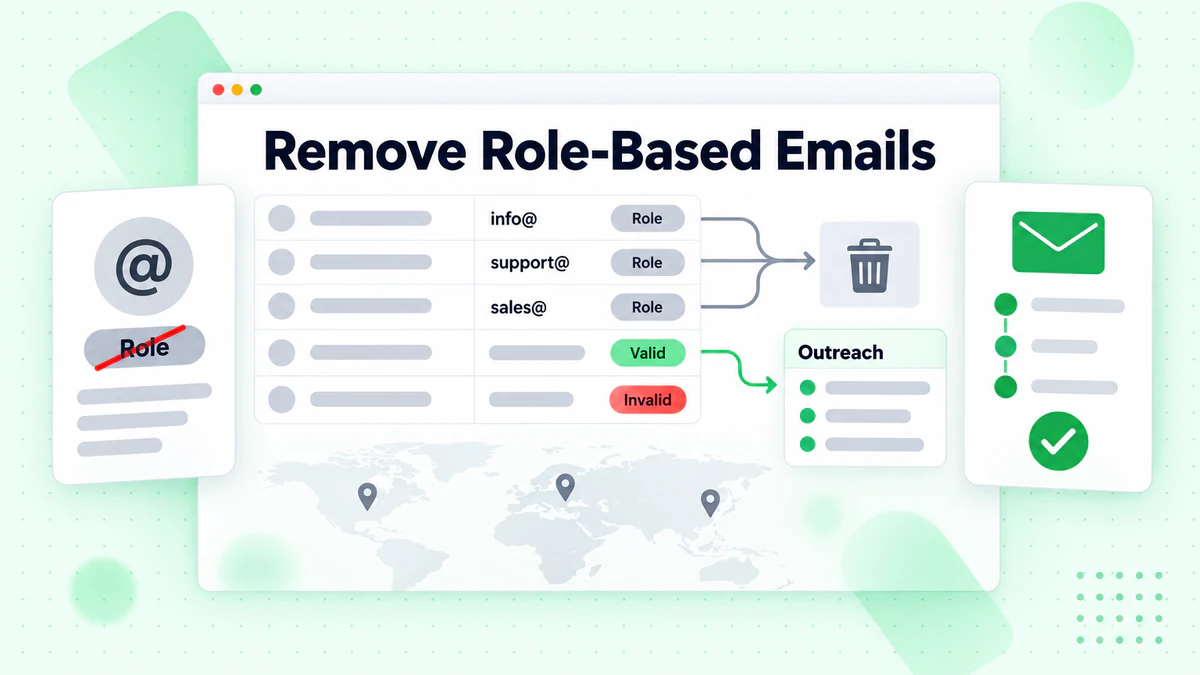
Role accounts also create a targeting problem. They may be monitored by several people, but they rarely reveal who the decision-maker is. That makes reply rates and conversion metrics harder to trust, and noisy metrics become a real problem when a business is comparing territory performance across countries.
Why removal usually improves targeting
A B2B SaaS team might find that a large share of its international list is made up of role-based accounts, then decide whether to remove them or handle them separately. The point is not to delete every shared inbox pattern without review. It is to stop treating a general mailbox as if it has the same sales value as a named prospect.
The SMTP-level email validation workflow helps because it flags those records before they enter the sequence. Once they are identified, sales ops can route them into a separate list, keep a record of which ones engage, and monitor whether a particular source keeps producing them. That source-level view matters more than the title alone, because some channels are far worse at delivering named contacts.
A few practical controls help a lot:
- Review by company type: Some specialized sectors rely more on role inboxes than others.
- Track by source: One lead source may produce far more shared inboxes than another.
- Gate lead scoring: If the address is role-based, it may need a different scoring path.
- Block patterns automatically: CRM workflows can keep these records out of the main pipeline.
The Email Validation API can also sit inside signup and lead capture workflows, so bad records are screened before they reach the CRM. That matters for international forms because the earliest touchpoint is often the cheapest place to correct a typo, reject a disposable domain, or stop a low-quality lead before it consumes rep time. For teams that need help with outbound execution, the Lead Printer B2B outbound service can complement that verification workflow.
Removing role accounts does not make the list smaller for its own sake. It makes the remaining records more likely to be real buyers, and that is what improves field productivity.
6. Auditing and Cleaning CRM Data Across Multiple International Sales Systems and Territories
Most international sales organizations do not have one clean database. They have several systems, regional teams, inconsistent import habits, and older records that never got reviewed after a territory shift. Once that happens, CRM hygiene stops being a one-time project and becomes a recurring operating task.
That matters because global sales managers still have to report on pipeline, conversion, and territory health across markets with different levels of process maturity. Clean records are what make those reports usable. If the underlying account and contact data is messy, the forecast may look active while the actual pipeline is full of duplicates, stale contacts, and misassigned territory records.
Audit, clean, then standardize
The most effective pattern is to schedule audits on a regular cadence and clean by territory, not just by one giant global file. That lets ops teams identify whether a region's problems are caused by sourcing, imports, duplicates, or outdated contact records. Bulk cleaning workflows help here because they are built for CSV uploads, live progress tracking, and export filters.
The point of audit work goes beyond making the CRM look tidy. It makes the pipeline believable. If one territory keeps importing invalid or duplicate records, the manager needs to see that pattern early, because the problem will show up later in rep activity, forecast accuracy, and handoff quality.
For teams using Dynamics 365 Sales CRM, the same logic applies. Territory rules, ownership fields, duplicate checks, and field validation need to match how the team sells across regions. If those controls are too loose, sales managers spend time untangling records instead of coaching the field.
A practical cleanup cycle usually includes deduping contacts, standardizing country and region fields, reviewing lead sources, and checking whether stale records still belong in active segments. It also helps to assign ownership for cleanup by market, since local teams often know which records are outdated, duplicated, or imported from the wrong source. Once the CRM becomes easier to trust, sales leaders can compare territories on real performance instead of data quality noise.
6. Auditing and Cleaning CRM Data Across Multiple International Sales Systems and Territories
Most international sales organizations don't have one clean database. They have multiple systems, regional teams, inconsistent import habits, and old records that were never reviewed after a territory shift. Once that happens, CRM hygiene stops being a one-time project and becomes a recurring operating task.
That's especially important because global sales managers are expected to report on pipeline, conversion, and territory health across markets with different levels of process maturity. The underlying sales profession still shows large replacement demand even with slow growth, and that means managers need systems that keep data usable at scale, not just a few reps with good habits (BLS projections summarized here).
Audit, clean, then standardize
The most effective pattern is to schedule audits on a regular cadence and clean by territory, not just by one giant global file. That lets ops teams identify whether a region's problems are caused by sourcing, imports, duplicates, or outdated contact records. BillionVerify's bulk cleaning workflow supports that kind of cleanup because it's built for CSV uploads, live progress tracking, and export filters.
The point of audit work is not to make the CRM look tidy. It's to make the pipeline believable. If one territory keeps importing invalid or duplicate records, the manager needs to know that before forecast reviews start.
A clean audit process usually includes:
- Regional exports: Break the database down by territory before cleaning.
- Duplicate removal: Stop the same contact from inflating pipeline counts.
- Source review: Track which import paths produce the weakest records.
- Post-clean validation: Check whether re-engaged contacts perform better after cleanup.
For teams using Dynamics 365 Sales CRM, the same logic applies. The software is only as useful as the data entering it, and international programs can't afford to build plans on records that were never valid in the first place.
7. Supporting Multi-Language and Multi-Region Sales Sequences with Verified Contact Data
Localized outreach fails when the list beneath it is untrustworthy. That's the hidden cost in multi-language selling, because teams often spend time perfecting translation, tone, and region-specific messaging while skipping the easier and more important question, are the contacts deliverable?
International sales roles increasingly depend on coordinated sequences across languages, markets, and channels. Digital prospecting is a bigger part of the mix too, with one industry analysis reporting online sales rising from 19.3% of total sales in 2023 to 25.5% in 2024, while trade-show participation fell from 46 to 42.4 events annually (Apollo industry analysis). That shift makes clean, segmented contact data more important than broad event-driven coverage.
Localization only works when the list is clean
The practical sequence design is simple. Verify by language and region before launch, then map those verified contacts into language-specific cadences. That helps teams route German-language contacts into German sequences, French contacts into French sequences, and so on, without guessing which records are usable.
A global staffing firm or software team can do this at scale by standardizing list quality across territories first. Once the data is reliable, the regional team can focus on message quality, compliance checks, and follow-up timing. That matters because the best translated sequence still fails if the domain is bad or the inbox never existed.
Clean data gives localization a chance to work.
This is also where compliance discipline fits naturally. Regional teams should fold GDPR and CASL checks into their verification workflows so they're not only sending to valid addresses, but also managing contact rules correctly for each market. The goal is a repeatable system, verified contacts, language-aware routing, and outreach that respects both deliverability and regulation.
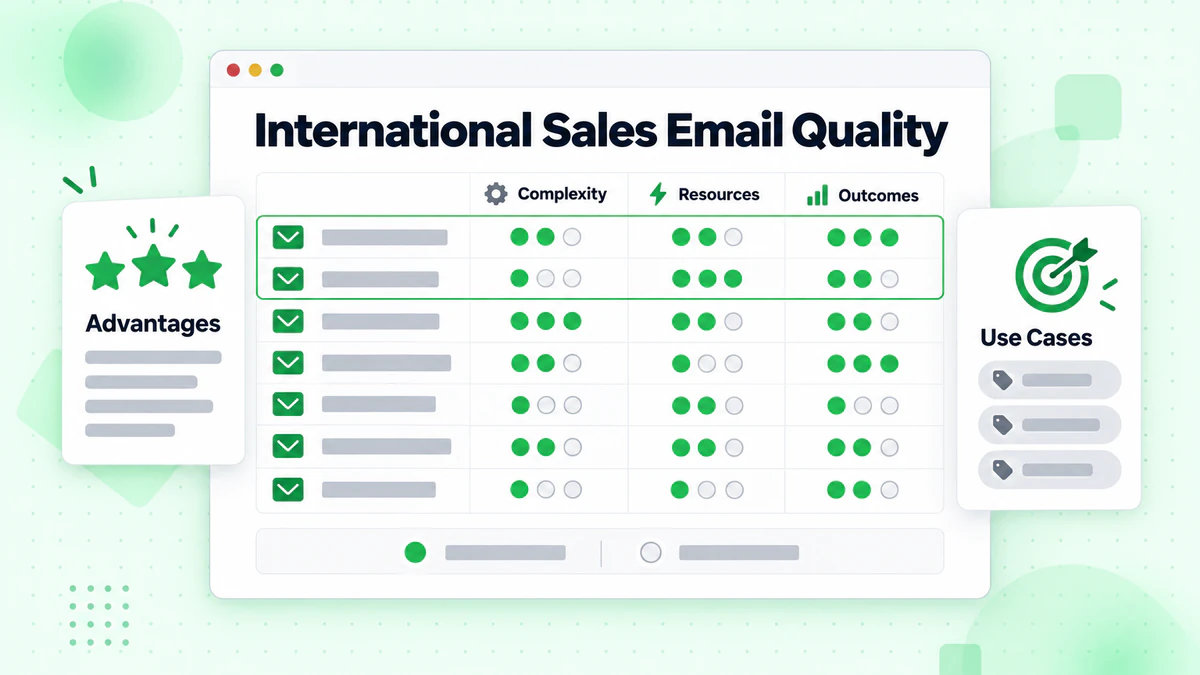
7-Point International Sales Email Quality Comparison
| Item | 🔄 Implementation complexity | ⚡ Resource requirements | 📊 Expected outcomes | 💡 Ideal use cases | ⭐ Key advantages |
|---|---|---|---|---|---|
| Validating Email Lists & Detecting Disposable Addresses Across International Markets | Medium 🔄, regional rules + SMTP checks | Moderate ⚡, bulk API, localization support | High 📊/⭐, sub‑1% bounces; fewer disposables | Geo‑diverse prospect lists; bulk cleaning before campaigns | Detects regional disposables; supports non‑ASCII domains; CRM-ready JSON |
| Reducing Bounce Rates and Protecting Sender Reputation in Multi-Region Email Campaigns | Low‑Medium 🔄, pre‑send workflows & scoring | Moderate ⚡, ESP integrations, scheduled checks | Very High 📊/⭐, sustained sender reputation; sub‑1% bounces | Pre‑campaign validation for high‑volume sends | Deliverability scoring; prevents ISP blocks; ESP integrations |
| Segmenting International Prospect Lists by Email Quality and Deliverability Confidence | Medium 🔄, define thresholds & CRM mapping | Low‑Moderate ⚡, scoring engine + export | High 📊/⭐, prioritized outreach; reduced risk | Tiered cadences; prioritize high‑confidence prospects | Data‑driven segmentation; optimizes sending resources |
| Detecting and Removing Role-Based Email Accounts from International Outreach Lists | Low 🔄, pattern rules & filters | Low ⚡, rule sets + bulk removal | Moderate‑High 📊/⭐, higher reply rates; cleaner CRM | B2B lists with many generic addresses; qualification gates | Removes low‑intent role accounts; improves engagement metrics |
| Enabling Real-Time Email Verification in International Signup and Lead Capture Workflows | Medium‑High 🔄, UI/webhook integration & rate control | High ⚡, sub‑500ms API, dev work, rate management | Very High 📊/⭐, blocks fakes at capture; fewer downstream cleans | Demo/trial signup forms, checkout, high‑value lead capture | Instant SMTP validation; typo feedback; blocks disposable signups |
| Auditing and Cleaning CRM Data Across Multiple International Sales Systems and Territories | High 🔄, cross‑system audits & governance | High ⚡, large CSVs, integrations, stakeholder planning | Very High 📊/⭐, standardized quality; major bounce reduction | Enterprise CRM cleanups, mergers, periodic audits | Comprehensive audit reports; dedupe; filterable exports for re‑import |
| Supporting Multi-Language and Multi-Region Sales Sequences with Verified Contact Data | Medium 🔄, language mapping & regional rules | Moderate ⚡, localization parsing + CRM exports | High 📊/⭐, improved deliverability for localized campaigns | Localized outreach; multilingual sequence rollouts | Language‑aware validation; compliance support; consistent list quality |
Unifying Your Global Sales Efforts with Clean Data
Expanding into international markets is a strategic imperative, but execution decides whether it pays off. The best international sales roles are built on more than cultural awareness and persistence, they're built on clean, verified, segmented data that lets reps reach the right people, protect sender reputation, and keep CRM reporting honest across territories. That's why data hygiene should sit upstream of every global sequence, not downstream as cleanup work after things go wrong.
The broader labor picture reinforces the point. Even with modest projected growth in some sales categories, the market still shows structural demand and high replacement needs, which means teams need operating systems that can scale across turnover, territory changes, and channel shifts (BLS projections summarized here). In that environment, a stack that includes verification, segmentation, CRM cleanup, and real-time capture controls isn't a nice-to-have. It's how you keep international motion efficient.
BillionVerify fits into that workflow as one relevant option for teams that want to solve the data problem directly. It supports bulk cleaning, real-time API checks, disposable detection, role-account filtering, and deliverability-focused segmentation, which makes it practical for sales, marketing, and RevOps teams that work across regions. If your current process still treats bad email data as a minor issue, the fastest way to improve global performance is to audit the list, fix the source, and make verification part of the standard workflow.
If your team is working across markets, start by cleaning the lists that feed your sequences and the forms that create new leads. Visit BillionVerify to verify addresses in bulk, add real-time checks to capture forms, and build a cleaner foundation for international outreach that's easier to scale and easier to trust.