



Most marketers believe email deliverability problems stem solely from subject lines or content quality. The truth is that poor email validation practices silently destroy sender reputation and campaign ROI before messages even reach inboxes. Enterprise email validation transforms marketing outcomes by verifying addresses before you send, protecting your domain reputation, and ensuring your carefully crafted campaigns reach real people. This guide reveals how enterprise validation works, which methods deliver the best results, and how to implement validation strategically across your marketing workflows to maximize deliverability and engagement.
Key takeaways
| Point | Details |
|---|---|
| Validation reduces bounces dramatically | Enterprise email validation can cut bounce rates by up to 85%, directly protecting sender reputation and inbox placement. |
| Two methods serve different purposes | Real-time validation secures new signups instantly while bulk validation cleans existing lists periodically for optimal results. |
| Strategic implementation maximizes ROI | Integrating validation at signup, pre-send, and during regular list maintenance creates sustainable deliverability improvements. |
| Reputation protection requires consistency | Continuous validation prevents spam trap hits and blacklisting that can take months to recover from. |
Understanding enterprise email validation and its benefits
Enterprise email validation is a sophisticated process that verifies email addresses through multiple technical checks before you add them to your marketing database or send campaigns. Unlike basic syntax checkers, enterprise validation examines syntax, domain records, mailbox existence, and reputation signals to identify invalid, risky, or temporary addresses that damage deliverability.
The validation process works in layers. First, syntax validation confirms addresses follow proper formatting rules. Next, domain validation checks DNS records to verify the domain exists and accepts mail. Mailbox verification then connects to mail servers to confirm the specific address is active without sending actual emails. Finally, advanced validation identifies spam traps, disposable addresses, role-based accounts, and catch-all domains that accept all messages but rarely engage.
These comprehensive checks deliver measurable benefits for email marketing operations:
- Improved deliverability rates by removing addresses that cause hard bounces
- Protected sender reputation through spam trap and complainer detection
- Higher engagement metrics since validated lists contain real, active recipients
- Reduced infrastructure costs by eliminating wasted sends to invalid addresses
- Better data quality for segmentation and personalization strategies
Pro Tip: Validation quality varies significantly between providers. Look for services that perform real-time SMTP verification rather than relying solely on historical data, as mailbox status changes constantly.
For enterprises sending millions of emails monthly, validation becomes essential infrastructure rather than optional hygiene. A single spam trap hit can land your domain on blacklists that block all future campaigns. High bounce rates signal to inbox providers that you practice poor list management, triggering automatic filtering to spam folders. Validation prevents these reputation disasters before they occur.
The return on investment appears quickly. When you eliminate 10 to 15 percent of invalid addresses from a 500,000 contact database, you save thousands in sending costs while simultaneously improving deliverability for the remaining valid contacts. Your engagement rates rise because you're reaching real people, and your sender score improves with each campaign that avoids bounces and complaints.
Comparing real-time and bulk email validation methods
Enterprise email validation operates through two distinct approaches that serve complementary purposes in your marketing technology stack. Real-time validation checks addresses instantly as users enter them, typically during signup forms, account creation, or CRM data entry. Bulk validation processes entire lists in batches, ideal for cleaning existing databases or preparing campaign segments.
Real-time validation integrates directly into web forms and applications through API calls. When someone submits an email address, the validation service checks it within milliseconds and returns a status before form submission completes. This prevents bad data from entering your system in the first place, maintaining list quality from the source. The method works perfectly for high-value signups where you want to ensure every new contact is legitimate.
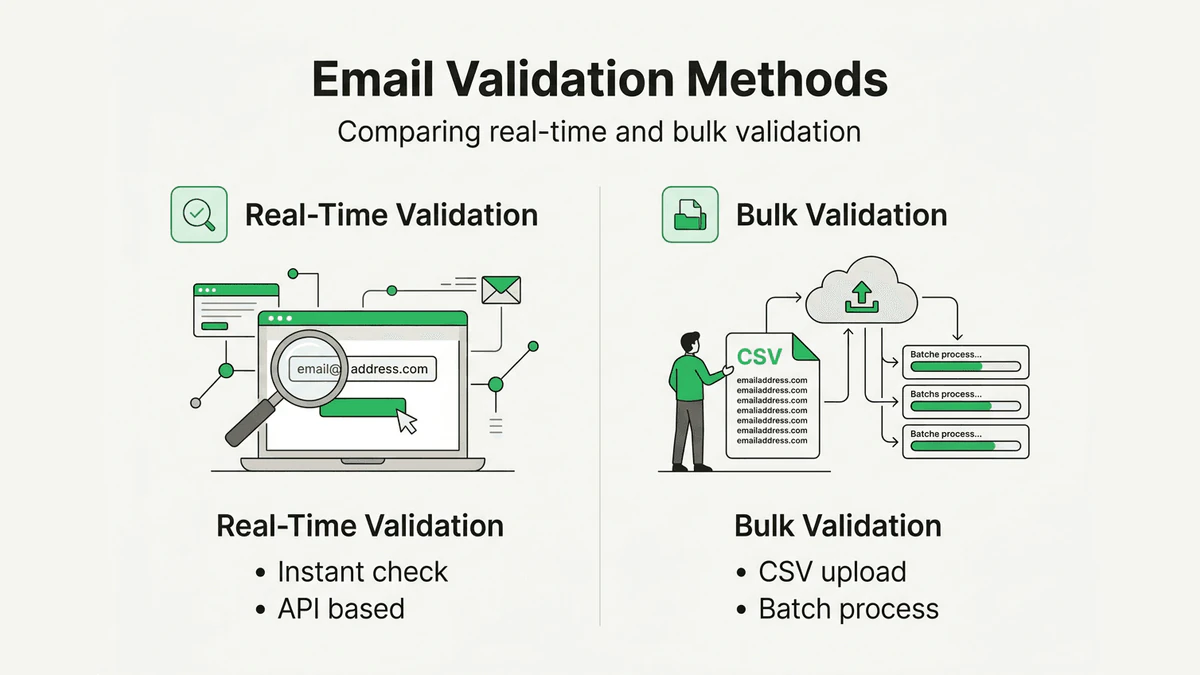
Bulk validation handles large volumes differently. You upload a CSV file containing thousands or millions of addresses, and the service processes them asynchronously, returning results within minutes to hours depending on list size. This approach suits periodic list cleaning, pre-campaign verification, or migration projects where you need to validate historical data accumulated over months or years.
| Feature | Real-Time Validation | Bulk Validation | | --- | --- | | Speed per address | Under 200 milliseconds | 1 to 5 seconds average | | Best use case | Signup forms and live data entry | Existing list cleaning and campaign prep | | Cost structure | Per API call, higher per-address cost | Volume pricing, lower per-address cost | | Integration complexity | Requires API implementation | Simple file upload process | | Data freshness | Validates current status instantly | Results valid for 30 to 90 days |
The strategic combination of both methods creates the most effective validation program. Use real-time validation to maintain quality for all new acquisitions, preventing invalid addresses from polluting your database. Deploy bulk validation quarterly or before major campaigns to catch addresses that degraded since initial validation, as roughly 25 to 30 percent of email addresses become invalid annually through job changes, domain expiration, and mailbox abandonment.
Pro Tip: Set different validation strictness levels for different use cases. Apply aggressive filtering for cold outreach lists but use moderate settings for customer databases where false positives could block legitimate contacts.
Cost considerations matter at enterprise scale. Real-time validation typically costs more per address but saves money by preventing bad data entry and the downstream costs of storing, segmenting, and attempting to send to invalid contacts. Bulk validation offers better economics for large list cleaning but requires periodic revalidation to maintain accuracy.
Accuracy differences exist between methods too. Real-time validation checks current mailbox status at the exact moment of verification, providing the most accurate snapshot. Bulk validation may take hours to process large files, during which some mailbox statuses could change, though this affects only a tiny fraction of results. Both methods should achieve 95 percent or higher accuracy when using quality providers.
How enterprise email validation reduces bounce rates and protects reputation
Email bounces fall into two categories with vastly different implications for your sender reputation. Hard bounces occur when addresses are permanently invalid due to non-existent domains, deleted mailboxes, or syntax errors. Soft bounces happen when temporary issues like full inboxes or server problems prevent delivery. Effective validation can reduce overall bounce rates by up to 85 percent by identifying and removing hard bounce risks before you send.
High bounce rates trigger algorithmic penalties from inbox providers that compound over time. When your bounce rate exceeds 2 to 3 percent, services like Gmail and Outlook interpret this as evidence of poor list hygiene or purchased lists. They respond by filtering more of your mail to spam folders, even for valid recipients. Sustained high bounce rates can result in complete blocking, where inbox providers reject all mail from your domain.

The reputation damage extends beyond immediate campaigns. Email service providers track sender behavior over weeks and months, building reputation scores that determine inbox placement. A single campaign with a 10 percent bounce rate can depress your sender score for 30 days or longer, affecting every subsequent send. Recovery requires consistent good behavior over extended periods, making prevention through validation far more cost effective than remediation.
Validation protects reputation through multiple detection mechanisms:
- Syntax verification catches formatting errors before they cause immediate hard bounces
- Domain validation identifies non-existent or expired domains that always bounce
- Mailbox verification confirms individual addresses exist and accept mail
- Spam trap detection flags honeypot addresses used to identify spammers
- Disposable email identification removes temporary addresses that never engage
- Catch-all detection identifies domains that accept all addresses but may not deliver
Maintaining bounce rates below 2 percent should be a non-negotiable standard for enterprise email programs. Validation is the only reliable method to achieve this consistently across large, dynamic contact databases.
Pro Tip: Monitor validation results over time to identify patterns. If you notice increasing invalid rates from specific acquisition sources, investigate those channels for quality issues before they contaminate your entire database.
Spam traps represent the most dangerous validation failure. These are email addresses specifically created or recycled by anti-spam organizations to catch senders with poor list practices. Hitting spam traps results in immediate blacklisting that can take months to resolve and requires proving you've fixed your processes. Quality validation services maintain proprietary spam trap databases and flag these addresses before you send.
Disposable email addresses create a different problem. Services like Mailinator or 10MinuteMail provide temporary addresses that users abandon immediately after signup. These addresses technically exist and won't hard bounce, but they never engage with your content and skew your metrics. Validation identifies disposable domains and patterns, allowing you to block them or require alternative addresses during signup.
Best practices for integrating enterprise email validation into marketing workflows
Successful validation requires strategic implementation across multiple touchpoints in your marketing operations. Integrating validation at signup, pre-send, and during regular maintenance creates comprehensive protection that maintains list quality continuously rather than through periodic emergency cleanups.
Follow this implementation framework to build validation into your workflows:
- Deploy real-time validation on all email capture forms including website signups, event registrations, content downloads, and account creation flows
- Configure validation APIs to reject obvious invalid addresses immediately while flagging risky addresses for manual review
- Implement bulk validation as a required step in your campaign preparation checklist, running it 24 to 48 hours before major sends
- Schedule quarterly full database validation to catch degraded addresses and maintain overall list health
- Create automated workflows that suppress or remove addresses flagged as invalid, disposable, or high-risk after validation
- Monitor validation results in your analytics dashboard alongside standard email metrics to identify trends and quality issues
Choosing the right validation provider matters enormously at enterprise scale. Evaluate providers based on verification accuracy, processing speed, API reliability, integration options with your existing marketing stack, and transparent pricing that scales with your volume. Request test validations on sample data to compare results between providers, as accuracy varies significantly.
Integration capabilities determine how seamlessly validation fits into existing processes. The best enterprise solutions offer native integrations with major email service providers, marketing automation platforms, and CRMs, allowing validation to run automatically without manual file exports and imports. API access enables custom integrations for unique workflows or proprietary systems.
Pro Tip: Automate as much validation as possible to eliminate human error and ensure consistency. Set up triggers that automatically validate new imports, run pre-send checks, and flag degraded addresses based on engagement signals.
Monitoring validation performance reveals insights beyond simple pass or fail rates. Track the percentage of invalid addresses by acquisition source to identify quality problems with specific lead generation channels or partners. Analyze validation results by domain to spot patterns like high disposable email usage from certain geographic regions or demographic segments. Use these insights to refine targeting and acquisition strategies.
Validation strategies should evolve based on your specific use cases and risk tolerance. E-commerce companies might apply stricter validation to promotional lists while using moderate settings for transactional emails to avoid blocking legitimate customer communications. B2B marketers often validate more aggressively to protect sender reputation given lower volume and higher value per contact.
Cost optimization comes from right-sizing your validation approach. Not every address requires validation before every send. Prioritize validation for cold lists, purchased data, and contacts older than 90 days. Recently validated active subscribers need less frequent checking. Balance thoroughness against processing costs and time constraints to find the optimal validation cadence for each segment.
Discover BillionVerify's AI-first email verification solutions
Transforming your email deliverability requires validation technology that matches enterprise scale and sophistication. BillionVerify provides AI-powered email verification that processes millions of addresses monthly with industry-leading accuracy, helping marketing teams eliminate bounces, protect sender reputation, and maximize campaign ROI through intelligent validation.
Our multi-layer verification technology goes beyond basic checks to identify disposable emails, spam traps, role-based addresses, and risky domains that other services miss. Real-time API validation integrates seamlessly with your existing marketing stack, while bulk processing handles large list cleaning projects efficiently.
BillionVerify supports native integration with over 20 major email marketing platforms and CRMs, making implementation straightforward regardless of your technology environment. Our enterprise plans scale to handle your highest volume periods while maintaining consistent sub-200 millisecond response times that keep forms fast and user experience smooth.
Frequently asked questions
What is enterprise email validation and why is it important?
Enterprise email validation is a comprehensive verification process that checks email addresses through multiple technical layers including syntax, domain records, mailbox existence, and reputation signals before adding them to marketing databases or sending campaigns. It's critical because invalid addresses cause bounce rates that damage sender reputation, trigger spam filtering, and waste marketing budgets on contacts who never receive your messages. For enterprises sending large volumes, even small improvements in list quality translate to significant deliverability gains and cost savings.
How often should enterprises validate their email lists?
Validate new addresses in real-time as they enter your system through signup forms and data imports. Run bulk validation on your entire database quarterly to catch addresses that degraded since initial verification, as 25 to 30 percent of addresses become invalid annually. Before major campaigns or seasonal pushes, validate your target segments 24 to 48 hours prior to sending. Lists that remain inactive for 6 months or longer require validation before reactivation to avoid reputation damage from accumulated invalid contacts.
Can email validation improve sender reputation immediately?
Validation reduces bounce rates within your first validated campaign, typically within 24 hours of implementation. However, sender reputation improvements accumulate gradually as inbox providers observe consistent good sending behavior over weeks. Expect noticeable deliverability improvements within 2 to 4 weeks of maintaining low bounce rates through validation. Full reputation recovery from previous damage can take 60 to 90 days of sustained quality sending, making early validation adoption crucial for long-term success.
What are the differences between real-time and bulk validation for enterprises?
Real-time validation checks addresses instantly during form submission or data entry through API calls, preventing invalid contacts from entering your database. It's ideal for maintaining quality at the source but costs more per address. Bulk validation processes large lists asynchronously through file uploads, offering better economics for cleaning existing databases or preparing campaign segments. Enterprises achieve optimal results by combining both methods, using real-time validation for new acquisitions and bulk validation for periodic database maintenance and pre-campaign verification.