



Proton Mail is an encrypted email service from Switzerland. It stores your messages so that even its own staff cannot read them, and it earns its money from subscribers instead of ads. This Proton Mail review explains what the product is, who owns it, how it works and where its limits lie.
We wrote it from Proton's own pages and help center, read in November 2026. We did not run a hands-on test and do not quote user ratings. We are not affiliated with Proton. BillionVerify is an email verification service. Comparing providers? See the side-by-side BillionVerify vs Proofy comparison.
Key facts (checked November 2026):
- Per the about page, a Geneva foundation is the primary shareholder of the Swiss company behind the product, which reports no venture capital investors.
- According to the encryption guide, every inbox message is stored with zero-access protection, but subject lines stay outside end-to-end encryption.
- Per the pricing page, a free account has 1 GB, one address and a limit of 150 sent messages per day.
- According to the tracker protection guide, Proton removes known spy pixels from messages without end-to-end encryption.
- Per the security page, all Proton Mail code is open source and has been audited by outside experts.
- BillionVerify's account gives 20 free credits on each day you use it, with no card needed, for checking addresses before a campaign.
What Is Proton Mail?
Proton Mail is the email product of Proton, a company that also sells a calendar, cloud storage, a VPN, a password manager and a wallet. The product runs on the web, in apps for iOS and Android, and in a desktop app. It stands out for its Swiss base, its encryption by default and its refusal to read mail for ads. Who owns Proton Mail is answered further below.
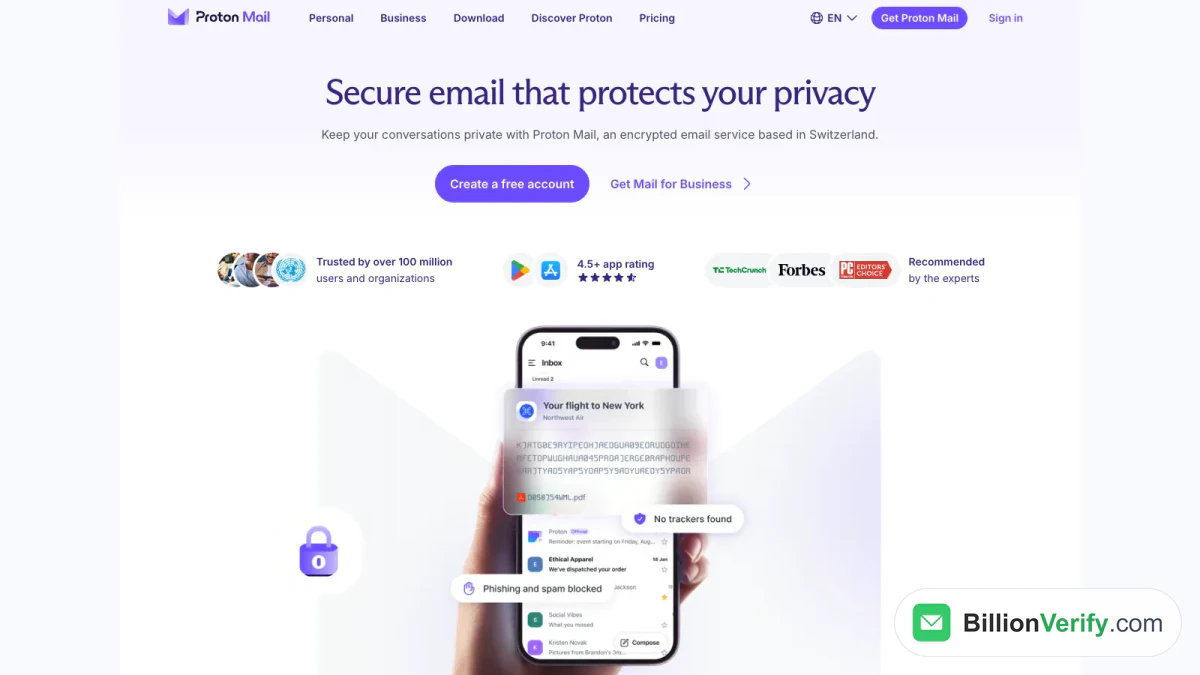
Screenshot: the Proton Mail homepage, which calls the product encrypted email based in Switzerland.
The homepage says over 100 million users and organizations trust the product, a figure that comes from Proton and that we could not check. It also states that Gmail and Microsoft Outlook can technically scan an inbox, while Proton Mail never sees yours, on any plan, because subscribers fund it.
How It Began
Proton says it started in Switzerland in 2014, when scientists who met at CERN built a mailbox where privacy is the default. A public crowdfunding campaign paid for the launch: more than 10,000 people gave over $500,000. That origin shapes the pitch of a privacy product paid for by its users.
What the Free Plan Offers
Anyone can open a free account. The pricing page lists 1 GB of storage, one encrypted address and a daily cap of 150 messages, together with three folders, three labels and a single filter. New free users begin with 500 MB and reach 1 GB through a short checklist in their first 18 days. Paid plans lift most limits, and our Proton Mail pricing guide covers each tier.
Ownership: Proton AG and the Proton Foundation
The question matters because privacy is the product, and anyone judging Proton Mail security should first ask who owns Proton Mail, since ownership decides who could pressure the company. The about page answers it in two sentences. Proton AG operates the services, and its primary shareholder is the non-profit Proton Foundation in Geneva.
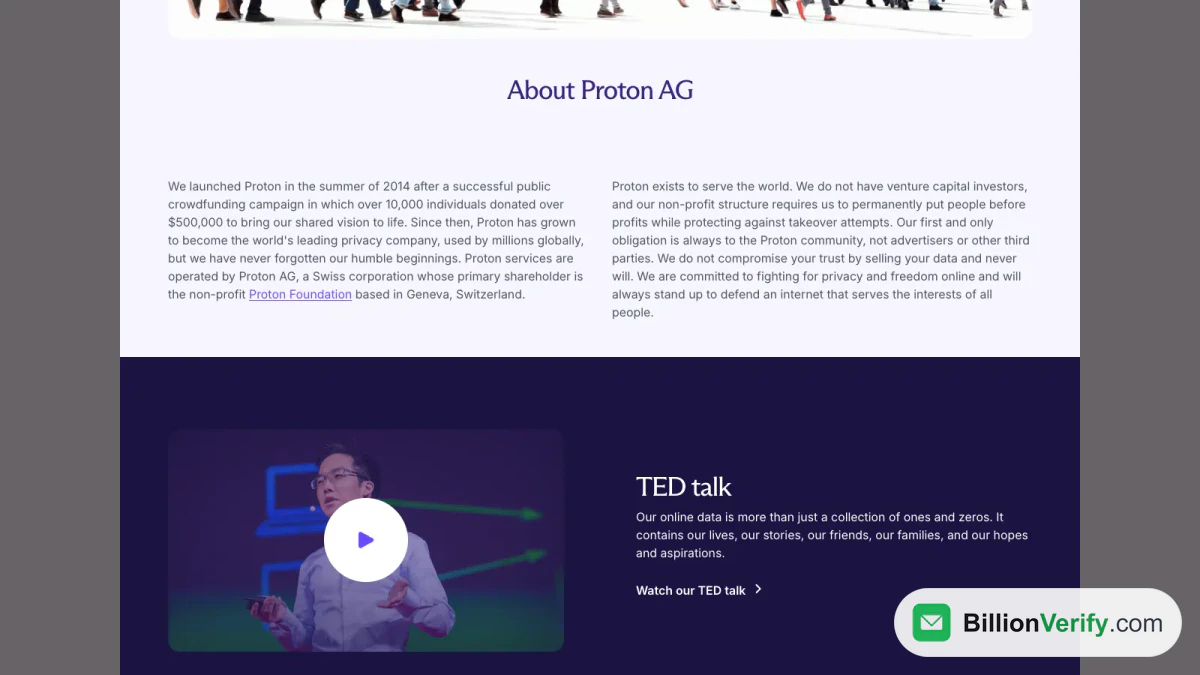
Screenshot: the section on the company page that says who operates Proton and who holds its shares.
The same page reports that no venture capital investors hold shares. It presents the foundation structure as a guard against takeovers, meant to keep people ahead of profit. These are Proton's statements about itself, and a review cannot confirm them. They do show how Proton chooses to answer the ownership question.
How Proton Mail Works
Two ideas carry the design of Proton Mail security: end-to-end encryption and zero-access encryption. Together they decide what the operator can see.
Zero-Access Encryption
Email arriving in your inbox is locked on the servers with your public key, so Proton has no technical ability to open it. Bodies and attachments are kept this way, including messages from non-Proton senders.
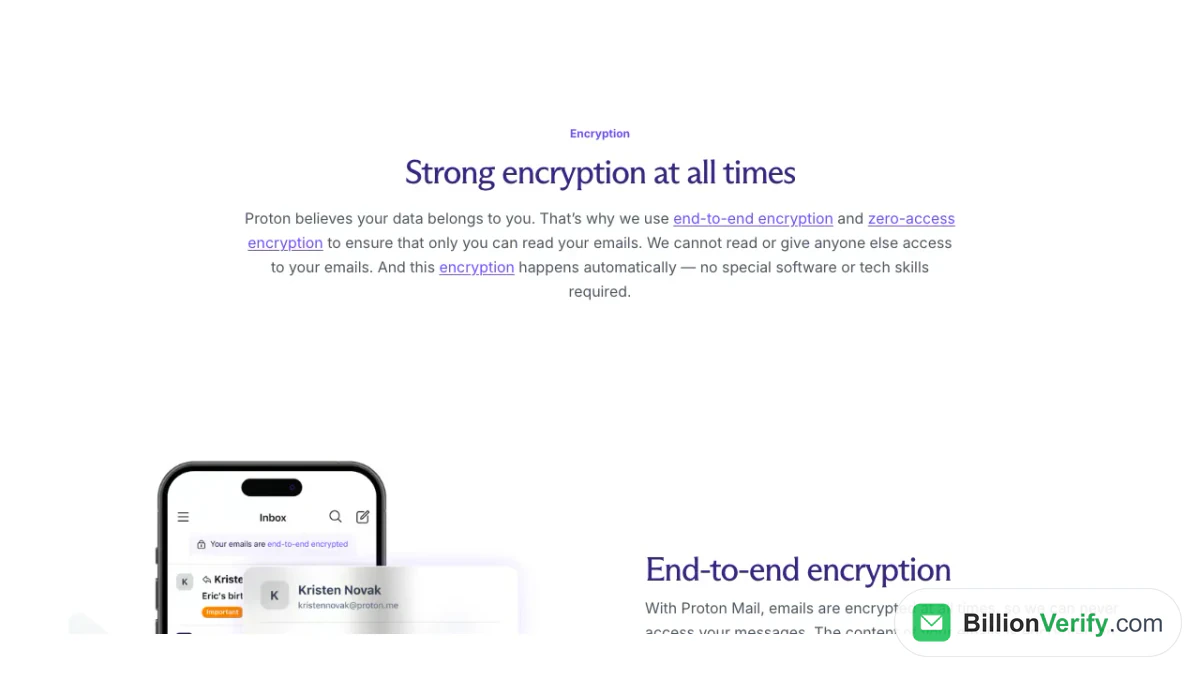
Screenshot: the encryption section of the security page.
End-to-End Encryption in Transit
Protection on the way depends on the other side. Between two Proton addresses, messages always use end-to-end encryption. From Proton Mail to an outside address, the message travels over TLS, which most providers accept, but it arrives without that extra layer, so the recipient's provider may be able to read it. From an outside address to Proton Mail, the message arrives over TLS and is then stored in locked form, yet the sender's provider may keep a copy.
To reach an outside address with true end-to-end encryption, use a password-protected email. You set a phrase in the composer, and the message stays closed to both Proton and the recipient's provider until the reader enters it. Proton Mail also supports PGP, which locks mail to the recipient's public key.
The Subject Line Exception
The subject line is the catch. The firm follows the OpenPGP standard, in which the subject sits in a header packet that stays open. It adds that reading one would take a court order approved by a Swiss judge, and it suggests a generic subject for sensitive mail. Many summaries leave this out.
Is Proton Mail Safe?
Safe against what? The fair answer separates three kinds of risk. Proton Mail security is documented for each, and this part lists it. So the real question, Is Proton Mail safe for my use, depends on which risk you mean.
Proton Mail Security Features
The security page lists several layers. Two-factor login works with authenticator apps and with hardware keys that follow the U2F and FIDO2 standards. Sentinel is an optional program in which analysts and software watch enrolled accounts day and night for takeover attempts, and the pricing page shows it on Proton Unlimited only. PhishGuard flags spoofed senders. Link protection shows the full target and asks you to confirm before it opens. It also supports SPF, DKIM and DMARC for custom domains.
On the hardware side, Proton says it owns and controls its servers in several Swiss locations, with biometric entry and fully encrypted disks, so your data never goes to the cloud. Key Transparency checks the public keys of your contacts to guard against man-in-the-middle attacks.
Open Source and Audits
According to Proton, every app that reaches your inbox is open source and every line of Proton Mail code was audited by independent experts, with results on its website. Open code lets outsiders hunt for flaws. We did not read the audits, so take this as Proton's statement.
Where the Limits Are
Strong encryption does not shield you from your own habits. A lost login has no remedy without a recovery method, because Proton keeps no copy, and our Proton Mail login guide shows which methods to set up. Phishing still works on people, so link protection helps but does not replace attention. And a message to a non-Proton recipient stays only as private as that recipient's provider. In short, Proton Mail safe use means trusting it against a curious operator, not against a skipped recovery step.
Privacy in Daily Use
Privacy also covers what senders learn about you, and Proton Mail security extends to that side too. Tracker protection strips known tracking pixels from every message that is not end-to-end encrypted. That hides your IP address, your device and the exact minute you opened the mail. Remote images load through a proxy with a generic address, and the web app also cleans tracking parameters from links. The feature is on by default and can be switched off per device.
For people who send mail, this has a consequence. An open rate is a weak signal for Proton readers, so lean on clicks and replies instead. We return to this below.
Addresses That Hide Yours
A hide-my-email alias is a random address that forwards to your mailbox, so a website never sees the real one. You can disable it at any time. The free plan and Mail Plus allow ten of them, and Proton Unlimited allows unlimited aliases.
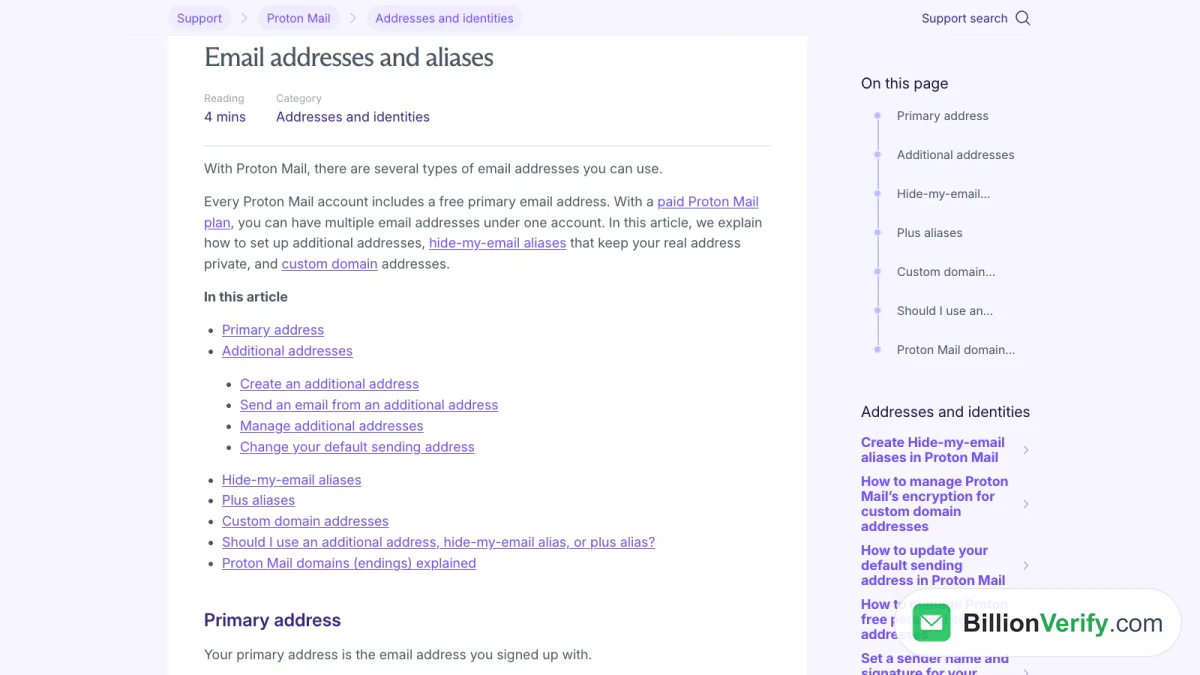
Screenshot: the help article that explains additional addresses, aliases and custom domains.
Features You Will Notice
The comparison table on the pricing page shows the shape of the product. Every plan allows attachments up to 25 MB and includes HTML signatures, password-protected emails and encrypted contact details. Paid plans remove the caps on folders, labels, filters and daily messages, and they add contact groups, auto-reply, a catch-all address, automatic forwarding, scheduling and snoozing of mail, and a short pm.me address. A writing assistant called Scribe is sold as an add-on with a trial.
The calendar is part of the bundle. Free users get three personal calendars, and the paid personal plans list twenty-five, with invitations and sharing. Drive storage, the VPN, the password manager and the other services sit around the mail product, and the free plan gives only basic access to them. Proton Unlimited bundles premium access to all of them, along with the largest mailbox at 500 GB.
Day to day, the web app feels like any other webmail, which Proton presents as a goal: the encryption should happen without special software or technical skill. The phone apps and the desktop app follow the same model, and the Bridge brings the mailbox into programs such as Outlook, Thunderbird and Apple Mail for paying users.
Limits and Trade-Offs
Every provider has costs, and this Proton Mail review lists the documented ones that matter to most readers:
- The free tier stays small: one address, a handful of folders and labels, and a send cap per day.
- No POP3 access exists, and Outlook-style email programs connect through Bridge, which needs a subscription.
- Free users get the desktop app only as a 14-day trial.
- Subject lines stay readable to the operator, as explained above.
- Mail sent to outside recipients is protected in transit only, unless you pick the password route or PGP.
- Recovery is your job, since a lost login cannot be reset by support.
Switching in is built in. Easy Switch imports email, calendars and contacts from Gmail, Yahoo, Outlook and any provider with IMAP, and it can run two imports at once from different accounts.
Proton Mail Alternatives for German Users
Readers in Germany who wonder who owns Proton Mail often also ask where their email is hosted, and they compare Proton with providers that host in Germany. Our guides cover two of them in the same plain way: the mailbox.org login and the Posteo login. Each has its own price, storage and rules, and we list the facts for each rather than a ranking. For the Gmail side of the comparison, see our Proton Mail vs Gmail guide.
The Short Version of This Proton Mail Review
Proton Mail is a Swiss encrypted email service, run by Proton AG and held mainly by a Geneva foundation. Its design keeps stored mail unreadable to the operator, and it adds end-to-end encryption between Proton users and for password-protected emails. Proton Mail security rests on layers the company documents in this Proton Mail review, from hardware keys to open code, though the audits are the company's claim and we did not read them.
Its limits are just as documented: small free caps, no POP3, a paid Bridge, a readable subject line and a recovery duty that falls on you. Judge it against your own needs. A reader asking Is Proton Mail safe for a given use should weigh the email it protects, not only the provider, and should check who owns Proton Mail once more on the company page.
Emailing Proton Mail Users? Verify Before You Send
You may collect a Proton address in a form or write to Proton users in a campaign. Three facts from this Proton Mail review matter for your email list. Tracker protection means pixels will not report opens, so a flat open rate says little about interest. Hide-my-email aliases forward to a real mailbox but can be switched off by the owner, so a working address can die later. And a single account can hold several addresses, so two rows may be the same person.
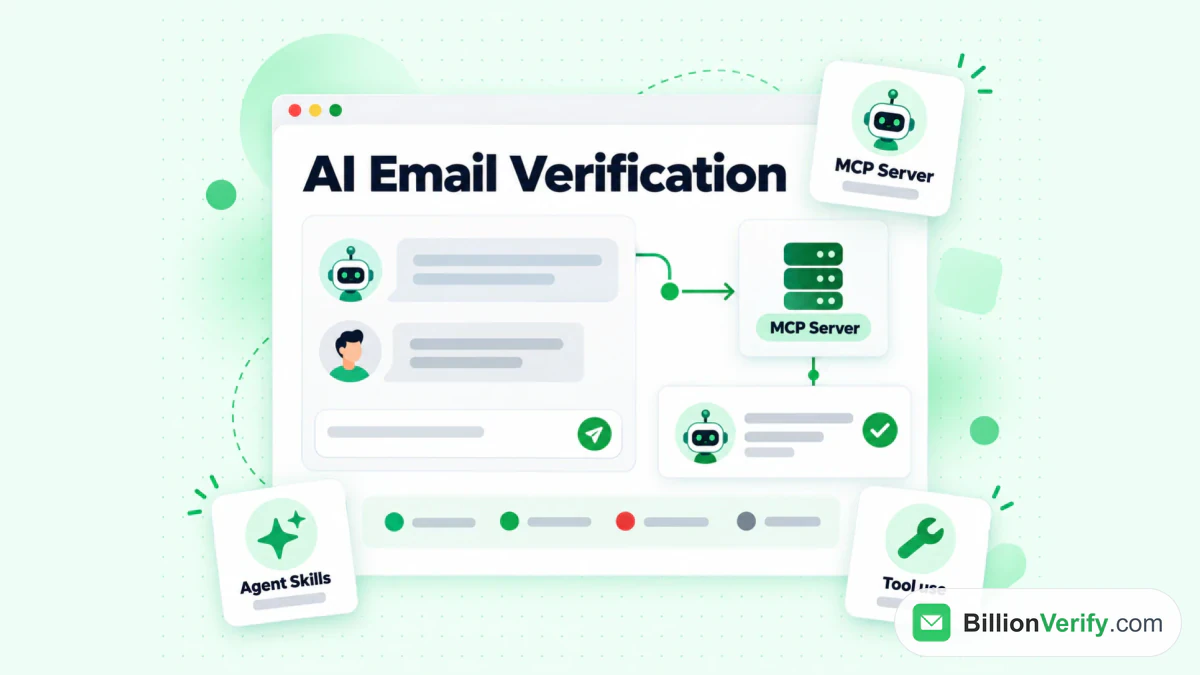
BillionVerify's verification flow checks addresses before they reach your sending domain.
BillionVerify's email verifier works on single entries, and bulk email verification handles whole lists. What to know:
- valid and invalid results cost 1 credit each, and unknown results are free
- a free re-check is available within 24 hours
- catch-all entries get their own label and are not counted as valid
- the free allowance is 20 credits per day of use, up to 600 a month, and credits never expire
- our servers are in France (EU), and a DPA can be signed
- you can use a REST API, an MCP server or one of 25+ integrations
We make no claim about how Proton's servers answer checks. If you also collect mobile numbers, our phone number validator shows whether a number fits its country. If a message claims to come from Proton, our reverse email lookup shows what is known about the sender.
FAQs
What is Proton Mail in simple terms?
It is a webmail and app product that locks your stored mail so that its operator cannot read it. A Swiss company runs it, and subscribers pay for it.
Who owns Proton Mail?
A Swiss corporation operates it, with a non-profit foundation in Geneva as primary shareholder. The company says it has no venture capital investors.
Does the service read my email?
The company says it cannot, because of zero-access encryption. Subject lines are the exception, and per the company they are reachable only through a Swiss court order.
Can I send encrypted mail to a Gmail user?
Yes, with a password-protected email or with PGP. Without either, the message is protected in transit by TLS only.
Is the free plan enough?
For a light inbox it can be. The limits are storage, address count, folders, labels, filters and a daily send cap.
How does it stop email tracking?
It removes known tracking pixels from messages lacking that protection and loads remote images through a proxy. Links get stripped of tracking tags in the web app.
Can I use my own domain with Proton Mail?
Yes, on a paid plan. Mail Plus supports one custom domain, and Proton Unlimited supports three.
Is Proton Mail safe from phishing?
Nothing makes phishing impossible. The spoof warning and link protection ask for confirmation, but a convincing fake still needs a careful reader.
Watch: Bulk Email Verification: How to Verify an Email List From a File
Watch: How to Validate a Phone Number: Free Phone Number Validator