



Outdated email lists silently destroy your marketing campaigns. Invalid addresses, dormant subscribers, and role-based emails accumulate over time, driving bounce rates sky high and triggering spam filters. For SaaS and e-commerce marketers, this means wasted budget, damaged sender reputation, and plummeting ROI. This comprehensive guide walks you through proven preparation, execution, and verification strategies to clean your email list and restore high deliverability.
Key takeaways
| Point | Details |
|---|---|
| Poor list hygiene damages deliverability | Unclean lists increase bounce rates and spam complaints, harming sender reputation and inbox placement. |
| Cleaning boosts engagement metrics | Companies with clean lists see 50% higher open rates and 75% better click-through rates. |
| Remove inactive and bounced contacts | Suppressing non-responders and invalid emails protects your sender reputation and reduces wasted spend. |
| Automate ongoing hygiene | Monthly or campaign-based cleaning schedules with automated bounce removal maintain long-term list health. |
| Re-engage before suppression | Re-permissioning campaigns revive dormant subscribers, reducing revenue loss before final removal. |
Understanding the impact of old email lists on deliverability
Email lists naturally degrade over time. People change jobs, abandon old addresses, and lose interest in your content. When you continue mailing these contacts, your campaigns suffer immediate consequences.
Bounce rates climb as invalid addresses accumulate. Poor list hygiene leads to higher bounce rates, spam flags, and wasted email effort. Internet service providers (ISPs) monitor these metrics closely. They interpret repeated bounces as a sign you're not managing your list responsibly.
Spam filters become increasingly aggressive when they detect patterns of sending to inactive or invalid recipients. Your sender reputation takes a hit with each hard bounce. Even one hard bounce per 100 emails can affect your deliverability, pushing future messages into spam folders instead of primary inboxes.
Engagement metrics tell the story clearly:
- Open rates plummet when a large portion of your list consists of dormant contacts
- Click-through rates decline as active subscribers become a smaller percentage of your total list
- Conversion rates suffer when your messages reach fewer engaged readers
- Revenue per email drops as you pay to send messages that never get opened
"Most businesses lose 22.5% of their email database annually due to natural list decay."
This natural attrition means yesterday's healthy list becomes today's deliverability problem without consistent maintenance. Understanding email list hygiene 2026 standards helps you recognize when cleaning becomes urgent. The longer you wait, the more difficult recovery becomes and the higher your costs climb.
Preparing your email list for cleaning
Successful list cleaning starts with thorough preparation. Jumping straight into deletions without planning creates risks of losing valuable data or removing the wrong contacts.
Start by backing up your complete email database. Export your list with all custom fields, tags, and engagement history. Store this backup securely before making any changes. If something goes wrong during cleaning, you can restore your original data.
Next, establish clear criteria for identifying problematic contacts:
- Hard bounces from previous campaigns indicate permanently invalid addresses
- Soft bounces that persist across multiple sends suggest temporary issues becoming permanent
- Role-based emails like info@company.com typically generate low engagement
- Inactive subscribers who haven't opened or clicked in 60-90 days drag down metrics
- Spam trap addresses that ISPs use to identify poor list management practices
Choose your verification tools carefully. Use email verification tools or cold email tools that offer built-in email validation. These platforms scan your list for syntax errors, invalid domains, and known problematic addresses.
Segment your list based on engagement levels before cleaning. This allows targeted approaches:
| Segment | Criteria | Action |
|---|---|---|
| Highly engaged | Opened or clicked in last 30 days | Keep and prioritize |
| Moderately engaged | Opened in last 60-90 days | Keep but monitor |
| Dormant | No opens in 90+ days | Re-engage or suppress |
| Invalid | Hard bounces or syntax errors | Remove immediately |
Pro Tip: Schedule your first deep clean during a low-volume period. This gives you time to monitor deliverability changes and adjust your sending strategy without impacting major campaigns.
Plan your ongoing cleaning schedule now. Monthly maintenance works well for most SaaS and e-commerce teams. High-volume senders or those with rapid list growth may need more frequent cleaning. Campaign-based cleaning before major launches ensures your most important messages reach the best audiences. Following our 7-step cleaning guide provides a structured framework, while implementing email list cleaning tips helps prevent future decay.
Executing effective email list cleaning
With preparation complete, execute your cleaning process systematically. Each step builds on the previous one to maximize list quality while minimizing lost opportunities.
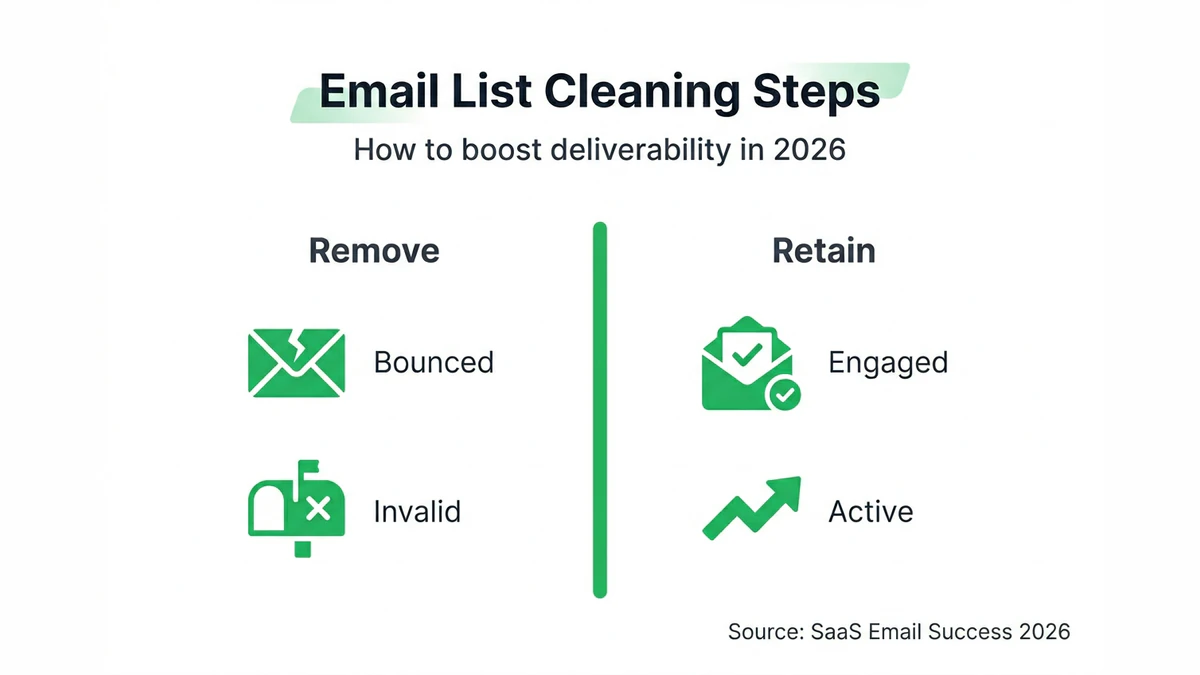
Step 1: Remove bounced and invalid emails immediately. Your verification tool identifies addresses with syntax errors, invalid domains, and known bounce patterns. Delete these without hesitation. They provide zero value and actively harm your sender reputation. Focus on hard bounces first, as these represent permanently undeliverable addresses.

Step 2: Segment inactive contacts for re-engagement attempts. If a lead hasn't opened or clicked in any of your email sequences the last 60 to 90 days, they're likely dragging metrics down or causing spam filters. Don't delete them yet. Create a separate segment for a final re-permission campaign.
Step 3: Send targeted re-engagement campaigns. Craft compelling subject lines that acknowledge the silence and offer genuine value. Ask subscribers to confirm their interest with a single click. Provide options to update preferences or reduce email frequency. Re-permissioning before suppression can revive dormant subscribers and recover potential revenue.
Step 4: Suppress unengaged contacts after re-engagement fails. Wait 7-14 days after your re-permission campaign. Contacts who don't respond should move to a suppression list. Keep them stored separately rather than deleting entirely. You might need this data for compliance purposes or future analysis.
Step 5: Automate bounce removal and ongoing hygiene. Configure your email platform to automatically suppress hard bounces. Set up rules to flag repeated soft bounces. Schedule regular verification scans to catch new invalid addresses before they impact campaigns.
Compare your cleaning approach options:
| Approach | Pros | Cons | Best For |
|---|---|---|---|
| Manual cleaning | Full control over decisions | Time-intensive and error-prone | Small lists under 5,000 |
| Automated verification | Fast and scalable | May need manual review of edge cases | Lists over 10,000 |
| Hybrid approach | Balances speed and accuracy | Requires setup and monitoring | Most SaaS and e-commerce teams |
Pro Tip: Tag contacts before suppression with their last engagement date and campaign type. This data helps you refine future acquisition strategies and understand which sources produce the highest quality subscribers.
Implementing proven email reengagement strategies before final suppression maximizes your chances of recovering valuable contacts. Track which re-engagement tactics generate the highest response rates, then apply those learnings to prevent future inactivity.
Verifying and maintaining email list hygiene long-term
Cleaning your list once solves immediate problems but doesn't prevent future decay. Sustainable deliverability requires ongoing verification and maintenance routines.
Track these critical metrics weekly:
- Bounce rate (target: below 2%)
- Open rate (benchmark: above 15% for most industries)
- Click-through rate (varies by industry but monitor trends)
- Spam complaint rate (must stay under 0.1%)
- Unsubscribe rate (healthy churn is 0.25-0.5% per send)
Establish clear benchmarks based on your industry and list type. Companies with clean email lists see 50% higher open rates and 75% better click-through rates compared to those neglecting hygiene. Use these standards to evaluate your progress.
Create a sustainable cleaning schedule:
| Frequency | Tasks | List Size |
|---|---|---|
| Weekly | Review bounce reports and suppress hard bounces | All sizes |
| Monthly | Run verification scan and segment inactive contacts | 10,000+ |
| Quarterly | Deep clean with re-engagement campaigns | All sizes |
| Before major campaigns | Verify high-priority segments | All sizes |
Automate wherever possible to reduce manual work. Most email platforms offer built-in hygiene features:
- Automatic hard bounce suppression after first occurrence
- Soft bounce monitoring with suppression after multiple failures
- Engagement-based segmentation that updates dynamically
- Integration with verification APIs for real-time validation
Monitor your inbox placement rate closely. Clean lists achieve 98% inbox placement while dirty lists often have 30-40% emails land in spam. Use seed list testing to check where your messages land across major ISPs.
"Regular list maintenance isn't optional for serious email marketers. It's the foundation of sustainable deliverability and ROI."
Document your cleaning procedures in a playbook. Include decision criteria for suppression, re-engagement templates, and escalation processes for unusual patterns. This ensures consistency as your team grows and new members join.
Understanding the importance of clean email lists helps justify ongoing investment in hygiene. Calculate the cost savings from reduced bounces and improved conversion rates. These metrics make it easy to demonstrate ROI to stakeholders who question the time spent on maintenance.
Optimize your email list cleaning with AI verification
Manual list cleaning works for small databases but becomes impractical as you scale. AI-powered verification delivers the accuracy and speed modern email marketers need.
Our AI-powered email verification platform scans your entire list in minutes, identifying invalid addresses, spam traps, and risky domains with 99.9% accuracy. Real-time API integration validates new subscribers at signup, preventing bad data from entering your system. Automated bounce removal and hygiene monitoring maintain your list health without constant manual intervention.
You'll save costs by only paying for emails that reach real people. Campaign ROI improves as your messages land in inboxes instead of spam folders. Detailed reporting shows exactly which segments need attention and tracks your deliverability improvements over time. Our ultimate guide to cleaning email lists provides additional frameworks you can implement immediately alongside our verification tools.
Thousands of SaaS and e-commerce marketers trust our platform to maintain their sender reputation and maximize campaign performance. Join them and experience the difference clean lists make.
FAQ
What is the best frequency to clean my email list?
Monthly cleaning or verification before major campaigns works best for most teams. Follow a monthly or campaign-based hygiene schedule to maintain optimal deliverability. Adjust frequency based on your list size and growth rate. High-volume senders with rapid acquisition may need weekly verification scans. Understanding email list hygiene principles helps you customize timing to your specific needs.
How can I re-engage inactive subscribers before removing them?
Send targeted campaigns asking subscribers to confirm their interest or update preferences. Re-permissioning before suppression can revive dormant subscribers who simply lost track of your emails. Offer incentives like exclusive content or discounts to encourage opens. Use compelling subject lines that acknowledge the silence and provide clear value. Testing various email re-engagement strategies helps identify which approaches work best for your audience.
What are the risks of not regularly cleaning email lists?
Higher bounce rates damage your sender reputation with ISPs, causing future emails to land in spam. Poor list hygiene leads to higher bounce rates, spam flags, and wasted email effort. Spam complaints increase as frustrated recipients mark your messages as unwanted. You pay to send emails that never reach real people, destroying your marketing ROI. Taking steps to protect sender reputation through regular cleaning prevents these costly outcomes.
How do I identify spam traps in my email list?
Spam traps are nearly impossible to identify manually since they look like normal email addresses. Professional verification services use proprietary databases to flag known spam traps before you send. These addresses never opted into legitimate lists, so their presence indicates poor acquisition practices. Regular verification scans catch spam traps early, before they trigger blacklisting. Focus on validating your acquisition sources and never purchase email lists, as these often contain spam traps.
Can cleaning my list reduce overall email marketing costs?
Absolutely. Most email platforms charge based on list size or send volume. Removing invalid and inactive contacts directly reduces these costs. You'll also save money by avoiding blacklist removal fees and reputation repair services. Higher engagement rates from clean lists improve conversion rates, generating more revenue per email sent. The combination of lower costs and higher returns makes list cleaning one of the highest-ROI activities in email marketing.