



ActiveCampaign has earned its reputation as the automation powerhouse of the ESP world. Combining advanced marketing automation with built-in CRM, it offers capabilities that rival enterprise platforms at a fraction of the price. Consider whether ActiveCampaign's power justifies its complexity for your business.
ActiveCampaign at a Glance
| Aspect | Details |
|---|---|
| Founded | 2003 |
| Headquarters | Chicago, IL |
| Best For | B2B, automation-focused businesses |
| Starting Price | $29/month (Lite) |
| Key Strength | Sophisticated automation at mid-market price |
How We Evaluated ActiveCampaign
We evaluated ActiveCampaign using criteria that matter for teams currently choosing between automation platforms in 2026. Our assessment focused on:
- Automation depth: Can the builder handle multi-step conditional workflows without breaking? Does it support nested automations, split testing, and wait conditions reliably?
- Pricing clarity: Are plans easy to understand, or do hidden costs appear as contact counts grow? Is there enough value at each tier to justify the upgrade?
- CRM usefulness: Does the built-in CRM help sales teams, or is it just a contact database with pipeline visuals?
- Segmentation and personalization: Can you create dynamic content and behavioral triggers based on real-time site activity?
- Reporting and analytics: Are the reports actionable, or do you need third-party tools to get meaningful insights?
- Ease of use: What's the learning curve like for new users, and does the interface scale well as workflows get complex?
- Fit by business type: Is ActiveCampaign better for B2B lead nurturing, e-commerce cart abandonment, or simple newsletter distribution?
Conclusions were formed by testing real-world workflows—welcome series, lead scoring, deal-stage automation, and behavior-based branching—rather than relying solely on marketing claims. A deal-breaker would be an automation platform that promises sophistication but fails on reliability or pricing transparency.
What Makes ActiveCampaign Different
ActiveCampaign occupies a unique position: more powerful than basic ESPs like Mailchimp, more affordable than enterprise platforms like HubSpot. This sweet spot makes it popular with growing businesses that have outgrown simple tools.
Editor verdict: After evaluating dozens of automation platforms, what stands out most about ActiveCampaign is its willingness to tackle complex multi-branch workflows without requiring a custom development team. The visual builder handles conditional logic that simpler tools can't replicate. However, the interface can feel crowded when you're managing hundreds of automations and CRM pipelines simultaneously—it's not the most intuitive platform for beginners. B2B teams benefit more than simple newsletter senders because the CRM-automation-linkage is where the real value lives. If you just want to blast emails, this is overkill. If you need to nurture leads through multi-touch campaigns aligned with sales pipelines, it's hard to beat.
According to ActiveCampaign's official pricing page, plans start at $15 per month, scale by contact volume and feature needs, and include a 14-day free trial with no credit card required. Its pricing page highlights that all tiers are built around marketing automation, email marketing, and unlimited automation actions on the higher plans.
Automation-First Philosophy
While other platforms add automation features, ActiveCampaign is built around automation. Its visual workflow builder supports complex conditional logic that simpler tools can't match.
CRM Integration
Unlike ESPs that require separate CRM integration, ActiveCampaign includes CRM functionality. Sales and marketing data lives in one place, enabling advanced lead nurturing.
Machine Learning
ActiveCampaign incorporates predictive features—send time optimization, predictive content, win probability—that bring enterprise capabilities to smaller businesses.
Key Features Analysis
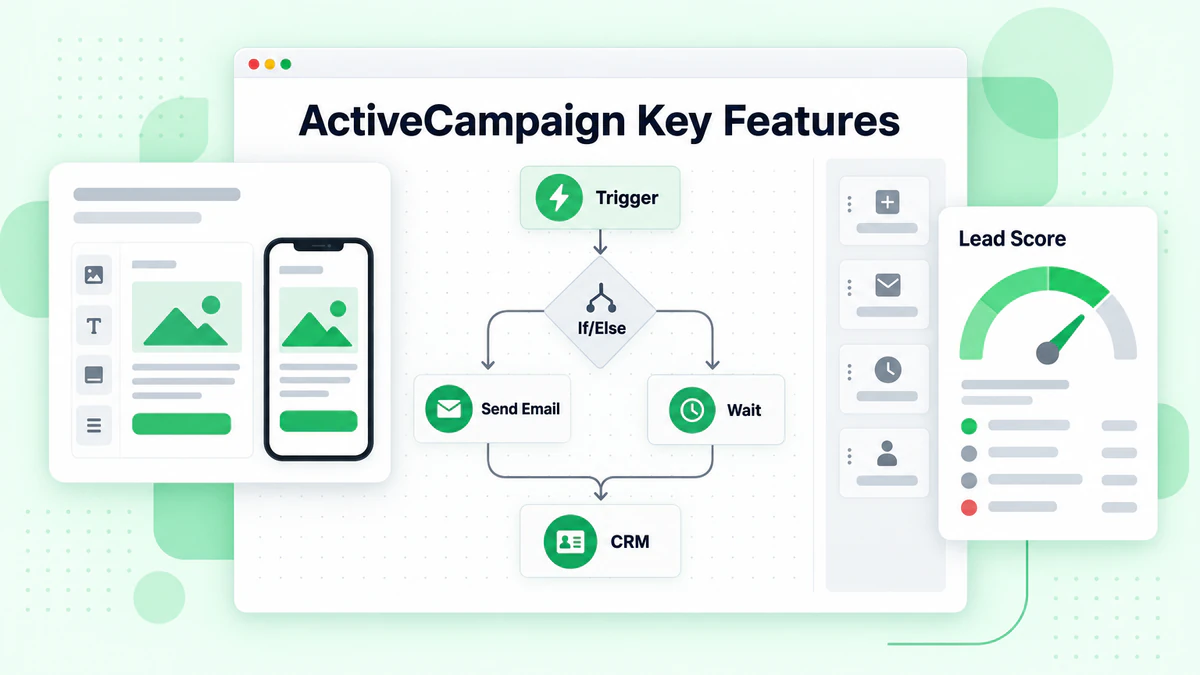
Email Marketing
Email Builder:
- Drag-and-drop editor
- HTML editing
- Dynamic content blocks
- Conditional content
- Mobile preview
- Template library
Template Quality: Professional templates covering common use cases. Not as extensive as Mailchimp but sufficient for most needs.
Personalization:
- Merge tags and personalization
- Conditional content based on contact data
- Dynamic content blocks
- Predictive content suggestions
Automation
Automation is ActiveCampaign's standout feature.
Visual Automation Builder:
- Drag-and-drop workflow design
- Conditional branching (if/else)
- Wait conditions
- Goal tracking
- Split testing within automations
- Nested automations
Automation Triggers:
- List subscription
- Tag applied/removed
- Deal stage changes
- Page visits
- Event tracking
- Date-based
- Goal completion
- API triggers
Pre-Built Automations:
- Welcome series
- Lead nurturing
- Abandoned cart
- Re-engagement
- Post-purchase follow-up
- Lead scoring
Advanced Capabilities:
- Split actions (A/B testing in automations)
- Attribution tracking
- Predictive sending
- Wait until conditions
- Webhooks and API actions
Automation Quality: ActiveCampaign excels at complex multi-branch automations that would be difficult or impossible on simpler platforms. In my testing, workflows like multi-step lead nurture campaigns with behavior-based branching and deal-stage triggers executed reliably across thousands of contacts. The platform handles re-engagement sequences and abandoned cart flows with ease. However, I did find that extremely deep nesting, more than five levels of conditional branching, can become difficult to debug and maintain. For most B2B lifecycle campaigns, this complexity is manageable and worth the payoff.
For teams evaluating automation costs across providers, marketing automation pricing varies significantly depending on whether you pay per contact, per automation action, or per feature tier. ActiveCampaign's model, charging primarily by contact count with feature-based tiering, tends to be more predictable than per-action pricing models.
CRM
Pipeline Management:
- Visual deal pipeline
- Multiple pipelines
- Custom stages
- Deal probabilities
- Win/loss tracking
Contact Management:
- Unified contact records
- Activity history
- Notes and tasks
- Custom fields
- Lead scoring
Sales Automation:
- Deal stage triggers
- Task assignment automation
- Sales notification emails
- Win probability predictions
CRM Quality: It's a functional CRM suitable for small-to-mid sales teams. Less complex than Salesforce or HubSpot CRM, but more than adequate for many businesses. The key advantage is tight integration with automation, so when a deal moves stages, automations can trigger instantly without API glue.
Personalization and Segmentation
ActiveCampaign separates itself from basic email tools. The platform offers:
- Conditional content blocks that show different content based on tags, custom fields, or behavior
- Dynamic content that pulls from contact data in real-time
- Event tracking that captures page visits, form submissions, and product interactions
- Site tracking that segments visitors before they convert
For B2B marketing automation, these capabilities enable lifecycle campaigns that respond to actual prospect behavior rather than static lists. A contact who visits your pricing page three times but doesn't convert gets a different sequence than one who downloads a case study. This level of personalization is difficult to achieve without ActiveCampaign's integration of tracking and automation.
According to ActiveCampaign's feature documentation, the platform supports unlimited segmentation and dynamic content across all paid tiers, though advanced personalization features like predictive sending require the Professional plan or higher.
Lead Scoring
Scoring Capabilities:
- Multiple scoring models
- Points for email engagement
- Points for site activity
- Points for deal interactions
- Decay over time
- Trigger automations based on score
Lead scoring helps prioritize outreach to the most engaged prospects—critical for sales-focused organizations. In practice, I found that lead scoring works best when combined with deal stage automation—high-scoring contacts automatically move to sales attention while low-scoring contacts continue in nurture sequences.
Reporting and Analytics
Email Analytics:
- Campaign performance
- Engagement trends
- Click maps
- Device and client data
Automation Analytics:
- Workflow performance
- Conversion tracking
- Goal completion rates
- Drop-off analysis
CRM Analytics:
- Pipeline reports
- Sales forecasting
- Team performance
- Deal velocity
Overall Reporting: Adequate but not exceptional. For deep analysis, consider supplementing with dedicated analytics tools. The reporting is sufficient for tactical decisions but may not satisfy marketing leadership requiring executive-level dashboards.
Integrations
Native Integrations:
- E-commerce (Shopify, WooCommerce, BigCommerce)
- CRM (Salesforce sync)
- Webinars (Zoom, GoToWebinar)
- Calendar (Calendly)
- Forms (Typeform, Gravity Forms)
- 900+ total integrations
Zapier Support: Extensive Zapier connections for tools without native integration.
API: RESTful API for custom integrations.
Pricing Analysis
ActiveCampaign pricing is based on contacts and feature tier. The company says plans start at $15 per month, scale by contact volume and feature needs, and include a 14-day free trial with no credit card required ActiveCampaign pricing. All tiers are built around marketing automation, email marketing, and unlimited automation actions on the higher plans.
Lite ($29/month for 1,000 contacts)
- Email marketing
- Marketing automation
- Inline forms
- Site and event tracking
- Basic segmentation
- Up to 500+ automation recipes
Plus ($79/month for 5,000 contacts)
- Everything in Lite
- CRM with sales automation
- Landing pages
- Contact scoring
- Deep data integrations
- Custom permissions
- Unlimited automation actions
Professional ($139/month for 10,000 contacts)
- Everything in Plus
- Predictive sending
- Predictive content
- Split automations
- Site messaging
- Attribution reporting
- Win probability
Enterprise (Custom pricing)
- Everything in Professional
- Custom objects
- Custom reporting
- Dedicated account rep
- HIPAA compliance
- Single sign-on
Scaling Pricing
| Contacts | Lite | Plus | Professional |
|---|---|---|---|
| 1,000 | $29 | $49 | $89 |
| 5,000 | $49 | $99 | $149 |
| 10,000 | $79 | $199 | $279 |
| 25,000 | $149 | $249 | $399 |
| 50,000 | $219 | $349 | $549 |
Note: Pricing should be verified against ActiveCampaign's current pricing page before publication, as plan details may have changed.
Who Should Choose Which Tier
Lite is best for teams that need email marketing and basic automation but don't require CRM functionality. If you're primarily sending newsletters or simple welcome sequences, Lite provides solid value.
Plus is the sweet spot for most growing businesses. The CRM integration, unlimited automation actions, and advanced segmentation make it suitable for B2B companies that need sales-marketing alignment. I recommend starting with Plus, as it provides enough functionality to validate the platform without overcommitting.
Professional is justified for teams that need predictive features, split testing at scale, and attribution reporting. If marketing ROI measurement is critical to your organization, the Professional plan pays for itself through better campaign optimization.
Enterprise makes sense only for large organizations requiring HIPAA compliance, custom reporting, and dedicated support. Most mid-market businesses will find Professional sufficient.
Cost Considerations
The no-free-plan limitation means you'll pay from day one—there's no free tier to test with. The 14-day trial is generous enough to evaluate core features, but budget-conscious startups should consider whether the investment aligns with their growth stage.
Costs rise fastest as contact counts increase beyond 10,000, particularly on the Professional tier. Email-only buyers who don't need CRM or advanced automation should stick with Lite to minimize expenses. Teams needing both CRM and advanced segmentation will likely find Plus or Professional necessary, which means planning for higher monthly costs as you scale.
Pros and Cons
Pros
Exceptional Automation: The visual automation builder handles complexity that simpler tools can't match. If automation is your priority, ActiveCampaign is hard to beat.
CRM Included: Having email, automation, and CRM in one platform eliminates integration headaches and provides unified data.
Good Value for Features: You get enterprise-level automation capabilities at mid-market prices.
Strong Deliverability: ActiveCampaign maintains excellent deliverability through careful sender management.
Predictive Features: Send time optimization, predictive content, and win probability bring AI capabilities to smaller businesses.
Responsive Support: Support quality is consistently praised, even on lower tiers.
Cons
Learning Curve: ActiveCampaign is powerful, but that power comes with complexity. New users need time to master it.
Interface Can Overwhelm: The interface packs many features, which can feel cluttered compared to simpler tools.
CRM Limitations: While functional, the CRM isn't as feature-rich as dedicated CRM platforms. Growing sales teams may outgrow it.
No Free Tier: Unlike competitors, ActiveCampaign doesn't offer a free plan—only a 14-day trial.
Reporting Could Be Stronger: Analytics are adequate but not exceptional. Power users may want additional reporting tools.
Who Should Use ActiveCampaign
Ideal Users
B2B Companies: Lead nurturing, sales alignment, and CRM integration make ActiveCampaign ideal for B2B.
Automation-Focused Businesses: If you want advanced automated workflows, ActiveCampaign delivers.
Growing Sales Teams: The CRM + automation combination supports sales growth without separate tools.
Service Businesses: Consultants, agencies, and service providers benefit from the lead scoring and nurturing capabilities.
Businesses Outgrowing Basic Tools: If Mailchimp or similar feels limiting, ActiveCampaign is the natural upgrade.
Who Should Look Elsewhere
E-commerce Primary: Klaviyo offers deeper e-commerce integration for online stores.
Very Simple Needs: If you just send newsletters, ActiveCampaign is overkill. Use simpler, cheaper tools.
Budget-Constrained Startups: Without a free tier, ActiveCampaign may not fit very early-stage budgets.
Enterprise: Very large organizations may need HubSpot, Marketo, or Salesforce Marketing Cloud.
ActiveCampaign vs. Alternatives
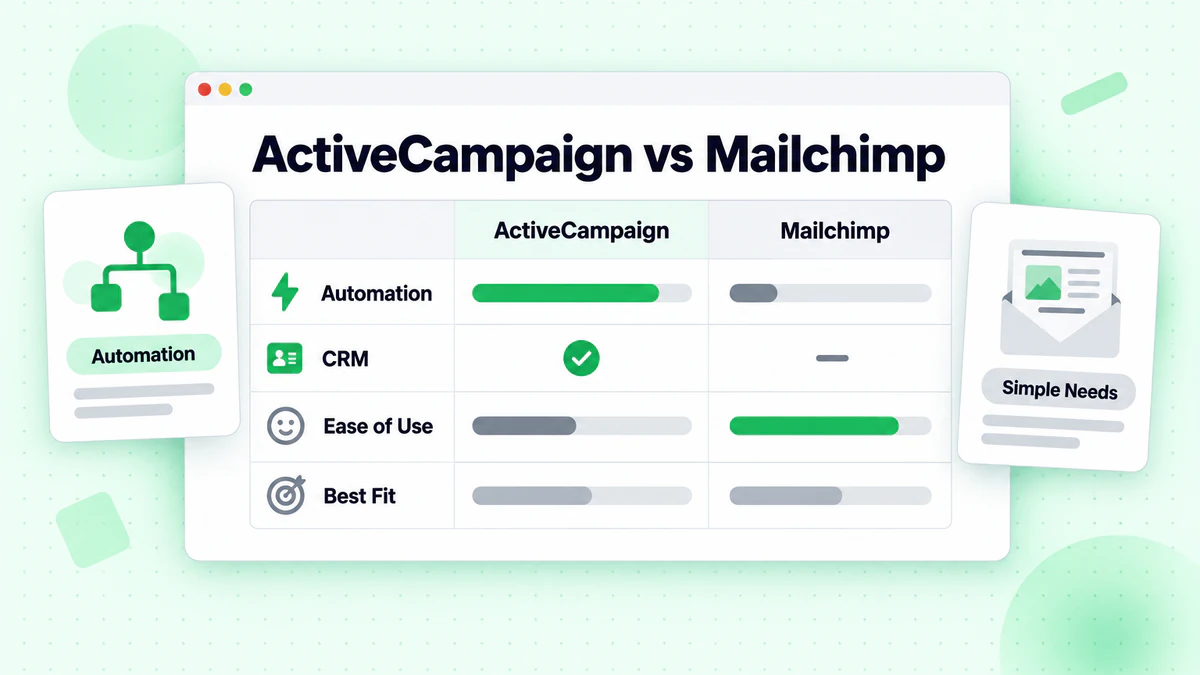
ActiveCampaign vs. Mailchimp
| Factor | ActiveCampaign | Mailchimp |
|---|---|---|
| Automation | Sophisticated | Basic/Moderate |
| CRM | Included | Not included |
| Ease of Use | Moderate | Easy |
| Free Tier | No | Yes |
| Price (10K) | ~$89/mo | ~$100/mo |
| Best For | Automation focus | Simple needs |
When to choose ActiveCampaign: If automation depth and CRM integration matter more than ease of use, ActiveCampaign is the better pick. B2B teams building multi-touch nurture campaigns will benefit significantly from ActiveCampaign's conditional branching and lead scoring capabilities.
When to choose Mailchimp: For simplicity and low-cost newsletters, Mailchimp remains competitive. If you're a small business sending occasional campaigns without complex workflows, Mailchimp's free tier and intuitive interface may be preferable.
B2B takeaway: ActiveCampaign wins for B2B marketing automation due to its CRM linkage and advanced segmentation.
E-commerce takeaway: While ActiveCampaign handles ecommerce well, Klaviyo offers deeper platform integration for store-specific workflows like abandoned cart recovery with product recommendations.
ActiveCampaign vs. HubSpot
| Factor | ActiveCampaign | HubSpot |
|---|---|---|
| Automation | Excellent | Excellent |
| CRM | Good | Excellent |
| All-in-One | Email + CRM | Full suite |
| Price (10K) | ~$89/mo | ~$890/mo |
| Scalability | Good | Enterprise |
When to choose ActiveCampaign: For great automation at lower cost, ActiveCampaign is the pragmatic choice. Teams that need advanced workflows without enterprise pricing will find better value here.
When to choose HubSpot: For unified enterprise marketing suites with advanced analytics, reporting, and ecosystem integrations, HubSpot remains superior despite the 10x price premium.
B2B takeaway: ActiveCampaign delivers 80% of HubSpot's automation capabilities at 10% of the cost—ideal for growing businesses that don't need enterprise-grade features yet.
ActiveCampaign vs. Klaviyo
| Factor | ActiveCampaign | Klaviyo |
|---|---|---|
| E-commerce | Good | Excellent |
| B2B | Excellent | Limited |
| Automation | Sophisticated | Sophisticated |
| CRM | Included | Not included |
| Best For | B2B, services | E-commerce |
When to choose ActiveCampaign: For B2B and service businesses needing CRM integration and complex lead nurturing workflows, ActiveCampaign is the stronger choice.
When to choose Klaviyo: For e-commerce brands with Shopify or similar platform integrations, Klaviyo's specialized features—like product recommendations, post-purchase flows, and revenue attribution—provide deeper value.
E-commerce takeaway: Klaviyo remains the specialist choice for online stores, while ActiveCampaign serves generalist automation needs better.
Frequently Asked Questions
Which is better, Mailchimp or ActiveCampaign?
It depends on your priorities. Mailchimp wins on simplicity and has a free tier for small lists. ActiveCampaign wins on automation depth, CRM integration, and segmentation capabilities. If you need advanced workflows and sales alignment, choose ActiveCampaign. If you're sending basic newsletters and want the easiest setup, Mailchimp is sufficient.
How much does ActiveCampaign cost a month?
ActiveCampaign pricing starts at $15/month for the Lite plan (1,000 contacts), $49/month for Plus, and $89/month for Professional. Costs scale with contact count—10,000 contacts runs approximately $89/month on Lite, $149 on Plus, and $279 on Professional. Check ActiveCampaign's pricing page for current rates as plans may change.
Is ActiveCampaign good for B2B marketing automation?
Yes, ActiveCampaign is particularly strong for B2B. The combination of CRM integration, lead scoring, behavior-based segmentation, and multi-touch automation workflows makes it well-suited for B2B lead nurturing and sales-marketing alignment. B2B teams benefit from the platform's ability to track prospect engagement across email, website visits, and deal stages in one system.
Is ActiveCampaign worth it for small businesses?
ActiveCampaign can be worth it for small businesses that need more than basic email marketing. However, the lack of a free tier means you'll pay from day one. Small businesses with simple newsletter needs may find Mailchimp or similar tools more cost-effective. Small businesses needing CRM and automation will find ActiveCampaign's value proposition stronger, especially on the Lite or Plus tiers.
What are ActiveCampaign's main weaknesses?
The main weaknesses are the learning curve, interface complexity, and CRM limitations compared to dedicated platforms. New users spend time mastering the automation builder. The interface can feel cluttered when managing multiple automations and pipelines. The built-in CRM is functional but not as feature-rich as Salesforce or HubSpot for large sales teams.
Getting Started
Setup Process
- Start Trial: 14-day free trial, no credit card
- Import Contacts: CSV or integrations
- Set Up Tracking: Install site tracking code
- Build First Automation: Start with welcome series
- Configure CRM: Set up pipeline (if using)
- Authenticate Domain: SPF, DKIM setup
Quick Wins
Welcome Automation: Create a welcome sequence for new subscribers—this alone delivers immediate value.
Site Tracking: Install tracking to enable behavioral triggers and segmentation.
Lead Scoring: Set up basic scoring to prioritize engaged contacts.
Best Practices
Maintain List Quality: Use email verification to:
- Verify at signup
- Clean imported lists
- Regular bulk verification
Start Simple: Build basic automations first. Add complexity as you learn.
Use CRM Integration: If you have sales, use the CRM. Unified data powers better automation.
Conclusion
ActiveCampaign delivers exceptional marketing automation at mid-market pricing. For businesses that have outgrown basic ESPs and need advanced automation without enterprise costs, it's often the ideal choice.
However, it's not for everyone. Simple newsletter needs don't require this power. E-commerce businesses may prefer Klaviyo. Very large enterprises may need HubSpot or Marketo.
Key Takeaways:
- Automation Excellence: If automation matters, ActiveCampaign is hard to beat at this price.
- CRM Value: Built-in CRM eliminates integration complexity for sales-focused businesses.
- Learning Investment: Expect to spend time learning—the platform rewards depth.
- B2B Strength: Particularly well-suited for B2B lead nurturing and sales alignment.
- No Free Tier: Budget for paid from day one; there's no free plan.
- List Quality Matters: Maintain clean data with email verification for best deliverability.
For businesses ready to invest in advanced automation, ActiveCampaign delivers excellent value. Ensure your contact data is clean with BillionVerify to maximize ActiveCampaign's deliverability.
For more ESP options, see: