



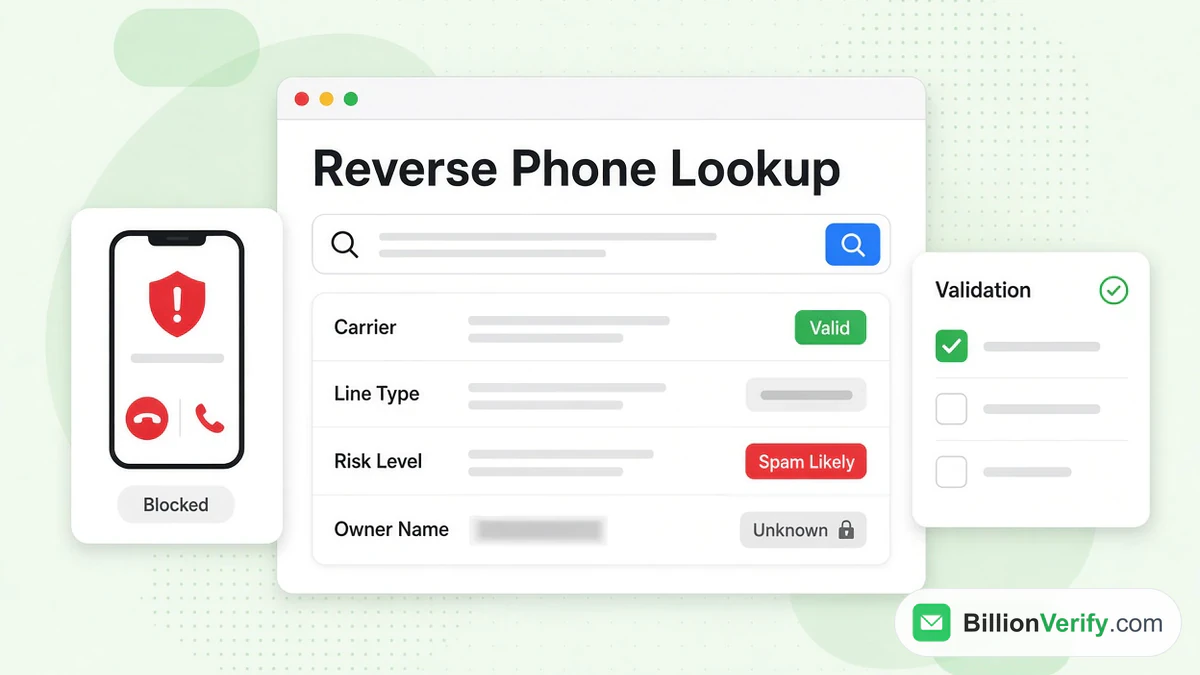
A free reverse phone lookup starts with a ten-digit number and returns whatever the service is willing to show without an account. In practice that means the carrier, whether it is a cell or a desk phone, a rough location and a spam rating. The owner's full name usually sits behind a paywall. This guide explains where that line falls, which free checks are worth your time, and how to confirm a number is real before you rely on it.
We are not affiliated with Whitepages, Google, Verizon, AT&T, T-Mobile or any other company named here. BillionVerify is an email verification service that also offers a free validator for phone numbers. Facts about other companies come from their own pages, checked in November 2026.
Key facts (checked November 2026):
- Whitepages says its reverse phone lookup covers more than 260 million U.S. phone numbers, per its reverse phone page.
- There, Whitepages lists carrier details, line type and a spam rating as free, and the full owner name for all numbers as Premium.
- AT&T says ActiveArmor spam and fraud call blocking is free with every AT&T wireless plan, per its ActiveArmor page.
- Verizon says Call Filter is free for basic use, and Call Filter Plus costs $3.99 per line, per its Call Filter page.
- The FTC manages the federal registry for telemarketing calls, per donotcall.gov.
- BillionVerify's validator checks a number's format, country and type, but it does not claim to know who owns it.
What a Free Reverse Phone Lookup Actually Shows
Most people expect a clear answer about who is behind the digits. What they get depends on the service, and the pattern is consistent across the big directories. A search that begins with a number reveals facts about the number itself first, and facts about the person only if the record is public enough or you pay for more.
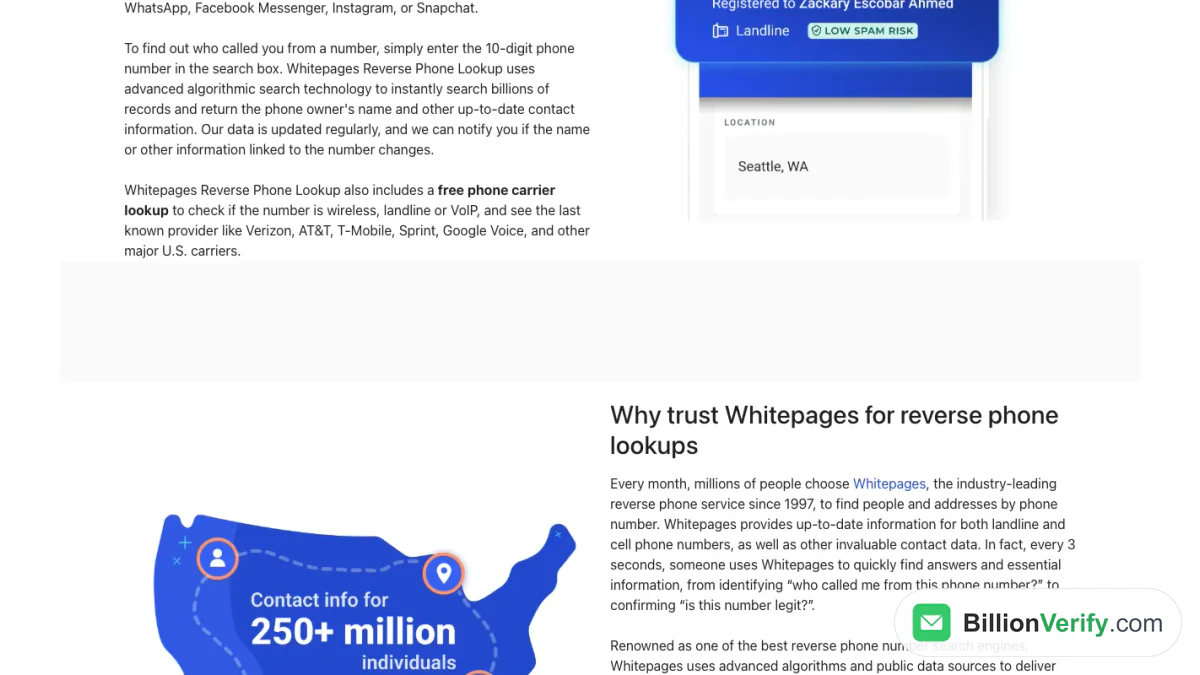
Whitepages spells out the split on that same page. Its free tier lists the owner's name and address "for most landlines and business numbers", plus the operator details, the line type (cellular, landline or VoIP) and the spam rating. Premium adds the full name of the owner for all phone numbers, the complete address, the exact age and date of birth, and API access for large-scale lookups. So a landline or a business can still give you a name at no cost. A personal mobile number mostly will not.
The difference follows from how the data is built. Business and landline listings have been public for decades, so directories can show them freely. Mobile numbers have no public directory, so the owner details come from other sources and are the part the paid product sells.
Carrier and line type
The carrier field names the company that last served the number, for instance a national network or a prepaid brand. Whitepages says the check covers major U.S. carriers and several prepaid brands. The line type separates mobile lines, landlines and VoIP numbers. Both facts help even when no owner appears, because a call that claims to come from a local bank but traces to an internet phone deserves suspicion.
Spam score and reports
The third free item is the risk rating. Whitepages says each lookup shows "the spam risk level, total user reports, and common caller types", and lists robocallers, telemarketers, scammers and debt collectors as the types. The score draws on community reports and recent call activity, so a number that rang thousands of people last week ranks worse than one that rang you once.
The owner's identity
The identity is the item people want most and get least often. For a business line, the listing usually shows the company. For a personal cell, the free result may show only a masked or partial result, and the full record requires a subscription. If the identity is all you need, the other methods below can sometimes get you there at no cost.
Free Ways to Check an Unknown Number
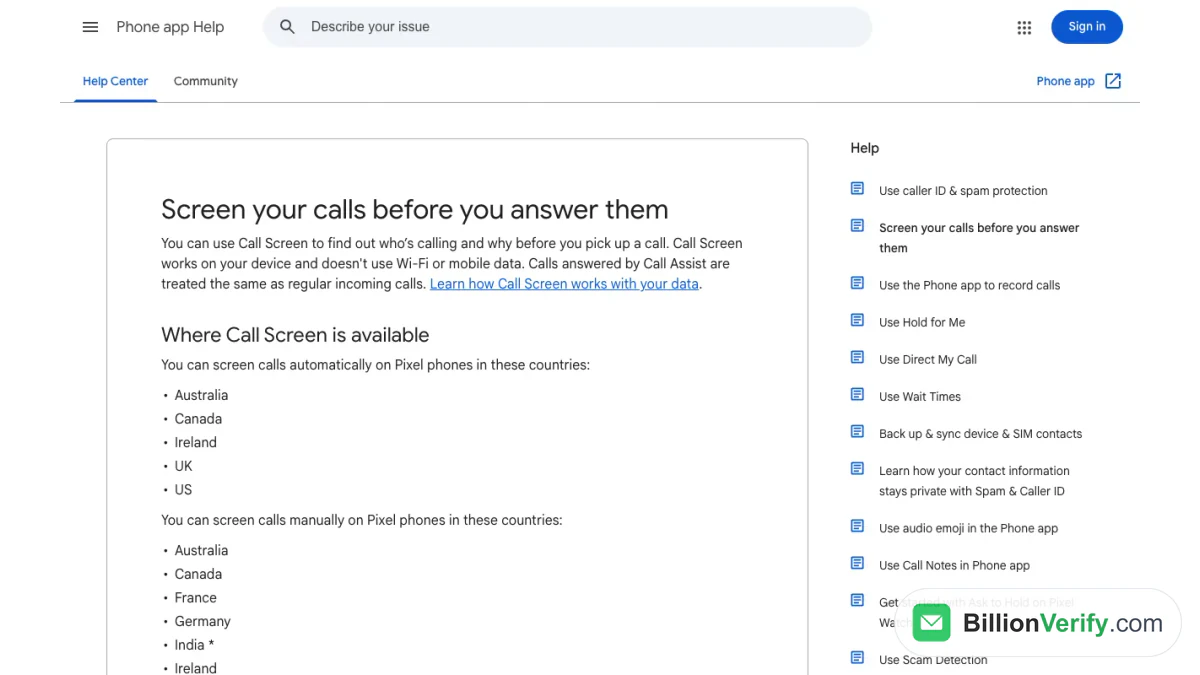
Screenshot: the Call Screen article in Google's help center, which picks up an unfamiliar ring for you and prints a transcript.
A single directory is only one source. Several free checks cost nothing and can answer the question faster, and they do not depend on any one company's database.
- Quote the digits in a search engine. Try more than one format, such as 555-123-4567 and 555.123.4567. Businesses that publish their number on their site will appear, and so will pages where other people complained about the number.
- Check your carrier's spam label. Networks screen traffic before it reaches you. Verizon says its basic Call Filter tier includes spam detection and blocking, and the paid tier adds caller ID. AT&T says the free ActiveArmor tier includes fraud and spam blocking. T-Mobile says its ScamShield works "at no extra cost" and labels suspicious calls.
- Let the phone screen it. Google's Phone app help describes Call Screen, which answers an unknown call for you and shows a transcript, and says automatic screening works on Pixel phones in the US, Canada, the UK, Ireland and Australia. The same page warns that "Not all spam calls and robocalls can be detected."
- Ring the organization back on its published line. If a caller says they are from a bank, an agency or a delivery company, hang up and dial the digits printed on your card, bill or the organization's own site.
- Open a reverse phone directory for the network and risk fields. These results are fast, and the free fields are the dependable part.
None of these checks needs an account, and the first four never ask for payment. The fifth shows why a search for a mobile number so often ends at a sign-up form.
How Carrier Data Goes Stale
Some people only want the network. That answer changes when its holder ports the number to another company, and the FCC explains porting in its consumer guide: customers can keep a number when they switch providers, and once a new company requests service, the old company cannot refuse to port the number. This is why a result can be wrong. A phone number lookup that reads the original assignment can point to a company the owner left years ago.
Google's open-source libphonenumber library documents the same caveat. Its README says "We do not provide data about the current carrier of a phone number, only the original carrier who is assigned the corresponding range." Treat any such result as a clue, not a fact. Our guide to the carrier lookup goes deeper on what these fields can and cannot tell you.
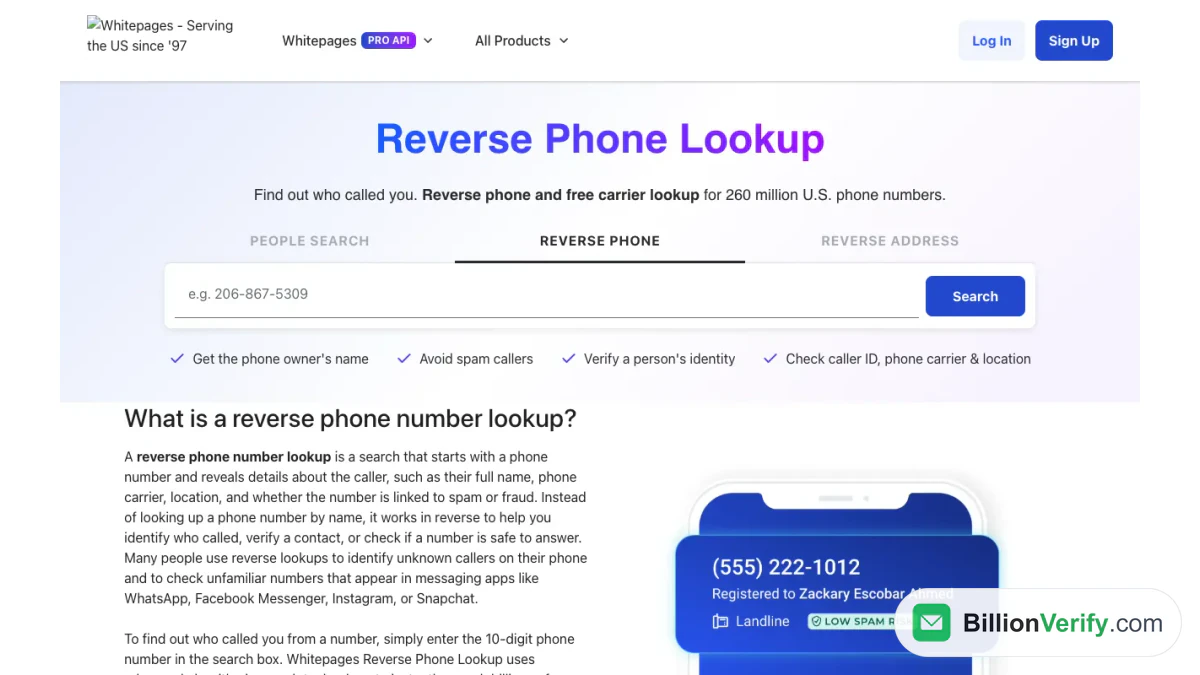
Screenshot: further down the Whitepages site, with its definition of this kind of search and a sample result.
Phone Number Search Free: Where the Limits Are
Free searches fail in four predictable ways, and knowing them saves time.
It is a cell phone. There is no public directory of mobile numbers, so free results are thin. Expect the operator and little else.
The number was recycled. Providers reassign numbers. An identity attached to an old record may belong to the previous owner, so confirm anything you plan to act on.
The caller spoofed the number. Scammers display a number that is not theirs, often a local one, to look trustworthy. A lookup then describes the wrong person. Whitepages itself notes that "Callers often spoof local numbers to bypass caution, so caller ID alone is not reliable."
The data is old. Directories refresh on their own schedule. A record updated last month is better than one updated three years ago, but the result rarely tells you which you have.
When the free result is thin, a sign-up wall is not the only answer. You can try the other checks above, or you can decide the number is not worth chasing.
How to Verify a Phone Number Before You Trust It
A phone number lookup tells you what a database says. Validation checks that the number can exist at all. They answer different questions, and the second is cheap.
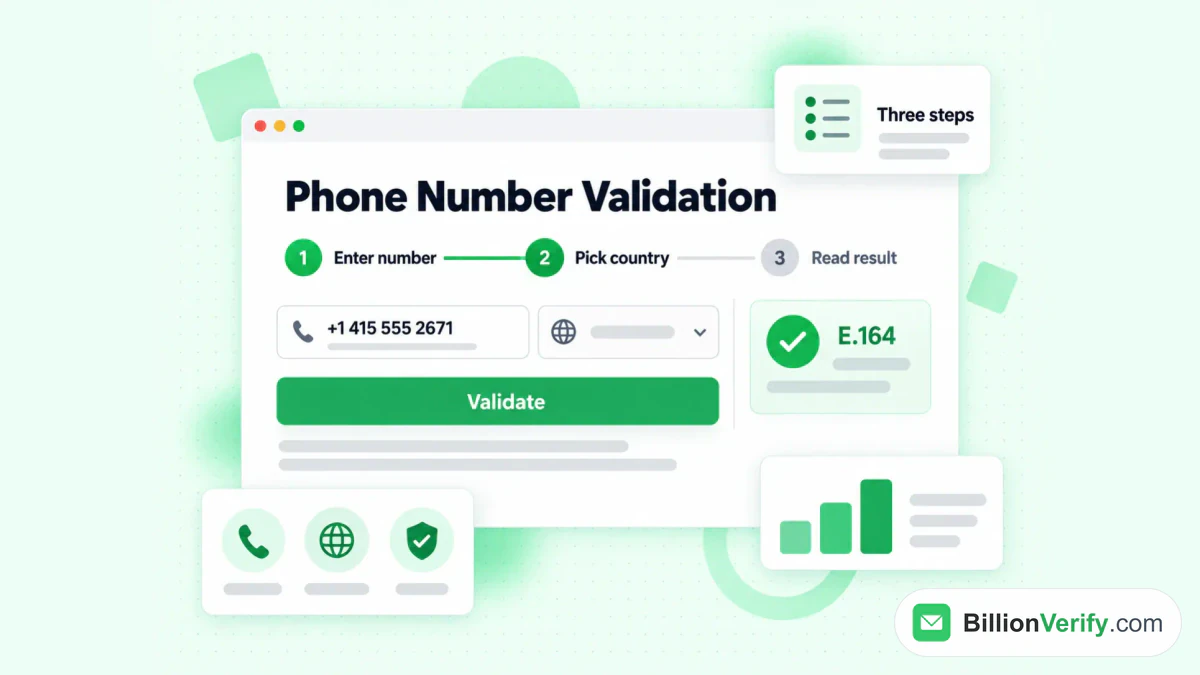
Our free phone number validator checks how the number is written and where it belongs, reports whether the line is mobile or fixed and returns the E.164 format. It is useful when you collect numbers in a form, a spreadsheet or a lead list, because it catches typos and impossible digits before anyone dials them. It does not reveal who holds it, and it does not prove that a person answers. That limit matters: it is a hygiene check, not an identity check.
The picture below shows the stages the tool runs, in order: the written format, then the country, then the type of line, then the normalized E.164 result.
Block, Report and Register
If a phone number lookup flags an unwanted caller, you have three simple next steps.
- Block it. Your phone and your network both let you block a number, and the free tiers above include blocking.
- Report it. The FTC runs ReportFraud.ftc.gov, a site for reporting scams and bad business practices, and reports help it spot patterns.
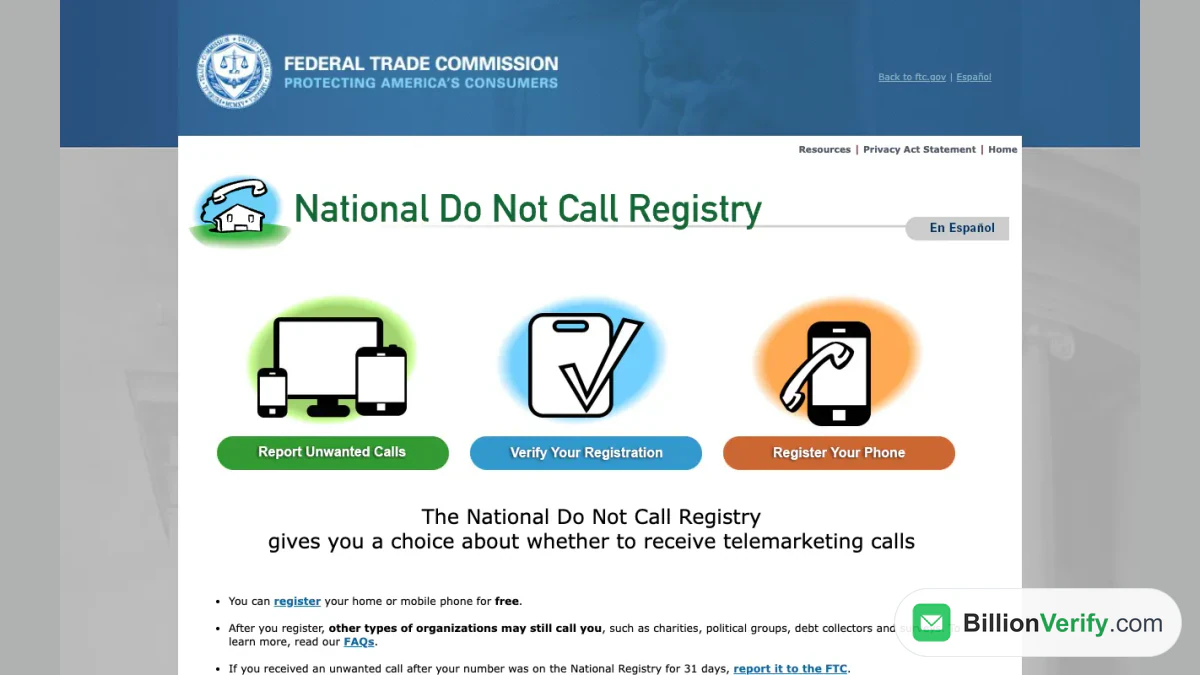
- Register your number. The National Do Not Call Registry is run by the FTC and gives you a choice about whether to receive telemarketing calls. Treat it as one layer of protection, not a shield against every unwanted ring.
Screenshot: the FTC's registry site, with options to sign up a number and report unwanted calls.
What You Must Not Use a Reverse Phone Lookup For
Free people-search results are not consumer reports. Spokeo's terms bar using its information to judge eligibility for employment, renting a home, credit or insurance, and the ZabaSearch notice says the same about lending, coverage, jobs and housing. The Fair Credit Reporting Act covers those uses, and the FTC enforces it. If you are screening a tenant, a job candidate or a borrower, use a screening service that follows the law, and get the person's consent.
Two practical limits apply to everyone. First, an identity from a lookup is a lead, not proof. Second, do not use a number to harass or track someone. Unwanted contact can break laws on stalking and harassment, whatever the search returned.
From a Phone Number to Contact Data
Sales and support teams often hold a number and need an email address, or the reverse. Two checks help, and both are free to try.
If you have an email address and want context, our reverse email lookup reads the domain, the organization and the mail routing from public signals. If you have a person's name and a company domain and need a work address, BillionVerify's Email Finder returns a verified work email, and Finder tools are available on paid accounts only. Either way, validate a contact before you send or dial, because dead numbers and dead inboxes cost time and hurt your sender reputation.
Screenshot: the Whitepages landing screen, showing the search box and its free-check claim.
Quick Reference
| What you want | Free? | Where to look |
|---|---|---|
| Which operator, mobile or landline | Yes | Any directory |
| Risk level and caller reports | Yes | A directory or your provider's filter |
| Business or landline listing | Often | A directory listing |
| Who holds a personal mobile | Rarely | Usually a paid tier |
| Whether the digits are valid | Yes | A validator tool |
FAQs
How do I do a free reverse phone lookup?
Enter the number into a reverse phone lookup tool and read the carrier and risk fields. If you need a person's identity, add other checks: put the number in quotes in a search, see whether your network flagged the call, or let your phone screen it. Free tiers rarely reveal a personal mobile owner.
Can a free reverse phone lookup show the owner?
Sometimes, for landlines and company lines. Whitepages lists an owner's name plus a street address as free for most such lines. For a personal mobile, the full name is a Premium feature, so a no-cost answer is the exception.
Can I run a phone number lookup free of charge without signing up?
Yes, for the basic fields. Directory results show the carrier and the risk rating with no sign-up. Search engines and your provider's labels also work without signing up. Anything beyond that, such as the owner's age or address, tends to need an account.
Why does a free search show nothing for my number?
The number is probably a mobile line, which has no public directory. Desk phones and shop lines have long public listings, so they show up more often. A recycled or newly issued number can also have no matching record.
How accurate is a free reverse phone lookup?
It is a clue, not proof. Operator data can list the original company, as the libphonenumber documentation warns, and a spoofed caller ID can point a search at the wrong person. Compare the result with how the caller behaves before you act.
Is a phone number lookup legal?
Looking up a number is legal for personal use. Using the results for hiring, renting, lending or coverage decisions is not allowed, because the FCRA governs them. Harassing someone with what you find can also break the law.
Does the person know I looked up their number?
Reverse phone services generally do not notify the person. Check the terms of the service you use, because each company sets its own rules. A call back, of course, tells the person you have their number.
How can I check that a number exists?
Run it through a validator. It confirms that the number is well formed and belongs to a real country, and it reports the kind of line and the E.164 form. It cannot say who answers, so pair it with a lookup when the holder matters.
What should I do with a number that keeps calling?
Block it on your phone, report it to the FTC at ReportFraud.ftc.gov, and consider adding yourself to the federal registry. Do not return unknown calls that left a vague message. Look the caller up first.
Watch: How to Validate a Phone Number: Free Phone Number Validator
Watch: Free Reverse Email Lookup: What It Shows and What It Can't
Read next: Truecaller Reverse Phone Lookup: How It Works and Its Limits
Read next: Who Called Me? How to Identify and Handle Unknown Calls