



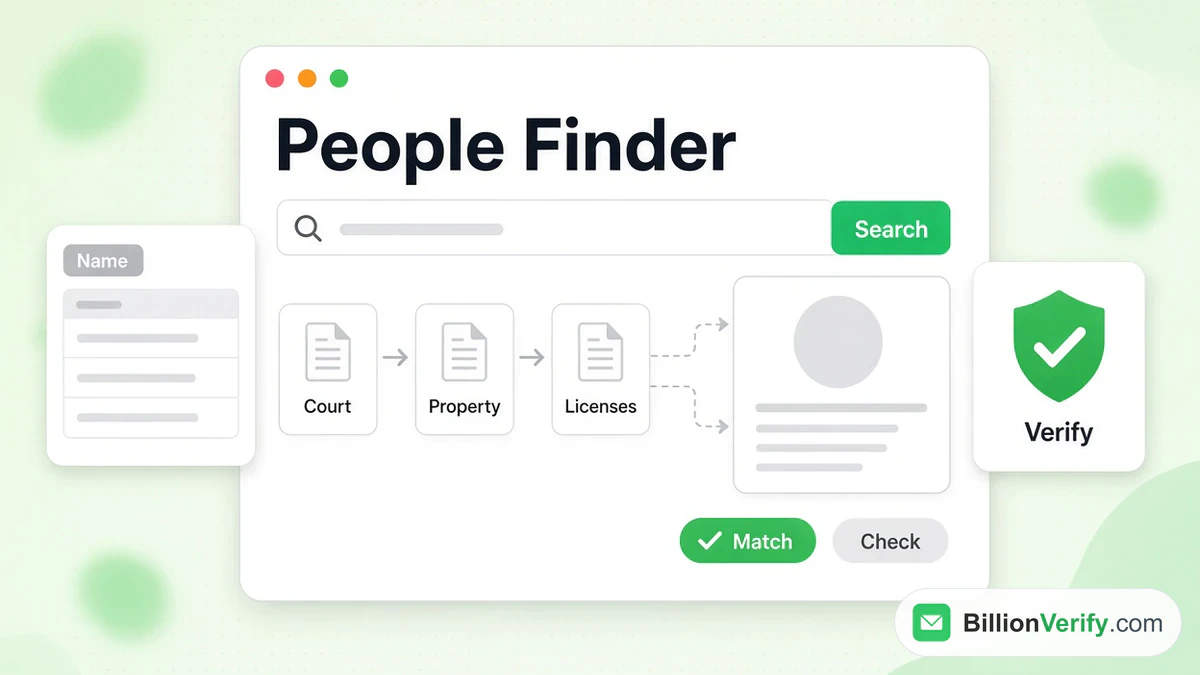
A people finder is a search tool that turns something you already know about a person into records you can read. You supply a name, a phone number, an address or an email, and the tool returns profiles built from public data. This guide explains which route fits which starting point, what a free people finder really gives you, and which uses the law rules out.
We are not affiliated with any company named below. BillionVerify is an email verification service, and the last part of this guide shows why a contact you find still needs a check before you reach out. Facts about other companies come from their own pages, checked in November 2026.
Key facts (checked November 2026):
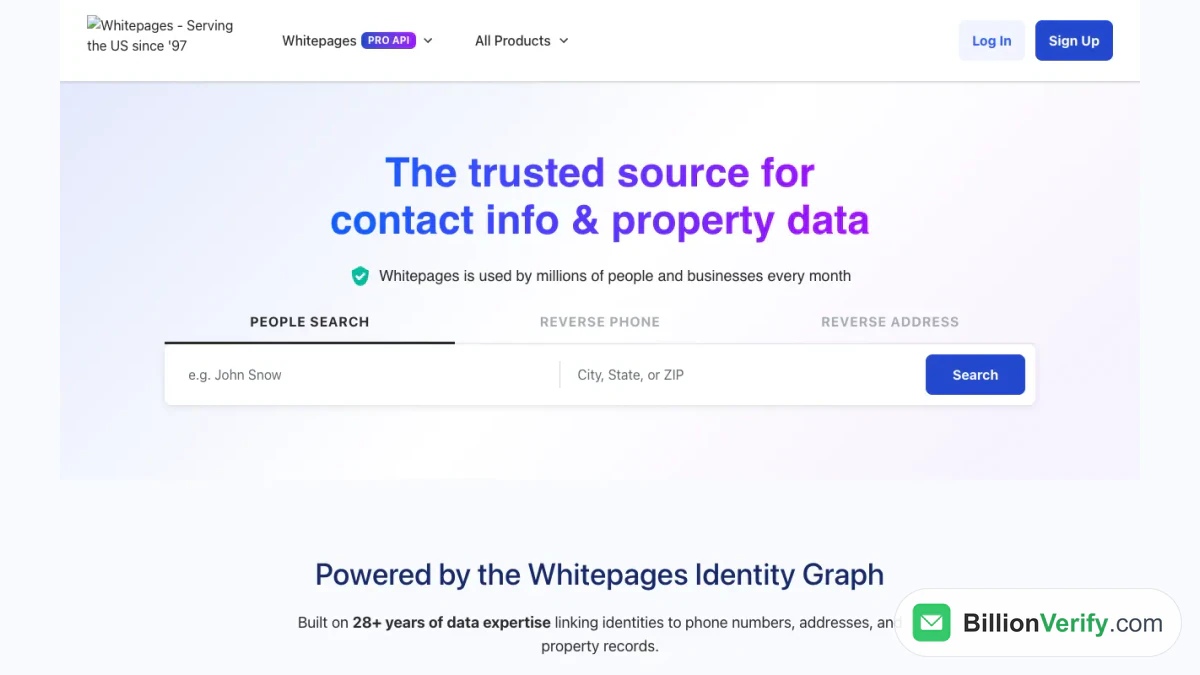
- Whitepages says its Identity Graph holds more than 350 million identity records and 112 million property records, per its home page.
- Spokeo says its database spans over 12 billion records, per its About page.
- ZabaSearch describes its free search as returning "basic information such as name, address, age, and partial phone numbers", with more offered for a fee, per a May 2025 copy of its site.
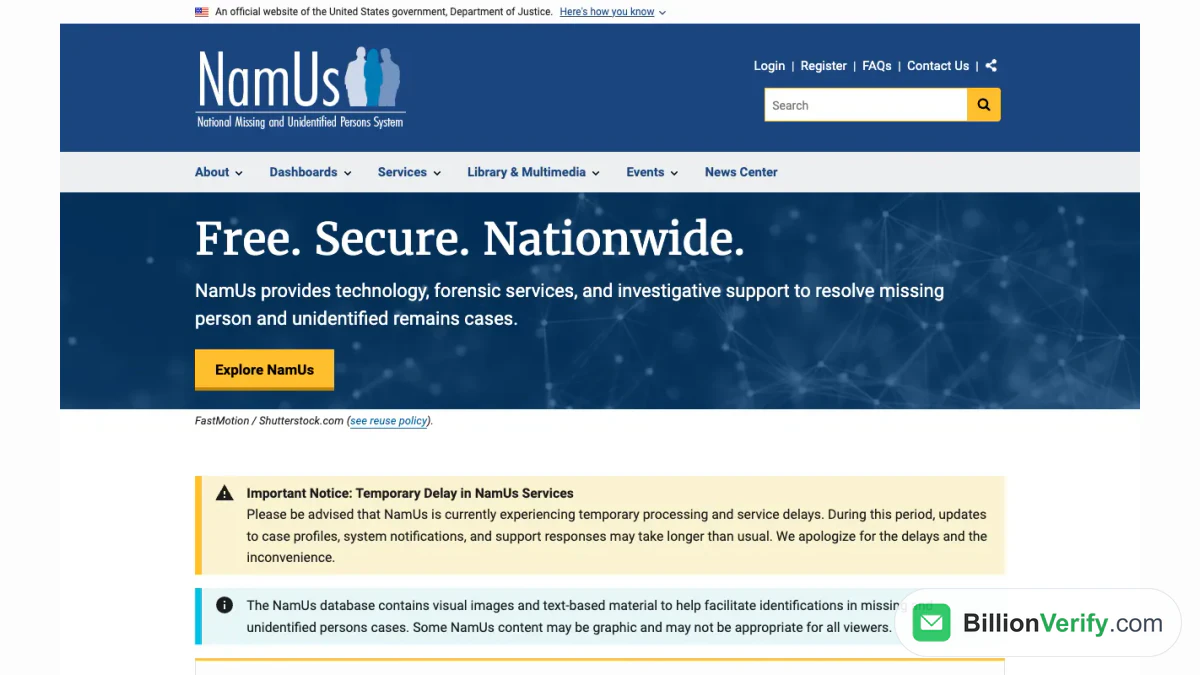
- NamUs, the U.S. Department of Justice's national database of missing and unidentified persons, says its services are free.
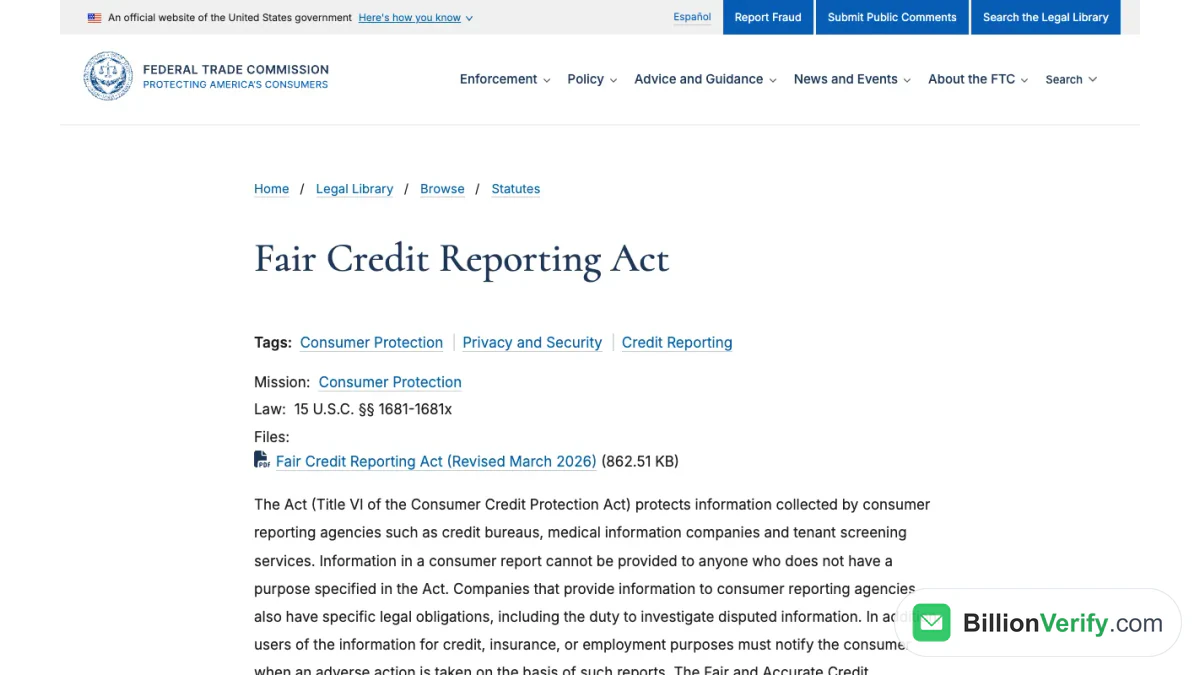
- The FTC says information in a consumer report "cannot be provided to anyone who does not have a purpose specified in the Act."
- BillionVerify offers a reverse email lookup that works from public signals only and does not claim to identify the owner.
What a People Finder Does
A people finder does one job: it links the scattered facts about a person. A name appears in one record, a phone number in another and an address in a third. The service collects court, property and licensing files plus other data sources, matches them to the same identity and shows the result as a single profile.
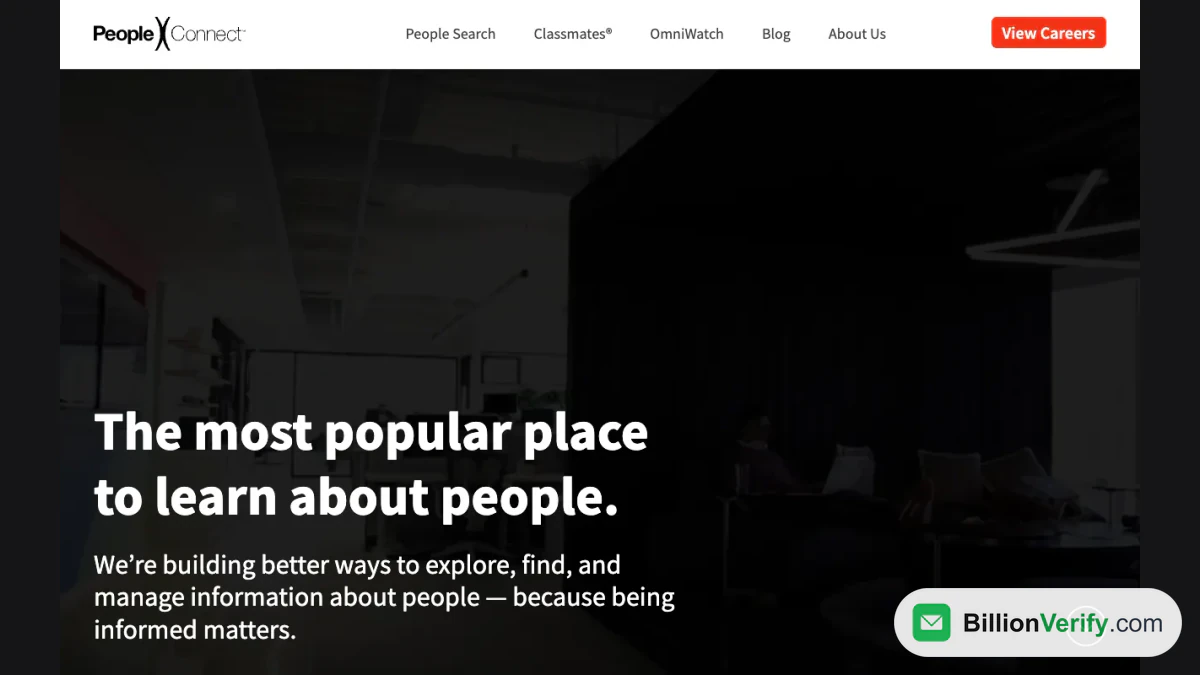
The breadth varies by company. Whitepages lists cell phone numbers, landlines, addresses, relatives, ages and home-ownership files across its search pages. Spokeo lists contact information, address history, social profiles and court records in its reports. PeopleConnect, the company behind Intelius, TruthFinder, US Search and Instant Checkmate, describes its brands as "one of the largest and most trusted sources in the people search industry". All of them combine public data with their own matching, and none of them is a primary record. A profile is a summary of other sources, and it can be wrong.
Person lookup versus people lookup
The labels differ, but the task is the same. The terms person lookup, people lookup and people finder all name one kind of search: you begin with details you know and finish at a profile. Some sites give each input its own box for name, phone, address and email, while others take a single box and work out the input type themselves.
Choose a Route by What You Know
The best starting point is the detail you are most sure of. A full name with a city narrows the field. A phone number or an address can narrow it to a household. The table below maps the common starting points to the kind of tool that suits them.
| What you know | Best route | Typical result |
|---|---|---|
| Full name and city | A name entered into a people finder | A short list of matching profiles |
| A phone number | A free reverse phone lookup | Carrier, line type, spam rating, sometimes a name |
| A street address | A county property-records check | Titled owner, assessed value |
| An email address | A look at the sender's domain records | Organization, hosting provider |
| A photo | A reverse image search | Matching pages and sources |
A people finder by name
A name entry is the most common route and the least precise. A common name returns a long list of matches, so add a city and state before you read any profile. Look for details that only the right person would share, such as an age range that fits or a past address you can confirm. If two profiles look alike, treat both as possible. A people lookup on a bare name with no location is the weakest start of all, and a people finder by name works best with a city attached.
A people finder by phone number
A phone number is a sharper key than a name, because each active line belongs to one account at a time. A people finder by phone number returns the carrier and the line type first, and the owner only if the record is public. Whitepages says its free tier shows an owner's name and address for most landlines and business numbers, and that the full owner name for all numbers is a Premium feature. The guide linked in the table explains what each field means. If the call was unwanted, who called me explains what to do next.
A people finder by address
An address leads to the owner of record and sometimes to residents. According to Whitepages, its reverse address search covers more than 210 million U.S. addresses. County assessors hold the underlying records, which we explain in who lives at this address.
A people finder by email
An email address leads to a domain and, for a work address, to the employer behind it. A people finder by email can read public signals about that domain, but a consumer inbox rarely reveals who owns it. The last section shows how to read the domain and test whether the mailbox exists.
Starting from a photo
A picture of the person can lead to pages where the image appears. Face search is a separate field with its own privacy risks, covered in find someone by photo.
Free People Finder Options
A free people finder rarely delivers a full profile. It usually offers a free first step: you run the query, see a teaser, and the full profile requires a purchase. ZabaSearch is a clear example. Its page says the free search shows only a handful of basic fields and that "if you want even more information, you can upgrade to a paid background check report". Its notice adds that you may be directed to Intelius.com, where fuller reports are sold.
Whitepages works the same way with a different split. Its free tier returns basic fields, and its Premium tier adds exact age, date of birth and complete addresses. Spokeo's pages also sell reports on top of a free search box. A free people finder by phone number follows the pattern: the carrier and the kind of line come free, while the owner often does not.
Free sources that cost nothing
Several sources give you real answers at no cost, and they do not depend on a people finder.
- A search engine. Search a full name in quotation marks along with a city, an employer or a school. Pages that the person published or appeared on come first.
- Social networks. Public profiles show names, cities, employers and photos. Use each platform's built-in tools.
- Government databases. NamUs, run by the U.S. Department of Justice, covers missing, unidentified and unclaimed person cases. Its home page says "Free. Secure. Nationwide."
- County and court records. Assessors, recorders and courts publish records that commercial services re-package.
Screenshot: the NamUs landing screen, with its tools for open cases.
When free is enough
If you only want to confirm that a person exists, or find a public profile, free sources are enough. If you need a full address history or relatives, a paid report is the usual route. A people finder by address, for example, tends to keep ownership history for the paid report, and the next sections explain the limits.
How People Finders Get Their Data
Commercial services collect data from public records, commercial data providers and other sources. Spokeo's own description says it organizes records "from thousands of data sources". Whitepages says it "brings together publicly available information". PeopleConnect describes brand-specific strengths on its About page, such as reverse phone profiles at Intelius.
Screenshot: PeopleConnect's front page, which fronts several people-finding brands.
Two consequences follow. First, the data is secondhand. If the original record is wrong or old, the profile is too. Second, the same person can appear under several profiles, one for each name variant or old address, and the profiles may disagree.
Accuracy and Common Mistakes
Results are leads. Any person lookup is only as good as the records behind it, and three mistakes cause most of the trouble.
- Treating a match as a fact. A profile with the right name and a plausible age may still be a different person. Look for a second detail that agrees before you act.
- Trusting old data. People move, change numbers and change names. A profile can describe someone from a decade ago.
- Merging two people. Relatives who share a name and an address are easy to confuse, especially when one is a parent and one a child.
When a result seems too convenient, try again from a different starting point and compare. A phone number that points to one person and an address that points to another is a warning, not a confirmation.
The Law: What a People Finder Cannot Be Used For
The most important limit is the Fair Credit Reporting Act (FCRA). The FTC page on the Act says it "protects information collected by consumer reporting agencies such as credit bureaus" and names medical information companies and tenant screening services as covered too. Because a report may go only to users with a permitted purpose, people finders say outright that they are not those agencies.
Spokeo's terms bar using its information to evaluate eligibility for employment, to evaluate a person for renting a dwelling, or for any other purpose the FCRA covers. ZabaSearch's notice says its site "must not be used to determine an individual's eligibility for credit, insurance, employment, housing or any other purpose covered by the FCRA".
The risk is not abstract. In 2012 the FTC announced that Spokeo would pay $800,000 to settle charges that it marketed profiles to employers and recruiters in violation of the FCRA. The agency alleged that Spokeo failed to make sure information was used only for permissible purposes, failed to ensure accuracy and failed to tell users of their obligations. If you screen a candidate or a tenant, use a screening company that follows the Act and get the person's written consent.
Screenshot: the FTC page on the statute that governs consumer reports.
Safety and respect
Beyond the FCRA, use these tools with care. Do not use a result to follow, harass or pressure someone. Do not publish what you find. If you are reconnecting with a lost contact, a short message through a mutual friend is kinder than turning up at a door.
Removing Your Own Listing
You can also look yourself up, to see what others can see. Several services offer removal tools.
PeopleConnect runs a Suppression Center that it describes as a free way to manage the display of your background report on its sites. The center covers TruthFinder, Instant Checkmate, Intelius and US Search, and it says suppression applies to name searches, so your information may still appear in phone, address or email reports. Spokeo's opt-out page asks for the URL of your profile and a contact email, says each listing must be removed individually, and says a request "should be processed in 24-48 hours". Spokeo also warns that your information may reappear.
From a Found Contact to a Verified One
Lookup tools and business contact tools overlap. A salesperson might use a name check to confirm a decision maker, then need the person's email. Before you write to anyone you found, check that the address works. A wrong or dead address bounces, and bounces damage your sending reputation.
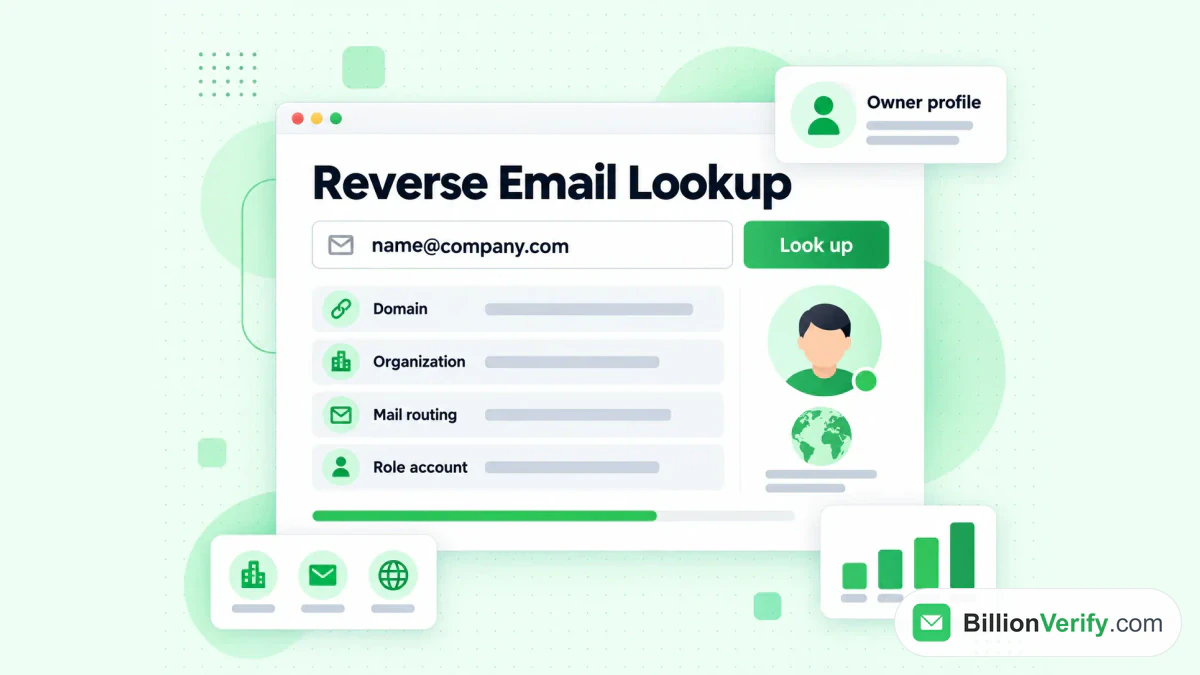
Our reverse email lookup shows the domain, the organization and the mail routing behind an address, and it uses public signals only. For a work address from a name and a company domain, see our guide to how to find someone's work email address. BillionVerify's Email Finder returns one verified work email for a person at a company, and it is available on paid accounts only. For a deeper look at one popular service, read our BeenVerified people search guide. For the Spokeo and ZabaSearch details, see is Spokeo legit and ZabaSearch.
Screenshot: the Whitepages front page, with the headline counts of identity and property records.
If you also collect phone numbers, our free phone number validator checks a number's format and country before anyone dials it. It does not say who answers the line.
FAQs
What is a people finder?
A people finder matches names, numbers and addresses to profiles drawn from open records. It combines data from many sources and ties it to one identity. The result is a summary of other records, so check it against a second source.
Is there a free people finder?
There are free first steps, not usually free full profiles. Sites such as ZabaSearch return a few fields at no cost and charge for fuller reports. Search engines, social networks and government databases such as NamUs cost nothing.
How does a people finder by name work?
You enter a first and last name, often with a location. The service searches its records for matching profiles and lists them. A location narrows a common name, and one more matching detail confirms a match before you rely on it.
Can a people finder by phone number find the owner?
Sometimes. Any number brings back its carrier and line type, and an owner name appears for landlines and shop lines more often than for personal mobiles. Whitepages puts full owner details for every number behind Premium.
Can a people finder by address show who lives there?
Partly. It can show the titled owner and, in some cases, past or current residents, using county and commercial data. Treat the residents as leads and confirm them with a second source.
Can a people finder by email name the person?
Rarely. A work address points to an employer, while a personal inbox usually reveals nothing public. Reading the domain and mail setup tells you about the organization, not the individual.
What is the difference between a person lookup and a people lookup?
Nothing important. Each label names the same search, and the only real difference is the interface a given site wraps around it.
Is a people finder legal to use?
Searching public records is legal for personal use. Using the results to decide on employment, tenancy, credit or insurance is not, because the FCRA covers those uses and the FTC enforces it. Harassment and stalking are separate offences.
Can I use a people finder to check a job candidate or tenant?
No. Spokeo's terms and ZabaSearch's notice both say the information must not be used for those purposes. A screening provider that complies with the Act is the lawful route, and it needs the person's consent.
Does the person know I searched for them?
Services generally do not tell the person. Policies vary, so read the terms of the service you use. A message to the person, of course, reveals that you found them.
How do I remove my information from a people finder?
Use the service's removal tool. PeopleConnect's Suppression Center is free and covers its main brands for name searches, and Spokeo has its own form for removing a profile. Removal does not erase the source records, and information can reappear later.
Do I need to verify an email I found with a people finder?
Yes. A found address can be old, mistyped or inactive. Verify it before you send, so you avoid bounces and protect your sender reputation.
Watch: How to Validate a Phone Number: Free Phone Number Validator
Watch: Free Reverse Email Lookup: What It Shows and What It Can't
Read next: Carrier Lookup: Find a Phone Number's Carrier and Line Type