



ZoomInfo vs Apollo is a classic head-to-head in B2B prospecting. Each sells contact intelligence to sales teams. Each holds hundreds of millions of business contact profiles. Each now wraps that database in AI. The real gap is in how they price access and which buyer they are built for.
Here is the short answer. ZoomInfo is the larger, quote-based platform for sales teams that want deep company signals and a rep to shape the contract. Apollo.io is the self-serve platform with public prices, a $0 entry plan and outreach tools in the same seat. Apollo vs ZoomInfo is less a question of which is good and more a question of which fits your budget and your sales process.
This guide compares ZoomInfo vs Apollo.io across eight areas: coverage, pricing, cost per contact, free tiers, integrations, compliance, AI and fit. Every fact comes from the two companies' own websites, read in October 2026. Where a ZoomInfo page blocked our browser, we used a recent copy saved by the Internet Archive. We are not affiliated with either company. BillionVerify is an email verification service, and the last section shows how to check an export from either tool before a campaign.
Key facts (checked October 2026):
- ZoomInfo says it holds profiles on 500M+ contacts and 100M+ companies, while Apollo.io lists 240M+ contacts and 30M+ companies.
- Apollo.io publishes its prices, starting at $49 per user a month on yearly billing, while ZoomInfo asks buyers to request a quote.
- On yearly Apollo Basic, one email reveal costs about 2 cents and one phone reveal about 16 cents.
- You can start at $0 on either side, with ZoomInfo Lite or Apollo's Free plan.
- ZoomInfo shows an ISO 27701 privacy badge on top of the two security badges that Apollo.io also holds.
- Contact details from any sales database can go stale, so check each address before a cold campaign.
ZoomInfo vs Apollo at a Glance
| ZoomInfo | Apollo.io | |
|---|---|---|
| Founded | 2007, Vancouver, Washington | 2015 |
| Stated coverage | 500M+ people, 100M+ firms | 240M+ people, 30M+ firms |
| Public price list | No, quote only | Yes, from $49 per seat monthly (annual) |
| $0 option | Lite edition | Starter plan, 75 reveals a month |
| Main sales product | ZoomInfo Sales and Copilot | Apollo.io platform with sequences and dialer |
| Native CRM links | Salesforce, HubSpot, Microsoft Dynamics 365 | Salesforce, HubSpot and 200+ integrations |
| Security badges | ISO 27001, ISO 27701, SOC 2 Type II | ISO 27001, SOC 2 |
| G2 score on its own site | 4.5 out of 5, 12,823 reviews | 4.7 out of 5, 9,690 reviews |
Each row comes from that vendor's own pages. The G2 numbers are the ones each company shows on its site, not our own count. The rest of this ZoomInfo vs Apollo review quotes the source for every row.
Who Makes Each Tool
The two companies come from different places. Their origins explain much of the ZoomInfo vs Apollo split.
ZoomInfo
ZoomInfo Technologies was founded in 2007. Its headquarters are in Vancouver, Washington, and it trades on the Nasdaq under the ticker GTM. Its pricing page says it is "Trusted by 35,000+ fast-growing companies worldwide." The 2025 annual report shows revenue of $1,249.5 million. It also counts 1,921 customers that pay $100,000 or more a year.
ZoomInfo sells five core paid products: Copilot, ZoomInfo Sales, Marketing, Operations and Talent. ZoomInfo Sales is the product most buyers mean when they weigh ZoomInfo against Apollo. The ZoomInfo Sales database also powers Copilot. Our ZoomInfo guide covers the full product line.
Apollo.io
Apollo.io was founded in 2015, per its About page. It began as a prospecting tool and grew into a full sales platform. Its data page asks visitors to "join over 600,000 companies using Apollo." The same page says Apollo.io has "2M+ data contributors."
Apollo.io puts search, sequences, a dialer and deal tools in one seat. Our Apollo.io guide explains each part.
Apollo.io also runs a page aimed at ZoomInfo buyers. Its Wall of Love calls Apollo "the fastest-growing and most-loved ZoomInfo alternative on the planet." That is the vendor's own claim, shown next to its G2 badges.
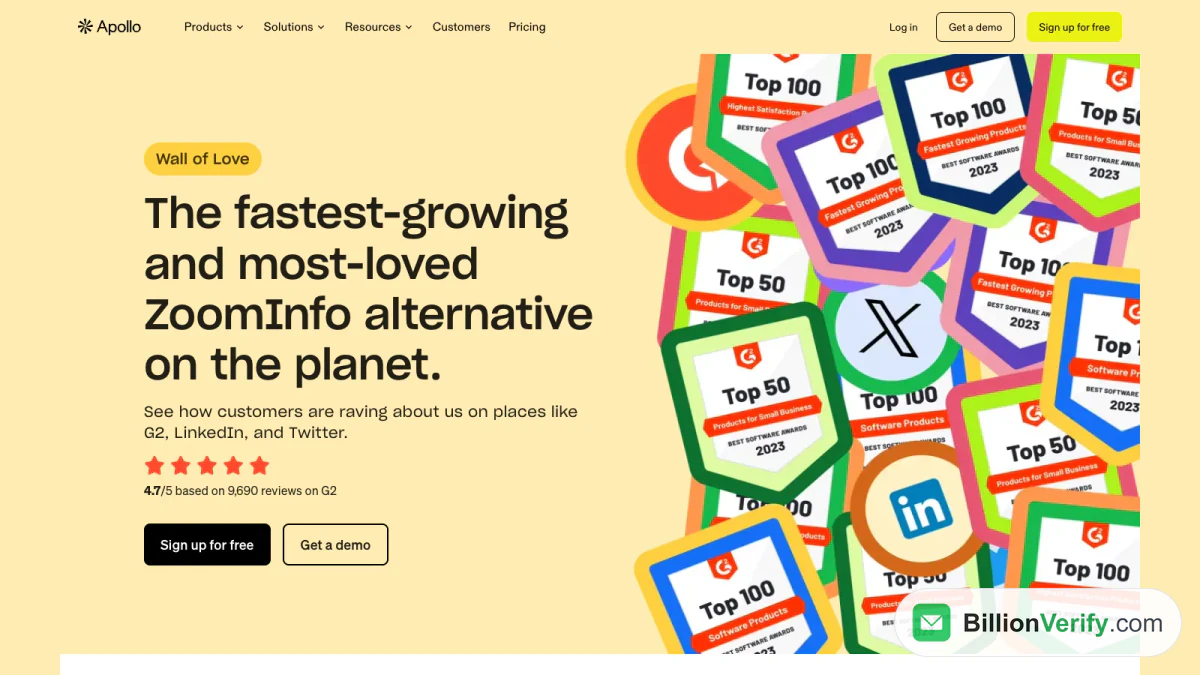
Screenshot: Apollo's "ZoomInfo alternative" Wall of Love page, late 2026.
Contact Coverage: ZoomInfo vs Apollo.io
Coverage is the first thing most sales buyers check. In the ZoomInfo vs Apollo coverage race, ZoomInfo leads on stated size.
ZoomInfo puts its reach at half a billion professionals. Its developer docs repeat that scale and add "50+ real-time buying and business signals." Apollo.io's figure is 240 million people across 30 million accounts.
On paper, ZoomInfo lists about twice as many people and more than three times as many firms. A headline count is not the same as a match rate for your market, though. The useful test is a sample of your own target accounts in each tool.
Where the contact data comes from
ZoomInfo names the public web, company websites, SEC filings and job postings as sources. It also runs a contributory network, where professionals share contact details in return for credits. ZoomInfo adds that "AI handles deduplication, and 300+ human researchers verify records."
Apollo.io describes a three-step model: source, enrich, orchestrate. Its own database fills fields first. When a field is empty, a "governed waterfall" checks "20+ leading vendors." Apollo.io also offers local business listings "sourced via Google Maps, inside Apollo." For leads that start on Google Maps, follow the Google Maps to cold email workflow from export to verified list.
Signals on top of contact data
Each tool adds signals to the raw contact list. ZoomInfo puts buyer intent, website visitors, champion tracking and job posting changes in its Copilot plans. Its Enterprise tier adds real-time intent, earnings call signals and custom intent.
Apollo.io shows intent, job changes and buying activity on its data page. Its Organization plan includes 12 intent topics. In this part of the ZoomInfo vs Apollo match, ZoomInfo offers the wider range of signals.
Pricing and Billing
Pricing is where Apollo vs ZoomInfo differs most. Apollo.io publishes a full table. ZoomInfo asks you to talk to sales.
ZoomInfo pricing
ZoomInfo does not publish prices. Its pricing page shows three sales plans: ZoomInfo Professional, Copilot Advanced and Copilot Enterprise. Each has a "Start free trial" button, and the page offers a "Get Pricing" form. No dollar amounts appear anywhere.
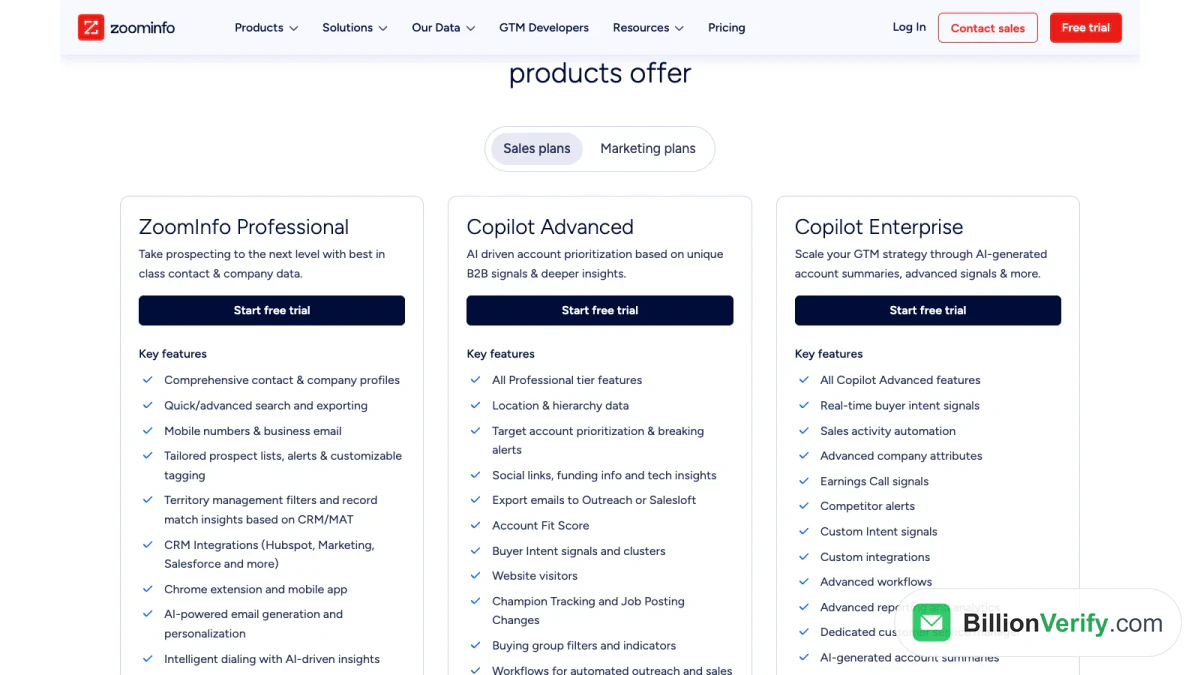
Screenshot: ZoomInfo's sales plans, from an archived copy dated October 17, 2026.
The pricing FAQ explains what drives a quote. It names three factors: "Features and functionality," "Number of licenses" and "Credit usage." It adds that the price of ZoomInfo credits "is based on the depth of information a customer requires." Basic credits cover firmographic details. Richer credits cover items such as technographics, org charts and funding alerts.
Two more lines matter for budgeting. ZoomInfo's packaged integrations "typically have a base cost to use and install and require a minimum purchase of bulk credits." Its Streaming Intent add-on is priced on "the volume of keywords and account universe" a customer wants to track.
The current ZoomInfo homepage FAQ frames it a little differently. It says ZoomInfo is "free to start with consumption credits based on usage" and "doesn't charge by fixed seat tiers." The annual report says pricing is "based on the functionality, users, and records under management." In short, a ZoomInfo Sales quote depends on your plan, your users and your credit volume.
Apollo.io pricing
Apollo.io lists every plan on its pricing page. Here are its prices per user each month this fall.
| Plan | Paid yearly | Paid monthly | Yearly allowance |
|---|---|---|---|
| Free | $0 | $0 | 900, released 75 a month |
| Basic | $49 | $65 | 30,000 |
| Professional | $79 | $99 | 48,000 |
| Organization | $119, three-user minimum | Annual only | 72,000 |
Apollo.io calls these introductory prices and says they may change. Credits pay for reveals: 1 credit for an email address and 8 for a phone number. Unused credits lapse at the end of each billing cycle. Our Apollo.io pricing guide walks through every limit.
Cost per Contact: ZoomInfo vs Apollo
Plan prices are hard to compare when ZoomInfo has no list. A better yardstick is cost per contact, ZoomInfo vs Apollo, measured on the people you actually reveal.
What Apollo.io charges per reveal
Apollo's numbers can be worked out from its own page. On yearly Basic, a single user pays $588 for 30,000 credits. That is about 2 cents a credit.
- Email only: 1 credit, roughly two cents.
- Phone only: 8 credits, near 16 cents.
- Email plus phone: 9 credits, around 18 cents.
- Monthly Basic: $65 for 2,500 credits, so about 2.6 cents an email.
- $0 plan: up to 75 email reveals a month at no charge.
Professional works out to the same rate on annual terms: $948 for 48,000. Seat count changes the total bill but not the unit price, because Apollo.io pools credits for the whole team.
ZoomInfo cost per contact
Apollo.io publishes enough to work out its cost per contact. ZoomInfo does not, so the number cannot come from public pages. You need the quote. Ask the ZoomInfo sales rep five questions:
- What is the total yearly contract price?
- How large is the included allowance?
- What does one email, one direct dial and one company profile use up?
- Do unused credits roll over?
- Does each CRM integration need its own minimum credit purchase?
Then divide the contract value by the number of people those credits can reveal. That gives your true cost per contact, ZoomInfo vs Apollo, on equal terms. Add any integration minimums and add-ons, such as Streaming Intent, to the top line before you divide.
Cost per usable contact
The number that matters most is what each reachable person costs. A record you pay for but cannot reach is pure cost. Say 1,000 Apollo.io reveals cost $20 and 100 of them bounce: you paid $20 for 900 good addresses. A ZoomInfo export follows the same math. That is why a list check before sending belongs in any cost per contact sum.
So when you set cost per contact, ZoomInfo vs Apollo, side by side, use the deliverable count, not the export count.
Free Plans and Trials
Each vendor lets you start without paying. The two no-cost tiers work in different ways.
Lite and the ZoomInfo trial
Lite is ZoomInfo's permanent $0 edition. ZoomInfo states that it "requires no credit card and no commitment." The annual report calls it a freemium product with "a set amount of monthly credits." Users can earn more each month by joining the contributory network.
ZoomInfo also offers a trial of its paid plans. For developers, GTM.AI starts with "1,000 data + 1,000 AI credits free."
The Apollo Free plan
Apollo.io's $0 tier has no end date and needs no card. Each user gets 900 credits a year, released at 75 a month. It allows two sequences per team and 250 email sends daily. Gmail is the only mailbox option on this tier.
Basic and Professional also come with a 14-day trial. Apollo.io says the trial "includes 75 credits and access to most features in the plan you selected."
In an Apollo vs ZoomInfo test run, Apollo's $0 plan gives you sequences as well as lookups. Lite gives you a taste of the ZoomInfo database. Neither suits a full outbound program.
Integrations
Both vendors connect to the CRMs most revenue teams use. The depth and the cost differ.
ZoomInfo integrates natively with Salesforce, HubSpot and Microsoft Dynamics 365. Its Partners & Integrations page showed "187 integrations found" when the Internet Archive saved it on October 10. The list runs from 6sense and Aircall to Amazon Web Services. The ZoomInfo Professional plan includes "CRM Integrations (Hubspot, Marketing, Salesforce and more)." Copilot Advanced adds "Export emails to Outreach or Salesloft."
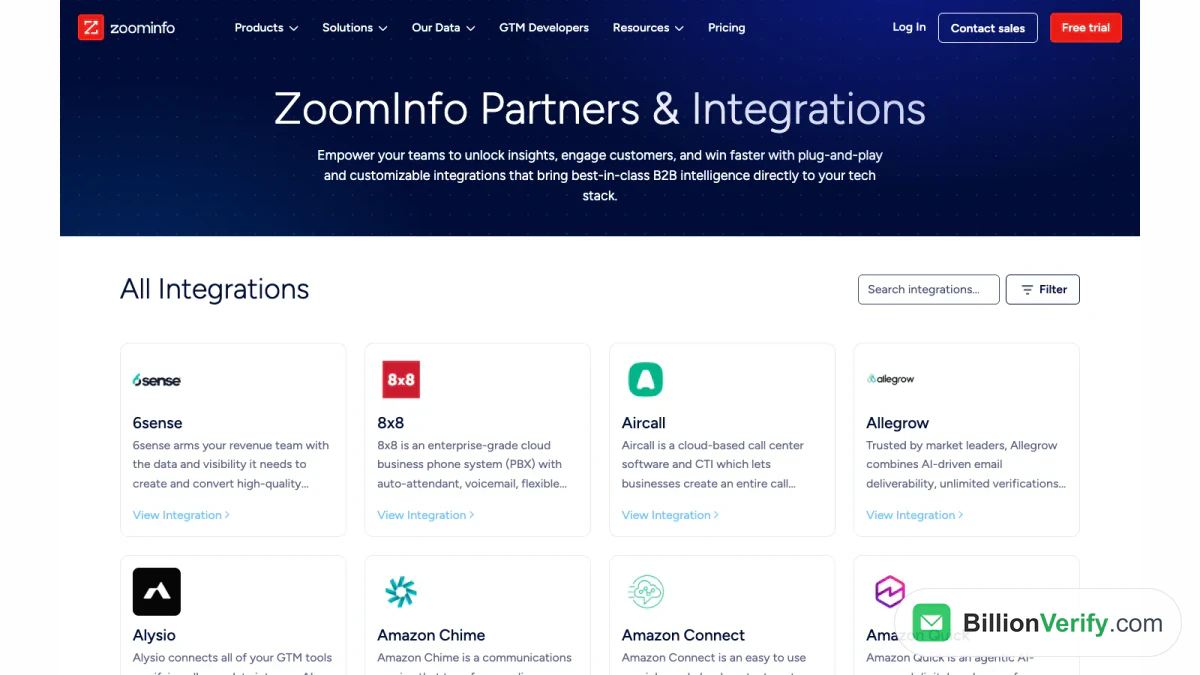
Screenshot: the ZoomInfo Partners & Integrations directory, archived in mid-October.
Apollo.io cites "200+ integrations to push data into your existing stack." Basic comes with core CRM integrations, and Professional adds advanced ones. Custom integrations through the API belong to custom plans.
In Apollo vs ZoomInfo terms, there is a practical gap. Apollo.io has its own sequences and dialer, so many of its users never export to a separate outreach tool. ZoomInfo plans include export paths to separate outreach platforms instead.
Each vendor also runs a Model Context Protocol (MCP) server for AI agents. ZoomInfo names Claude and ChatGPT as assistants that can connect. Apollo.io lists Apollo MCP in its product menu.
Compliance and Security
Contact profiles describe real people, so privacy law applies. Each vendor publishes its compliance stance.
ZoomInfo says it "processes professional contact data under GDPR's legitimate-interest basis, honors data subject rights." Its homepage lists three certifications. The ZoomInfo Trust Center adds TRUSTe Enterprise Privacy Certification and the EU-US Data Privacy Framework.
Apollo's security page says it is "ISO 27001 and SOC 2 certified" by A-LIGN. It calls Apollo.io "GDPR compliant as both a Data Processor and Data Controller." Data is encrypted in transit and at rest. Integrations use OAuth2, and "credentials are not stored for those services." A third party runs penetration tests every year.
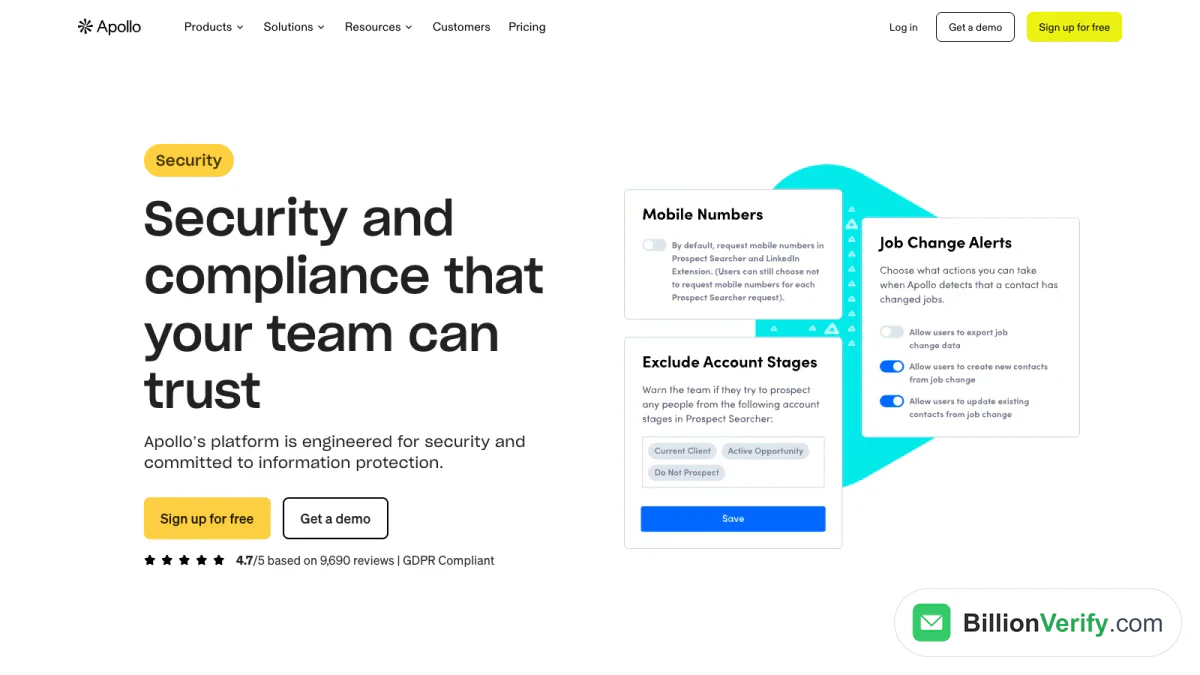
Screenshot: Apollo's Security page with its admin privacy controls.
ZoomInfo carries one extra standard, which covers privacy management. For a buyer with a tough vendor audit, that badge can matter. For most small teams, either set of badges will clear a basic vendor check.
On paper, ZoomInfo vs Apollo.io is close on compliance. Vendor compliance does not cover your own sending, though. Under GDPR and anti-spam laws, you still need a lawful basis and an opt-out in every cold email.
AI Features
Both vendors now lead with AI. The products differ in where the AI sits.
ZoomInfo AI
ZoomInfo Copilot is the "AI sales agent" in ZoomInfo's menu and the first core paid product in its 10-K. The Advanced tier adds AI account prioritization, an Account Fit Score and AI-generated talking points. Copilot Enterprise adds AI account summaries, AI ideal customer profile creation and Copilot chat.
ZoomInfo GTM Studio builds workflows that run on buying signals. Developers reach the ZoomInfo database through GTM.AI, with an API, a CLI and an MCP server.
Apollo.io AI
Apollo.io includes an AI Assistant on every plan. The Free tier caps it at five chats. Paid plans add AI writing, with monthly word limits per tier. AI research draws a credit per run. Professional adds AI lead scoring.
Apollo.io says chatting with its assistant uses no credits, while research and enrichment tasks do. It also says customer data is not used to train the outside models behind its AI.
In short, ZoomInfo vs Apollo.io in AI splits by layer. ZoomInfo AI sits on top of a large signal layer. Apollo AI sits inside the daily work of writing and sending.
When Does ZoomInfo Outperform Apollo?
So when does ZoomInfo outperform Apollo? Based on what each vendor states, it tends to when five traits apply.
- You sell to large accounts. ZoomInfo lists more companies and more people. Enterprise sellers often need many contacts inside one account.
- You run on intent signals. ZoomInfo offers real-time intent, Streaming Intent, website visitors and earnings call signals.
- You face a tough vendor audit. ZoomInfo adds a privacy badge and TRUSTe to the common ones.
- You already use Outreach or Salesloft. Copilot Advanced includes export paths to both.
- You also hire. ZoomInfo Talent covers recruiting, which Apollo.io does not sell.
In these cases, ZoomInfo can outperform Apollo even at a higher price. A higher cost per contact buys more signals per account. Where ZoomInfo does not outperform Apollo is price transparency and speed to start.
When Apollo Is the Better Fit
Apollo.io wins on other terms.
- You need a price today. Apollo.io shows every plan and limit in public.
- You want one tool. Apollo.io includes sequences, a dialer and AI writing in the same seat.
- You are a small team. Basic starts at $49 a user per month, billed annually.
- You want to start at $0. The no-charge plan comes with sequences, not just lookups.
- You want month-to-month terms. Basic and Professional can be paid monthly.
For most startups, Apollo vs ZoomInfo comes down to this list. Apollo.io is easier to buy and easier to start.
Which Is Better: ZoomInfo Sales vs. Apollo.io?
Which is better: ZoomInfo Sales vs. Apollo.io? The ZoomInfo vs Apollo choice depends on team size, budget and sales motion.
| If your team... | Lean toward |
|---|---|
| Sells to enterprise accounts with long cycles | ZoomInfo Sales |
| Needs a tool live this week without a contract | Apollo.io |
| Relies on intent and website visitor signals | ZoomInfo Sales |
| Wants prospecting and sequences in one seat | Apollo.io |
| Has a procurement team and a security review | ZoomInfo Sales |
| Has one to five reps and a fixed budget | Apollo.io |
Some teams use both. They buy ZoomInfo Sales for account research and Apollo.io seats for outreach. If you do that, watch for duplicate profiles when two tools sync into one CRM. Both are capable contact intelligence platforms, and the right pick is whatever your sales reps will use every day.
Other Contact Intelligence Tools
ZoomInfo vs Apollo is not the only match buyers run. Many shortlists for contact intelligence also include RocketReach. A full ZoomInfo, Apollo, RocketReach contact intelligence review adds a third source and a third price model. Our RocketReach guide covers that tool.
Whichever three you test, use the same sample. Pick 50 target accounts. Look them up in each product. Count how many contacts you get and what each costs. That small test tells you more than any headline database size. It is the fairest way to run a ZoomInfo, Apollo, RocketReach contact intelligence trial.
Verify Exports From Either Tool
Whatever the ZoomInfo vs Apollo verdict, every contact database ages. People change jobs, and companies change domains. An address that was right at the last update may bounce today. That holds for ZoomInfo and for Apollo.io alike.
Bounces hurt more than one campaign. A high bounce rate damages your sender reputation, and future mail lands in spam. Mailbox providers watch it closely.
Before you send, check the export:
- Export the list as a CSV from ZoomInfo or Apollo.io.
- Upload it to an email verifier and let it check syntax, domain, MX and the mailbox.
- Keep the deliverable rows. Remove undeliverable ones.
- Handle catch-all domains with care. A catch-all domain accepts any address, so the mailbox cannot be confirmed.
- Re-import the clean list into your sequence tool.
BillionVerify checks lists from both tools. Our pages on ZoomInfo email verification and Apollo email verification show the steps for each export. BillionVerify reports catch-all, role, disposable and unknown results as separate groups. Unknown results cost nothing. You get 20 free credits every day you use your account, up to 600 a month, with no card required.
To see what a bad list costs, try our email bounce rate calculator. Enter sends and bounces to see where you stand against common thresholds.
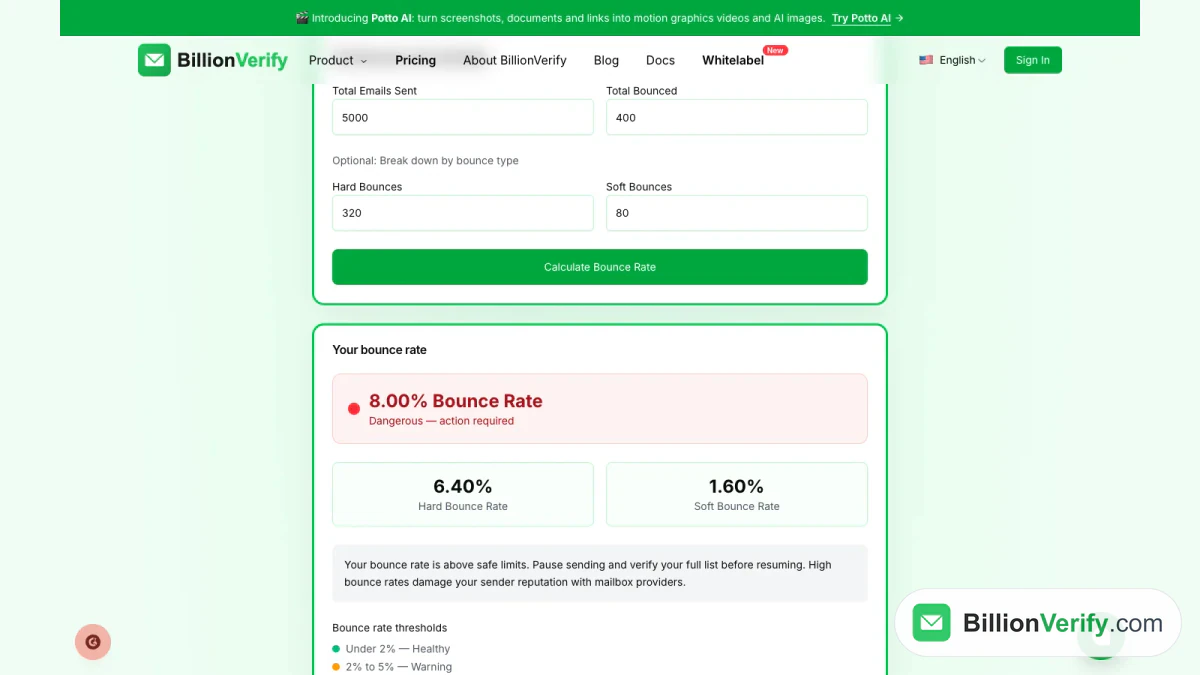
The BillionVerify bounce rate calculator splits a result into hard and soft bounces.
Two free tools help with single checks. A reverse email lookup shows the domain, organization and public signals behind a single address. A phone number validator checks whether a direct dial from either vendor is valid for its country and shows the line type.
Frequently Asked Questions
Is ZoomInfo better than Apollo?
ZoomInfo suits enterprise sales teams that need a large database, intent signals and extra certifications, while Apollo.io suits smaller teams that want public prices and built-in outreach. Run a short trial with real target names before you sign.
Is Apollo cheaper than ZoomInfo?
Apollo.io is usually the cheaper entry point, because its paid plans start at $49 a seat and its entry plan costs nothing. ZoomInfo quotes each deal, so compare the full contract value, not the seat price.
What is the cost per contact on Apollo?
An Apollo.io email reveal runs near two cents on annual Basic, and a phone number about eight times that. The math is $588 divided by 30,000 credits.
How do I compare cost per contact, ZoomInfo vs Apollo?
To line up the two, use Apollo's published credit math, then divide ZoomInfo's yearly contract price by the number of people its credits can reveal. Count only deliverable addresses on both sides.
When does ZoomInfo outperform Apollo?
Expect to see ZoomInfo outperform Apollo for enterprise accounts, intent-led selling and formal vendor audits. Apollo.io tends to win on public pricing, a no-cost start and built-in sequences.
Does ZoomInfo have more contacts than Apollo?
ZoomInfo states larger coverage than Apollo.io, with 500 million people against 240 million. Match rates for your own market can differ from those totals.
Do ZoomInfo and Apollo both have a free option?
Yes, each vendor has a $0 tier: ZoomInfo Lite and the Apollo Free plan. Apollo's version gives 75 credits a month and includes sequences, while Lite gives a set allowance each month.
Should I verify emails from ZoomInfo or Apollo?
Emails exported from ZoomInfo or Apollo.io should be verified before a campaign, because people change jobs between database updates. A verifier removes undeliverable addresses and flags catch-all domains, which protects your sender reputation.
Watch: How to Verify Emails Before Importing into Salesloft
Watch: How to Validate a Phone Number: Free Phone Number Validator