



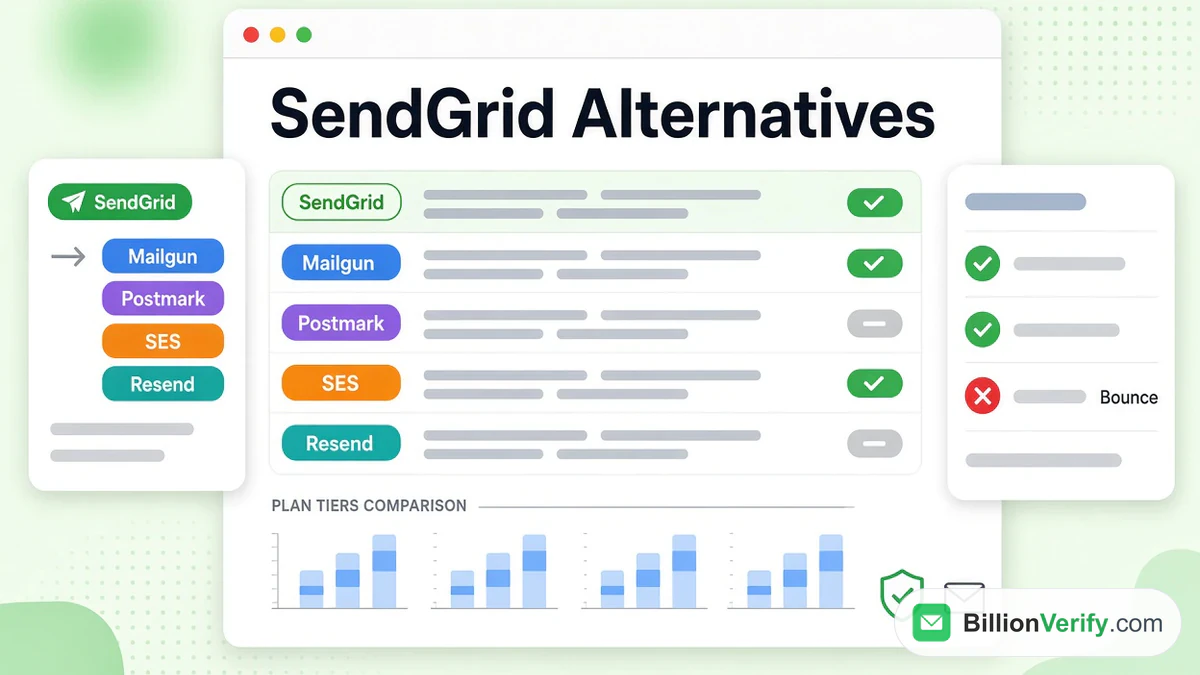
The main SendGrid alternatives are Postmark, Mailgun, Resend and Amazon SES. All four sell an API and an SMTP relay for transactional sending, and each prices its first rung differently: Mailgun and Postmark begin at $15 monthly, Resend at $20, and the AWS service charges by the thousand. SendGrid itself offers a trial of two months and then Essentials at $19.95, so the right pick depends on your volume, your appetite for a free quota and whether you want validation included.
This comparison uses only the vendors' own pricing pages, read at the time of writing, and it makes no claim about which service is best. Prices change, so confirm them before you move. BillionVerify is not connected to any of these companies, and we do not tell you to contact any of them.
Key facts (checked November 2026):
- SendGrid's API pricing starts with a trial, then moves to Essentials and Pro.
- Mailgun's price list shows a free tier, then Basic, Foundation and Scale at rising prices.
- Postmark has a no-charge developer tier and a trio of paid plans with an identical entry volume.
- SES lists sending by the thousand and charges a cent for each validation.
- Resend has the roomiest entry quota of the four, then Pro and Scale.
- BillionVerify checks a list ahead of any provider, so bad addresses never reach the service you pick.
Why People Look for SendGrid Alternatives
Most searches for a SendGrid alternative start with one of four reasons. The first is the free offer, because SendGrid's is now a two-month trial rather than an open-ended allowance. The second is cost at low volume, where the jump after the trial can feel steep. The third is features locked behind higher tiers, such as a dedicated IP or address validation, which come with Pro and above. The fourth is curiosity, since sending services are easy to swap when your app talks to them through a standard SMTP login.
Our guide to what SendGrid is explains the product itself, and the SendGrid pricing guide lists each tier. This article takes the next step and sets four alternatives beside it. For people who arrived from a newsletter tool, Mailchimp vs SendGrid covers that matchup separately.
SendGrid Alternatives at a Glance
The table puts the entry point of each alternative next to SendGrid: what you get at no cost, the opening price and how each one handles validation. Checking matters here because the goal is to keep undeliverable sends off your sending reputation.
| Service | Free option | First paid tier | Validation |
|---|---|---|---|
| SendGrid | Trial | Essentials, $19.95 | Pro and Premier only |
| Mailgun | 100 daily | Basic, $15 | Add-on, included on Scale |
| Postmark | 100 monthly | Basic at $15 | Not listed |
| SES | Up to $200 of credit | $0.10 per 1k | Add-on, $0.01 each |
| Resend | 3k monthly | Pro, $20 | None listed |
Mailgun
Mailgun is the closest like-for-like rival among the four. Its tiles open with a free plan that allows a hundred messages daily, with ticket support, one custom domain and a day of log retention. Basic starts at $15 for 10k messages, Foundation costs $35 for 50k and begins with a trial month, and Scale costs $90 for 100k. Overage prices begin at $1.80, $1.30 and $1.10 per thousand on those three rungs.
The feature split resembles SendGrid's. IP pools, single sign-on and send time optimization sit on Scale, which is also the only plan with an included validation allowance of 5k. The lower plans can buy validations as an add-on, quoted from $1.20 per 100, and Scale from $0.80 per 100. Mailgun was founded in 2010 and has belonged to Sinch since 2021, according to its own history page. Our Mailgun login guide covers sign-in and sign-up, and Mailgun pricing goes through every tier.
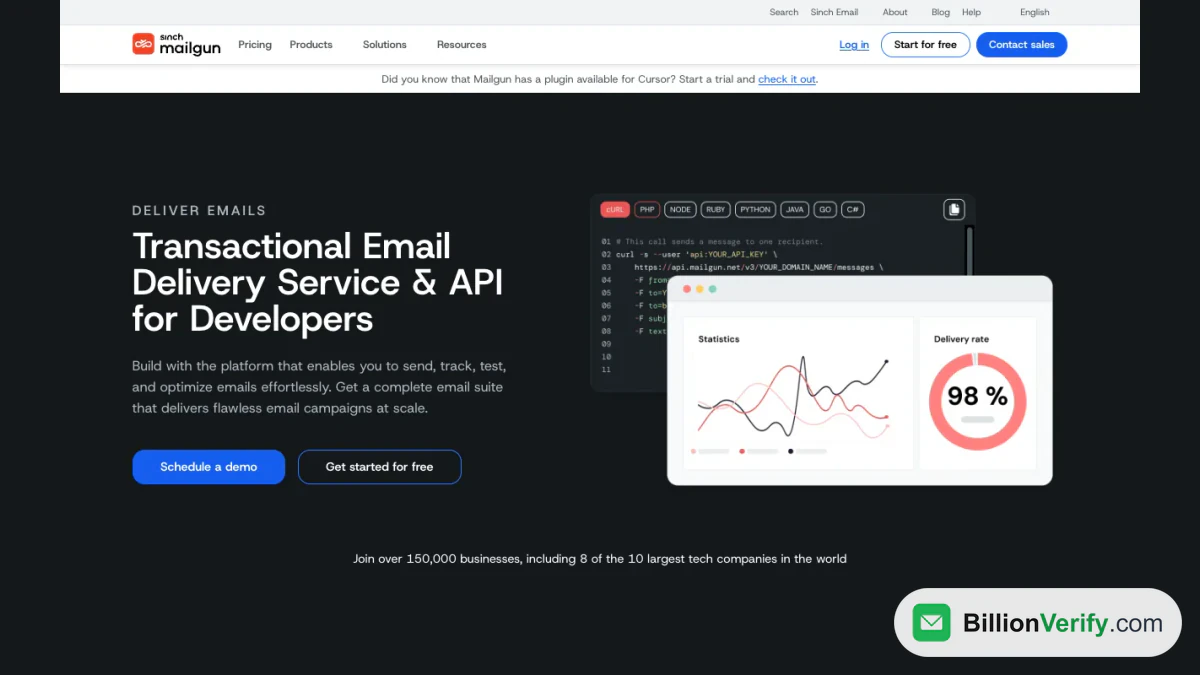
Screenshot: Mailgun's home page, which describes its API and SMTP service for developers.
SendGrid vs Mailgun
In a SendGrid vs Mailgun comparison, the price lists are close at the bottom. Mailgun's entry plan sits slightly under SendGrid Essentials, and both tie validation to costlier plans. At the top they look alike too, because reserved IPs and sign-on controls sit on the upper plans of each. The practical gap is what you get at the start: Mailgun's no-cost entry carries a daily ceiling, while SendGrid has a trial.
Postmark
Of these alternatives, Postmark keeps its pricing the shortest. Everyone starts on a developer plan of 100 messages monthly, and that plan does not expire or allow overages. The three paid levels share one starting volume of 10k: Basic costs $15, Pro is $16.50 and Platform is $18, with extras priced from $1.80 on Basic, $1.30 on Pro and $1.20 on Platform per 1k. The plans differ in custom sending domains, at 5, 10 and unlimited, and in data retention, where Pro and Platform can extend the 45-day default up to a year.
The page also lists dedicated IPs for senders above 300k, starting at $50 monthly per IP. Its comparison table separates transactional message streams from marketing and bulk streams. Nothing we read on Postmark's site mentions a built-in checker, so a team that wants one before sending would need to add it. SendGrid vs Postmark comes down to scale: SendGrid offers a longer ladder of plans, while Postmark holds a shorter feature list and a developer entry that never expires.

Screenshot: Postmark's plan screen, which opens with a volume slider and a free trial button.
SES on AWS
SES is the odd one out here: priced by volume instead of by tile, it is the cheapest per message on paper. AWS's page offers an à la carte rate of ten cents per thousand outbound, plus $0.12 per GB of attachments, with no minimum fees. It also lists three bundled plans, whose rates for the first ten million are $0.16, $0.22 and $0.23 per thousand, with monthly fees of $105 for the middle one and $500 for the top one. New AWS customers receive up to $200 in credits that can be applied to the service.
For address checks, SES has the most detailed answer of the group. Validation is a paid add-on on the bundle called Essentials and is included on the other two, with 2,500 and 5,000 API validations respectively. Extra validations cost $0.01 each, and automatic validation of every send costs $0.01 per 1,000. The trade-off is that it is a set of AWS building blocks rather than a finished product, so you manage identities, quotas and warm-up in a console built for engineers.
Screenshot: the opening page of the AWS developer guide, which describes what the service does.
Resend
Resend is the newest of the alternatives and is aimed at developers. Its free allowance includes 3k messages a month, capped at a hundred daily, with three domains and a month of retained data. Pro runs $20 for 50k, and the page lists $35 for 100k. Scale starts at $90 and climbs by volume, with extras above the included amount from $0.90 per 1k on Pro. A reserved IP is a $30 add-on on Scale for customers sending more than 3k daily.
Resend also has a separate marketing product with its own pricing, billed by contact count. Like Postmark, its pricing lists no address checker, so list checking stays outside the service. SendGrid vs Resend is mostly a question of what you get before paying: a monthly quota against a time-boxed trial, and a developer-first interface against a larger feature set.
Screenshot: Resend's documentation introduction, which presents it as the email API for developers.
Choosing Among the Alternatives to SendGrid
Put side by side, the alternatives split into two camps. Resend, Postmark and Mailgun use plan tiles with included volumes, while the AWS option works on usage-based rates with optional bundles. On the free side, Resend gives the most monthly room, Mailgun and Resend both cap by the day, and Postmark hands out a small allowance for testing. No source used here supports calling any of these alternatives better overall, so pick by volume and the features you cannot live without. The lowest cost per send belongs to SES, and the simplest pricing page to Postmark.
Keep Hard Bounces Away From Any Provider
Whichever service you choose, mailbox providers judge you on the recipients you send to. A domain that keeps producing failed deliveries gets treated with suspicion, and the sender's platform will often suppress those recipients after the first failure. Switching vendors does not reset your list, so a dirty one follows you.
Only some of the alternatives include a check. SendGrid reserves checks for its upper tiers, Mailgun includes an allowance on Scale, and SES includes one on its two larger bundles. Where a provider has no check, or where you have used your allowance, an outside check is the practical step. An email verifier tests one address, and bulk email verification handles a whole file before you import it. BillionVerify charges 1 credit for each valid or invalid result and nothing for unknown results, reports catch-all addresses as their own class, and gives a free account 20 credits on each day it is used, up to 600 a month, with no card. We compare the vendors' own tools in SendGrid email validation.

For a sign-up you do not recognize, a reverse email lookup shows what is publicly tied to it. If your product also sends texts, a phone number validator checks the numbers first.
FAQs
What is the cheapest alternative to SendGrid?
SES has the lowest per-message rate when used without a bundle. For a flat monthly price, the entry plans at Mailgun and at Postmark cost the same $15.
Which alternative has the most generous free usage?
Resend offers the largest monthly allowance, with a daily cap. Mailgun gives a daily quota, and Postmark a small monthly one.
Is Mailgun cheaper than SendGrid?
At the entry level, yes by a small margin. Volumes and features differ, so compare the exact tiers you need.
Do these alternatives check addresses?
Some do. SendGrid, Mailgun and SES each build a check into certain plans, whereas the Postmark and Resend lists show none.
Can I switch without changing my code?
If your app sends over SMTP, you mostly change the host, the username and the secret, because every option above offers a relay. Apps built on the SendGrid API need code changes, since each provider has its own API.
Watch: How to Verify an Email: Single, Bulk, File and API
Watch: How to Validate a Phone Number: Free Phone Number Validator