



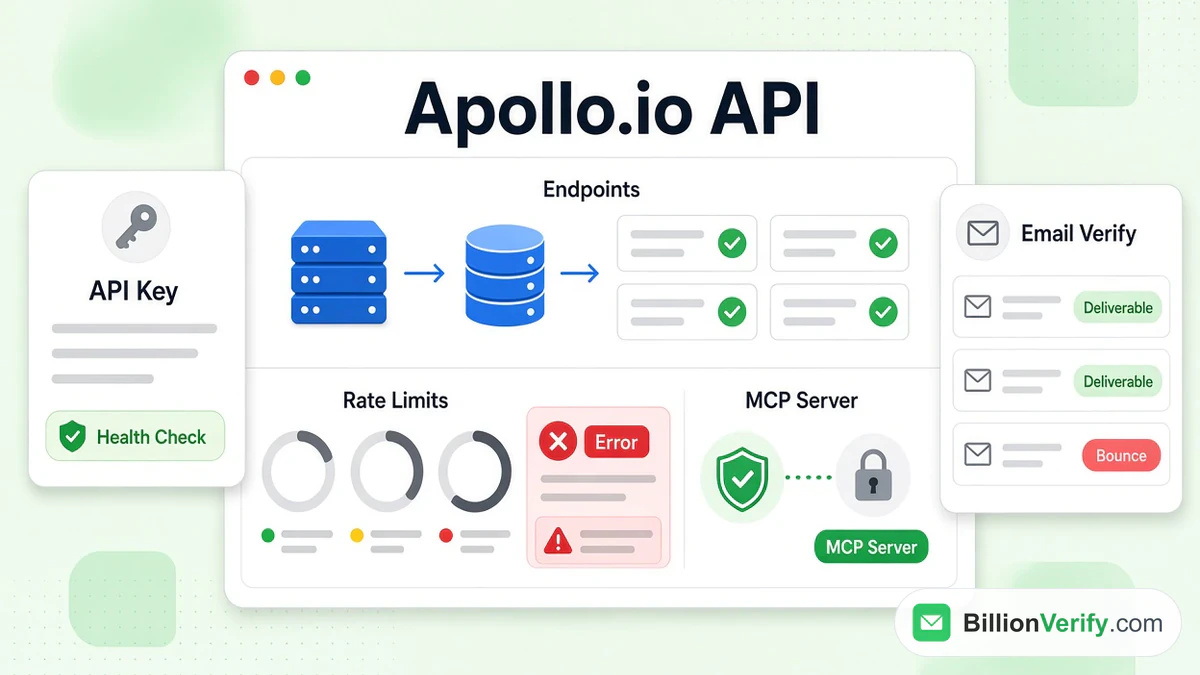
The Apollo.io API lets your own code search for people, enrich records and manage your sales workflow. You call it over HTTPS with an Apollo.io API key. You can also skip the key and let an AI client reach the same data through the Apollo.io MCP server. Both routes spend your plan's credits and follow your plan's limits.
This guide walks through the Apollo.io API from the first click to the first call. It shows how to create a key and where to find it. It covers the Apollo.io API documentation, the health check, people search, enrichment, rate limits and credit costs. It ends with the official MCP server for Apollo.io and a routine for checking the addresses the API returns. Everything comes from the official developer docs at docs.apollo.io, read in October 2026. Apollo.io marks several pages as recently updated, so confirm details on the day you build.
We are not affiliated with Apollo.io. BillionVerify is an email verification service. For a wider view of the platform, read our Apollo.io guide.
Key facts (checked October 2026):
- Every tier, free included, comes with some access to the API. Free accounts need a work email for certain endpoints.
- The Apollo.io API sends the key in the
x-api-keyheader, and the base URL ishttps://api.apollo.io/api/v1. - A scoped Apollo.io API key reaches only the endpoints you tick. A master key reaches all of them.
- Most endpoints accept 200 calls each minute on a paid tier, against 50 on the free tier.
- The Apollo.io MCP server lives at
https://mcp.apollo.io/mcpand signs in with OAuth.
What the Apollo.io API Does
Apollo.io describes its API as a way to search, enrich, create and manage data programmatically. Behind it sits a database of more than 240 million contacts and 30 million companies. The docs sort the work into three jobs:
- Build integrations. Connect your product to Apollo.io data, create accounts and drive sequences.
- Enrich data. Fill in people and company records one at a time, or in bulk.
- Find people. Search by job title, location, seniority and many other filters.
Your plan decides which endpoints you can use, how fast you can call them and what each call costs. Apollo.io also says its tools cannot do anything you could not do in the app. If your account lacks a feature, the API will not unlock it.
Which plans include the API?
The developer FAQ says every tier has basic access. More advanced functions sit on certain tiers only. Our Apollo.io pricing guide lists the tiers and their credit pools.
One catch applies to free accounts. Some people search, enrichment and record endpoints need an account registered with a work email address. Each affected endpoint page says so. Paid accounts are not affected.
Who is the Apollo.io API for?
Three groups use it most:
- Sales and RevOps teams who want to push enriched data into a CRM or a data warehouse.
- Developers at software companies who embed Apollo.io data in their own product.
- Partners who build marketplace integrations. They sign in with OAuth 2.0 instead of a key.
Apollo.io adds a licensing note. Sharing, exposing or reselling its data to people who are not Apollo.io users needs a custom contract.
Apollo.io API Documentation: Where Everything Lives
The Apollo.io API documentation sits at docs.apollo.io. The top bar splits it into Get Started, API, MCP, CLI, OpenAPI and Changelog. The API section holds one page for each endpoint.
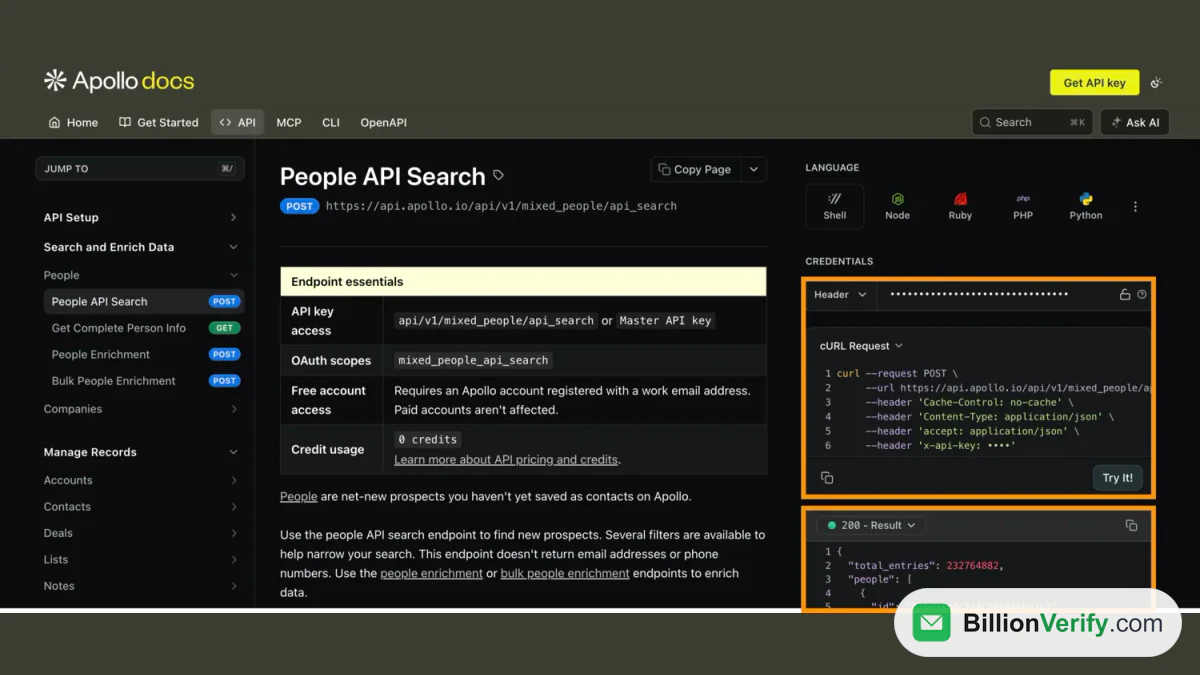
Screenshot: the People API Search page in the Apollo.io developer docs, from Apollo.io's guide to testing a key.
Every endpoint page follows the same pattern. An "Endpoint essentials" box at the top lists the key access path, the OAuth scope, who can use it and how many credits it costs. Below it come the parameters. On the right you get a language picker, a credentials field, a cURL request and an example response.
You can test live from the page. Paste your key into the header field, fill in the required parameters and press Try It. A 200 means the call worked. Even without a key, you can open each example response to see the schema.
The OpenAPI file
Apollo.io publishes the whole API as one OpenAPI 3 file at https://docs.apollo.io/openapi/apollo-rest-api.json. It is rebuilt whenever the docs change. Load it into Postman or another API client and every endpoint arrives with its parameters. You can also feed it to a code generator to build a typed client in your own language.
In Postman, keep the key in the preconfigured API Key authorization and set an apiKey variable. The docs warn that pasting the key as a Bearer token returns a 401. Bearer tokens are for OAuth partners.
A machine-readable index
The docs also publish a plain-text index at docs.apollo.io/llms.txt. It lists every page as a Markdown link. AI coding tools can read it to find the right endpoint page without crawling the site.
How to Get Apollo.io API Key
An Apollo.io API key is created inside the app, not on the docs site. The path is Settings, then Integrations, then API Keys. Only admins can do this, and so can users whose permission profile covers keys.
Here is how to get Apollo.io API key access step by step:
- Open Apollo.io and click Settings > Integrations > API Keys. The developer dashboard at developer.apollo.io shows the same page.
- Click Create new key.
- Enter a name and a description.
- Tick each endpoint the key may call, or switch on Set as master key.
- Click Create API key.
- Click Copy and paste the key somewhere safe.
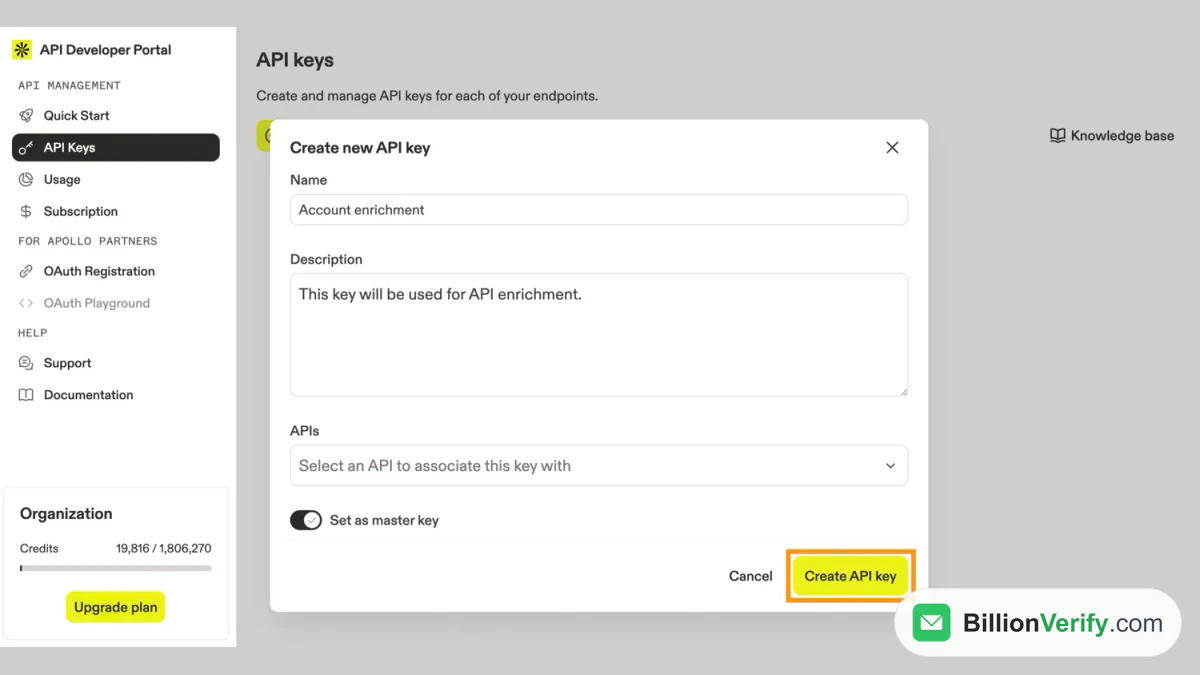
Screenshot: the Create new API key dialog in the Apollo.io developer portal, from Apollo.io's docs.
Apollo.io shows the full key at the end. Copy it then. If you lose it, regenerate it from the dashboard.
Where to find an existing Apollo.io API key
If you need to find an Apollo.io API key you made earlier, go back to the developer dashboard and open API keys. Each key you made sits in that list. The portal sidebar also holds Quick Start, Usage and Subscription pages. The same sidebar has an OAuth Registration page for partners.
Apollo.io lets you do two things with an existing key. Regenerate gives you a fresh secret and copies it. Delete removes the key for good. Treat both as one-way doors, because every script that used the old key breaks.
Master key or scoped key?
This choice matters more than any other when you create an Apollo.io API key.
| Type | What it reaches | Use it for |
|---|---|---|
| Scoped key (default) | Only the endpoints you ticked | Most integrations |
| Master key | Every endpoint | Endpoints that demand it, and the MCP server over a key |
A scoped key calling an endpoint you did not tick gets a 403. Some endpoints, such as the workspace user list, only work with a master key. Apollo.io tells you to treat a master key like a password. It can take any API action your account allows.
Which user does a key act as?
An Apollo.io API key identifies your workspace, not a person. Apollo.io cannot tell which teammate used it. Every request acts as the workspace's longest-standing active admin, and that user owns whatever the call creates. To see who that is, call the get current user profile endpoint, which is free of credits.
This surprises teams who create a key from a limited-permission login. The key does not narrow what the code can reach.
Apollo.io API Health Check
The quickest way to test a new key is a single health call. It is one GET request to auth/health, and no credits are spent.
curl --request GET \
  --url 'https://api.apollo.io/api/v1/auth/health' \
  --header 'Content-Type: application/json' \
  --header 'x-api-key: YOUR_API_KEY'
If everything is set up right, the Apollo.io API health check returns two values:
{ "healthy": true, "is_logged_in": true }
When both are true, the key works. If either is false, look for stray spaces or line breaks after the key, then send the request again. In Postman, set the Authorization type to No Auth and add the key as a header instead.
Is the Apollo.io API down?
People who search for this term sometimes want a different answer. They want to know whether the service itself is down. The auth/health call tests your key and a sign-in, not the whole platform. For outages, Apollo.io runs a status page at status.apollo.io.
A 429 response with the code USAGE.RATE_LIMIT.PLATFORM_RATE_LIMIT means the platform is rejecting traffic because of high load across the board. It has nothing to do with your plan. The docs say to wait 60 seconds and retry.
Main Endpoint Groups in the Apollo.io API
The reference lists dozens of endpoints. They fall into six groups.
| Group | What it covers | Examples |
|---|---|---|
| Search and enrich | Find people and companies, fill in records | People API search, people enrichment, organization search |
| Manage records | Accounts, contacts, deals, lists, notes | Create a contact, bulk update accounts, add records to a list |
| Engage with prospects | Sequences, emails, calls, tasks, conversations | Add contacts to a sequence, send email now |
| AI assistant | Hand a task to the built-in assistant | Run an assistant task, poll an assistant task |
| Workspace | Users, mailboxes, custom fields | Get a list of users, create a custom field |
| Analytics and usage | Reports, usage stats, webhook results | Query analytics report, view usage stats |
Record management, sequences and most workspace calls use 0 credits. The cost sits in search and enrichment, which we cover below.
Search is not enrichment
This split trips up new users. Searching Apollo.io's database of people returns profiles. The results hold no emails or phones. You need a second call, to an enrichment endpoint, to get those. Searching your own saved contacts is a different set of endpoints, and they are limited differently.
Apollo.io API People Search Documentation
The Apollo.io API people search documentation covers one POST endpoint: /mixed_people/api_search. Apollo.io describes people as net-new prospects you have not saved as contacts yet.
curl --request POST \
  --url 'https://api.apollo.io/api/v1/mixed_people/api_search?person_titles[]=sales%20director&person_locations[]=california&per_page=10' \
  --header 'accept: application/json' \
  --header 'x-api-key: YOUR_API_KEY'
The parameters go in the query string. You can narrow the search by:
- Job titles:
person_titles[], plusperson_not_titles[]to exclude some. - Seniority:
person_seniorities[]. - Location:
person_locations[]for where people live,organization_locations[]for company headquarters. - Company size and revenue:
organization_num_employees_ranges[]andrevenue_range[min]. - Technology: filters on more than 1,500 technologies a company uses.
- Hiring signals:
q_organization_job_titles[]and job posting counts. - Email status:
contact_email_status[], with values such as verified, unverified, likely to engage and unavailable. - Paging:
pageandper_page.
The people search endpoint uses 0 credits. It returns up to 100 records per page. It also has a display limit of 50,000 records, which is 500 pages. Add filters to stay under it.
What the Apollo.io API people search returns
A people search response holds a total_entries count and a people list. It leaves out emails and phones. To get contact details, pass each result to the enrichment endpoint.
Search has its own limits, listed in the rate limit section below.
If you search by contact_email_status[], remember where the value comes from. It describes Apollo.io's own record of the address. It is not a live mailbox test.
How to read the Apollo.io API people search documentation faster
Start with the Endpoint essentials box. Check the credit usage and the free account access rows. Then scan the parameter list for the filters you need. Finally, run one small request with per_page=10 before you page through thousands of results.
Enrich People With the Apollo.io API
Enrichment refreshes records you already hold. Apollo.io offers two endpoints for people:
- People enrichment:
POST /people/match, one person per call. - Bulk people enrichment: up to 10 people in a single request.
Apollo.io needs enough detail to match the right person. An email address alone works. So does a name plus a company domain. The endpoint also accepts a LinkedIn URL, an organization name or an Apollo.io person ID. If you send only a name, you may get a 200 response that enriched nothing.
Check match_confidence in every response. It is high, medium, low or none.
curl --request POST \
  --url 'https://api.apollo.io/api/v1/people/match?email=mark%40sumware.com' \
  --header 'accept: application/json' \
  --header 'x-api-key: YOUR_API_KEY'
The response carries the person's title, employment history, company data and an email_status, such as verified. That status is Apollo.io's own label. Our check later in this guide tests the address itself.
Phones, personal addresses and waterfall
Three optional switches change what you get back:
reveal_personal_emails=trueadds personal addresses. Apollo.io will not reveal them for people in GDPR regions.reveal_phone_number=trueadds every phone number, including mobiles. It requires awebhook_url. Apollo.io checks the numbers asynchronously and posts them to your webhook, which can take several minutes.run_waterfall_emailandrun_waterfall_phonesearch Apollo.io first, then your configured outside data providers. Final results also arrive by webhook.
Avoid paying twice
If you enrich the same person again later, you may spend credits again for the same data. Apollo.io suggests converting enriched people into contacts. A contact belongs to your organization, so its data stays reachable.
Apollo.io API Rate Limits
Rate limits are per team, not per key or per user. They are also per endpoint, and they run in three windows at once: a minute, an hour and a day. You must stay inside every window that applies.
| Limit | Free | Basic | Professional | Organization |
|---|---|---|---|---|
| Requests per minute | 50 | 200 | 200 | 200 |
| Requests per hour | 200 | 400 | 400 | 600 |
| Requests per day | 600 | 2,000 | 2,000 | 6,000 |
That table is the default. Search and enrichment endpoints get higher limits on paid plans:
- Enrichment endpoints: 1,000 requests a minute on paid plans, with no hourly or daily cap. Free accounts get 50 a minute, and 20 on bulk endpoints.
- Search endpoints: 200 a minute, 6,000 an hour and 50,000 a day on paid plans.
- Lower limits: the query analytics report allows 5 requests an hour.
Apollo.io's docs point out that the high enrichment limit is not a license to send unlimited calls. Your credit balance still controls how much you can enrich.
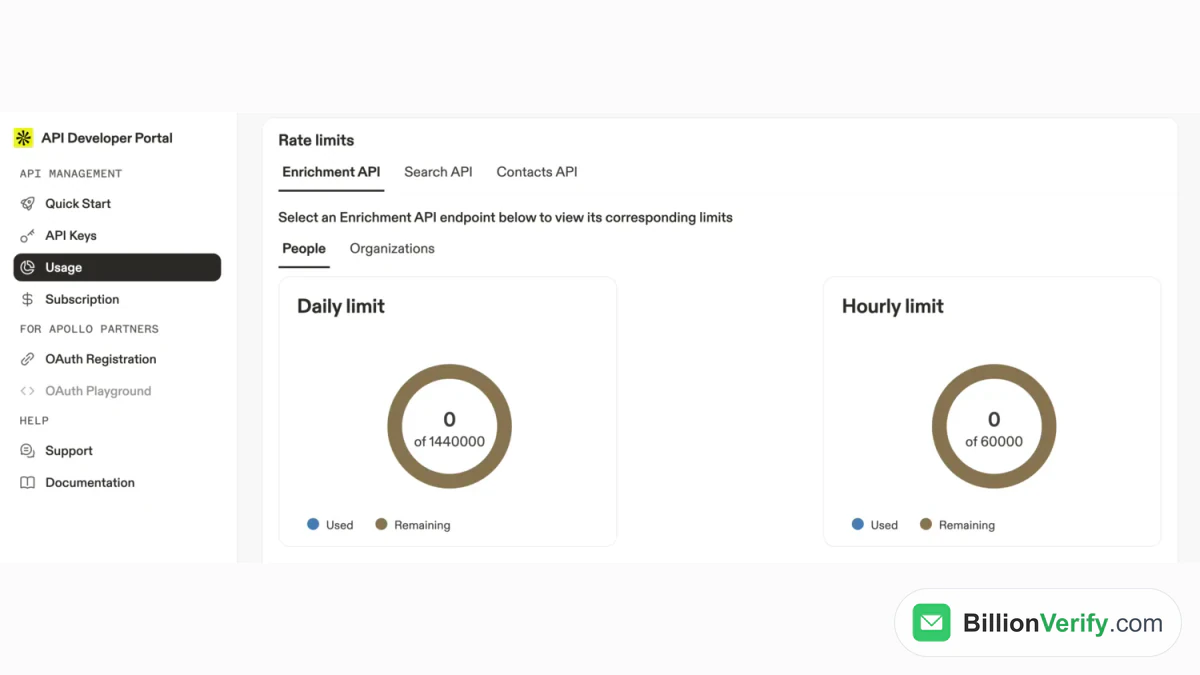
Screenshot: the Usage page of the Apollo.io developer portal, with daily and hourly limits for the enrichment endpoints, from Apollo.io's docs.
Response headers and the 429 error
Apollo.io adds headers to authenticated calls. They show the limit, the use so far and the requests left for each window:
x-rate-limit-minute,x-rate-limit-hourlyandx-rate-limit-24-hourx-minute-usage,x-hourly-usageandx-24-hour-usagex-minute-requests-left,x-hourly-requests-leftandx-24-hour-requests-leftretry-after, sent with a429, gives the seconds until the window resets
When you cross a limit you get a 429. Read retry-after and wait. The window opens on your first request and is not tied to the clock. The error body holds an error_details object. Its code is USAGE.RATE_LIMIT.API_RATE_LIMIT_EXCEEDED for your own limit.
To read your team's current limits in code, call the view API usage stats endpoint. A single call can cover up to 74 endpoint paths, and none of it costs credits.
Apollo.io API Credits: What Costs Money
Many calls cost nothing. Apollo.io says endpoints that create, update, list or manage records consume 0 credits. Credits go to enrichment, organization search, news search and AI insight endpoints, and only when they return qualifying data.
| Endpoint | Credit cost |
|---|---|
| People enrichment | 1 to 9 per person: 1 for demographics or email, plus 8 if a mobile phone returns |
| Bulk people enrichment | Same logic, up to 10 people per request |
| Organization enrichment | 1 per organization |
| Organization search | 1 per page, up to 100 results a page |
| News articles search | 1 per page, up to 25 results a page |
| Organization job postings | 1 per page |
| Get complete person info | 1 per person |
| Assistant task | Variable, set by the actions the assistant takes |
People search is free, so a sensible build searches first and enriches only the best matches. Paging a credit-consuming endpoint spends credits on every page. Apollo.io advises a small test run and a look at your usage before you scale.
Waterfall enrichment can cost more. Email waterfall typically uses 1 to 4 credits, and some setups use 20 or more. Phone waterfall typically uses 8 to 25, and some use 45 or more.
To track spending, open Settings > Billing and credits > Credit usage in the app. The developer dashboard's Usage tab shows phone and email credits used in the current billing cycle. Legacy plans can differ, so check the About credits page for your workspace.
Errors and Status Codes
Most Apollo.io API endpoints share a short list of status codes:
| Code | Meaning | Common cause |
|---|---|---|
401 | Unauthorized | Key missing, invalid or from an inactive account |
403 | Forbidden | Plan lacks API access, or a scoped key lacks the endpoint |
404 | Not found | The record does not exist or is not visible to you |
422 | Unprocessable | Invalid or missing parameter |
429 | Too many requests | You crossed a rate limit |
500 | Server error | A fault on the Apollo.io side, so retry |
Apollo.io is moving errors onto one format. Where an endpoint has moved, the response includes an error_details object with a stable code, a message, suggestions and context. Branch your code on error_details.code, never on the message text. Apollo.io plans to remove the old root-level error fields on 16 February 2027, so build on the new object now.
The Apollo.io MCP Server
MCP is a standard that lets AI tools call outside services. The Apollo.io MCP server links Claude, ChatGPT and similar clients with your Apollo.io account. You can then ask in plain language: find VP-level marketing leaders at SaaS companies, or enrich these ten prospects.
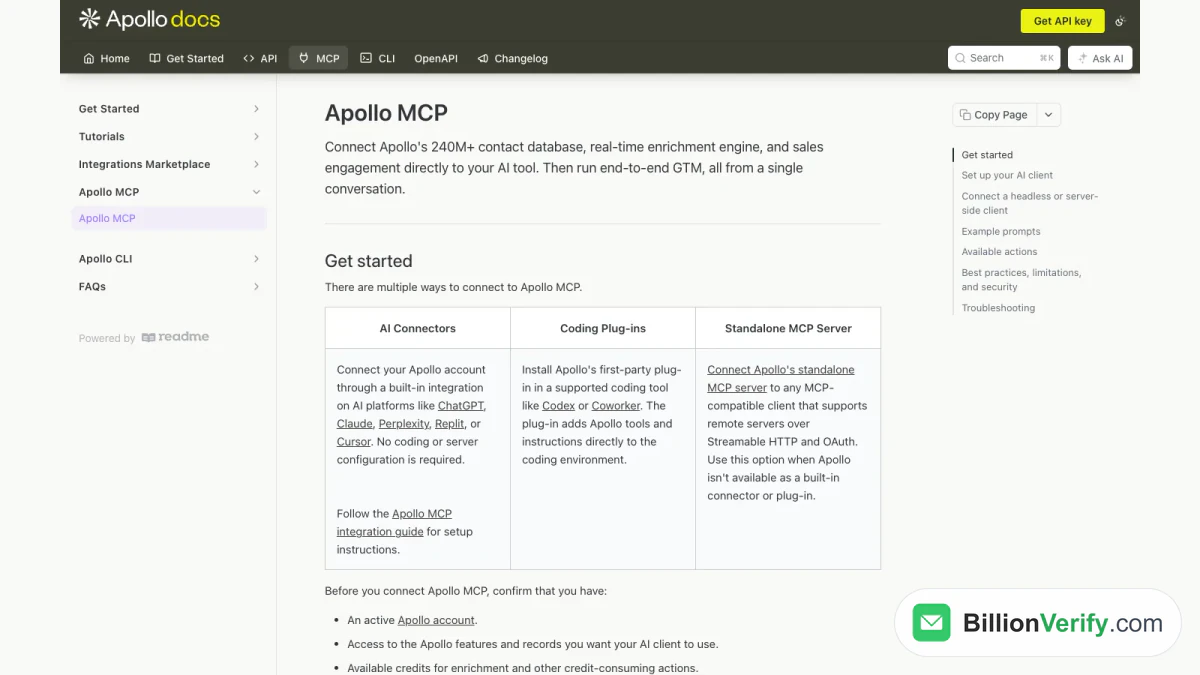
Screenshot: the Apollo.io MCP page in the developer docs, October 2026.
Three ways to connect
| Route | How it works |
|---|---|
| AI connectors | Built-in integrations on ChatGPT, Claude, Perplexity, Replit and Cursor. No server setup. |
| Coding plug-ins | First-party plug-ins for tools such as Codex. |
| Standalone MCP server | Point any MCP client that supports remote servers at one URL. |
The standalone settings are short:
| Setting | Value |
|---|---|
| Endpoint | https://mcp.apollo.io/mcp |
| Transport | Streamable HTTP |
| Sign-in | OAuth 2.0 |
| Local install | Not needed |
| API key | Not needed, unless the client has no browser |
In Claude Code, one command adds the server. Run it, then type /mcp and finish the OAuth sign-in:
claude mcp add --transport http apollo https://mcp.apollo.io/mcp
If you manage several workspaces, add the same URL under a different name for each one. Sign in to each connection separately.
Servers with no browser
OAuth needs a browser window. A cron job or a CI pipeline has none. For those, the server accepts an API key sent as X-Api-Key. The key must be a master key. A scoped key gets a 403 with the code API_INACCESSIBLE, because the MCP server is not one of the endpoints you can tick.
Store that key like any production secret. It acts as the workspace's admin and spends workspace credits. New MCP tools reach a master key at once, but your client may keep a cached tool list. Reconnect and call tools/list to refresh it.
What the Apollo.io MCP server can do
The tool list covers search and prospecting, people and company enrichment, contacts, lists, sequences, one-off emails, tasks, email domain checks and analytics. Enrichment actions use credits. Most other actions use none. Apollo.io warns that people search does not return emails or phones, so your assistant must run an enrichment step for those.
Practical limits from the docs:
- There is no extra charge for connecting. Your plan, permissions and credits apply.
- Destructive actions, such as bulk delete, are not supported.
- The server follows your permissions. With OAuth it acts as the user who signed in.
- Apollo.io MCP uses separate rate limits and does not return the rate limit headers.
- Apollo.io prohibits AI model training on its MCP data, so turn training off in your AI client first.
Apollo.io recommends setting credit-consuming actions to Approval required, so a chatty assistant cannot burn through credits on its own.
Other Ways to Use the Apollo.io API
- Apollo.io CLI. A command-line tool with access to the full API. Install it with Homebrew, a prebuilt binary or from source. It uses OAuth, so it needs no key.
- OAuth 2.0. Partners use it to call the API for mutual customers, and the docs list a marketplace application for finished integrations.
- Chrome extension. For clicking rather than coding, read our Apollo Chrome extension guide.
Check Addresses From the Apollo.io API Before You Send
Whatever route you pick, the data has one weak spot. It comes from a database. People change jobs, and companies move to new domains. The email_status field is Apollo.io's own label, not a fresh test. A cold email to a dead address bounces, and bounces hurt your sender reputation.
So put a check between enrichment and your sequence. BillionVerify tests each address without sending a message. It checks syntax, domain, MX records and, when you ask for it, the mailbox over SMTP. It flags disposable and role addresses. It reports catch-all as its own result instead of counting it as valid. Unknown results cost nothing, and a re-check within 24 hours is free. Before you wire up the API, you can check whether an email address exists by hand on the free web checker.
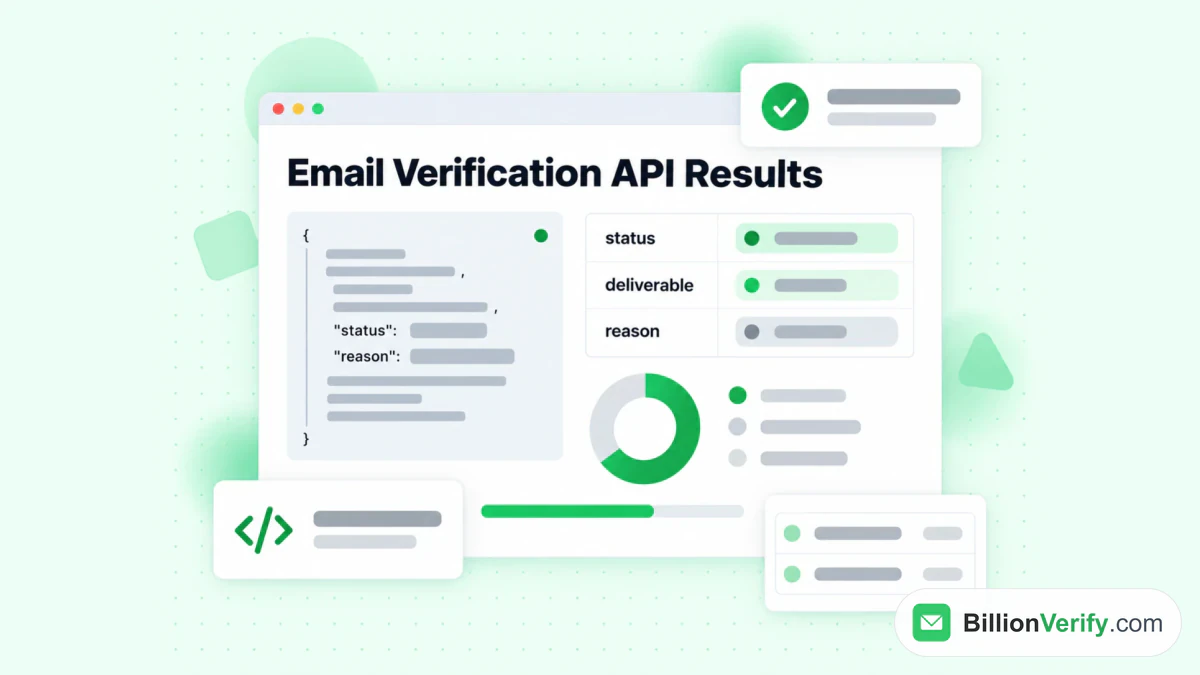
BillionVerify returns a status, a deliverable flag and a reason for each address.
A small pipeline
A simple pipeline has four steps:
- Run a free people search through the API.
- Enrich only the best matches.
- Send each address to the BillionVerify REST API.
- Add only deliverable addresses to your sequence.
The BillionVerify call is one POST. Send the key in the BV-API-KEY header, and set check_smtp to true for a live mailbox test:
curl -X POST https://api.billionverify.com/v1/verify/single \
  -H "BV-API-KEY: YOUR_KEY" \
  -H "Content-Type: application/json" \
  -d '{"email":"mark@sumware.com","check_smtp":true}'
The reply holds status, is_deliverable, is_catchall, is_role, is_disposable and a reason. For up to 50 addresses in one call, use the bulk route. For a whole export, upload a CSV, TXT or XLSX file and download the results later. The full reference is in the BillionVerify documentation.
Verify from the AI client
If you already connect Apollo.io's MCP setup to an AI client, add BillionVerify's hosted MCP server beside it. It lives at https://mcp.billionverify.com/mcp and uses OAuth for sign-in. Your assistant can then enrich a prospect through Apollo.io and check the address in one conversation. Tell it your policy, such as which statuses to accept and what to do with catch-all.
Other checks
- Our Apollo email verification page covers the export workflow.
- A suspicious contact can go through our free reverse email lookup, which shows what is publicly tied to an address.
- Phone numbers returned through the webhook deserve a test too. Our free phone number validator shows whether a number is valid for its country and what line type it is.
BillionVerify gives 20 free credits each day you use your account, up to 600 a month. They never expire, and you need no credit card.
Tips for Building on the Apollo.io API
- Start with one scoped key per integration. If one leaks, you revoke only that one.
- Run the health check first. It rules out key problems before you debug code.
- Read the Endpoint essentials box. The Apollo.io API people search documentation shows the credit cost up front.
- Search before you enrich. Search is free and enrichment is not.
- Test with
per_page=10. Small runs show credit costs before they hurt. - Honor
retry-after. Hammering a limited endpoint only extends the wait. - Read
error_details.code. Message text can change without notice. - Verify before you send. A credit spent on a bouncing address is wasted twice.
FAQs
Does Apollo.io have an API?
Yes, Apollo.io has a REST API. It lets you search people and companies, enrich contacts and update accounts, deals and sequences. Basic access comes with every tier. Your plan sets which endpoints you can call, how fast and what each call costs.
How do I get an Apollo.io API key?
An Apollo.io key comes from the Integrations area of Settings: open API Keys and choose Create new key. Name it, tick the endpoints it may call and confirm, then copy the secret straight away. An admin, or a user with the right permission profile, can do it.
Where can I find my Apollo.io API key?
Your Apollo.io API key list sits on the API Keys page, which you reach from the app or from the developer dashboard. The full secret appears when you create the key. A lost secret means regenerating the key, which issues a new one.
Is the Apollo.io API free?
Apollo.io API calls that create, list or update records cost nothing, and neither does people search. Enrichment and some search endpoints charge credits when they return data. Free accounts can call the API within the free plan's limits, but some endpoints require a work email.
What is the Apollo.io API rate limit?
On a paid tier, most Apollo.io API endpoints take 200 calls per minute, with hourly and daily caps that vary by tier. The free tier takes 50 per minute, 200 per hour and 600 per day. Limits apply per team and per endpoint, and a 429 response means you crossed one.
How do I test the Apollo.io API health check?
The Apollo.io health check is a GET request to the auth/health path with the key header set. A response of healthy: true and is_logged_in: true means the key works. No credits are spent.
Does the Apollo.io API people search return emails?
No, the Apollo.io people search endpoint hands back profiles only, with no emails or phones. Run the people enrichment or bulk people enrichment endpoint on the results to get contact details, which costs credits.
Where is the Apollo.io API documentation?
The Apollo.io API documentation is at docs.apollo.io. Each endpoint has its own page with parameters, a test panel and an example response. You can also download the OpenAPI file and import it into Postman.
What is the Apollo.io MCP server?
The Apollo.io MCP server links AI clients with your workspace through the Model Context Protocol. Its URL is https://mcp.apollo.io/mcp, it uses Streamable HTTP and OAuth, and it needs no local install. Your plan, permissions and credits still apply.
What is the best MCP server for Apollo.io?
Apollo.io publishes one official MCP server, and that is the one its docs describe. We did not test third-party options. Pick the official server if you want the same permissions and credit rules as the app.
Should I verify emails that come from the Apollo.io API?
Yes, check every email address from the Apollo.io API before a campaign. The email_status field reflects Apollo.io's own records, and people change jobs. A quick pass through the BillionVerify API removes dead addresses and protects your sender reputation.
Watch: How to Validate a Phone Number: Free Phone Number Validator