



The best Apollo.io alternatives are ZoomInfo, Lusha, Cognism, RocketReach, Hunter, Seamless.AI, Clay and Instantly. Each of these Apollo.io competitors replaces a different part of the platform. ZoomInfo and Cognism sell sales intelligence. Hunter and RocketReach find addresses. Clay and Instantly cover enrichment and sending. A few have a no-cost route, and a few sell only by quote.
This guide compares the Apollo.io alternatives side by side. It shows what each one charges, what a unit of usage buys, and which job each does best. Every figure comes from each vendor's own site, read in October 2026 unless noted. Prices change often, so confirm them before you buy. We are not affiliated with Apollo.io or with any company named here.
Key facts (checked October 2026):
- Apollo.io's paid plans started at $49 per seat, billed yearly, per its pricing.
- Apollo.io charges 1 credit for an address and 8 for a mobile number.
- Lusha charges 5 credits for a mobile number, and its entry tier allows up to 40 a month.
- Hunter's first paid plan was $34 a month on yearly billing.
- In ZoomInfo vs Apollo.io, only Apollo.io publishes its prices. Seamless.AI and Cognism also sell by quote.
- BillionVerify does not bill an unknown result, so checking an export from any Apollo.io alternative costs nothing for unresolved addresses.
Apollo.io Alternatives at a Glance
| Apollo.io alternative | No-cost route | Entry price | Strength |
|---|---|---|---|
| Apollo.io itself | Free tier, 900 a year | $49 a seat, billed yearly | Leads plus outreach in a single seat |
| ZoomInfo | Lite edition and a trial | Quote only | Enterprise suite with intent signals |
| Lusha | Up to 40 a month | Set by volume | Quick reveals in an extension |
| Cognism | None listed | Quote only | Phone-verified mobiles in Europe |
| RocketReach | 5 lookups | $33 a month, billed yearly | Plain lookups |
| Hunter | 50 a month | $34 a month, billed yearly | Addresses found by company domain |
| Seamless.AI | Sign-up offered | Quote only | Real-time lead search |
| Clay | Free tier, 100 data credits a month | $185 a month | Waterfall enrichment across vendors |
| Instantly | 14-day trial | $47 a month | Cold sending plus a lead database |
The table is a starting point. ZoomInfo vs Apollo.io is the matchup readers ask about most, so it gets its own section further down. Each section below explains what the price buys.
What Apollo.io Offers
To judge any Apollo.io alternative fairly, start with Apollo.io itself. It pairs a contact database with sequences, a dialer and AI tools, and its homepage claims "240M+" contacts. Our guide to what Apollo.io is and how it works covers the whole platform.
Apollo.io lists four plans on its pricing. Prices are per seat:
| Apollo.io plan | Yearly billing | Monthly billing | Notes |
|---|---|---|---|
| Free | $0 | $0 | 900 a year, released 75 monthly |
| Basic | $49 | $65 | Unlimited sequences |
| Professional | $79 | $99 | Higher limits, call recording |
| Organization | $119 | Annual only | Minimum of 3 seats |
Credits pay for reveals. An address uses 1 and a mobile number uses 8. Unused credits expire when each billing cycle ends, and everyone on an account must share a tier. Our Apollo.io pricing guide explains every limit.
Why Teams Look at Apollo.io Alternatives
Most buyers compare Apollo.io alternatives for one of six reasons:
- Credit math. A mobile costs eight times an address, and unused credits lapse each cycle. Buyers who reveal many mobiles may price this differently elsewhere.
- Region. Teams that sell in Europe often want contact data and call screening built around local rules.
- Enterprise needs. Large companies want intent signals, a vendor audit trail and a contract written around their process.
- A sequencer already owned. Some teams only need data.
- Enrichment depth. A few teams want several vendors checked in order, not a single database.
- Contract shape. Apollo.io says its standard terms bar reselling its contacts, so teams that need that right must negotiate a custom agreement.
No Apollo.io alternative wins on all six, so the best choice depends on which reason matters most to your team. Reviewers tell a related story: users praise search and filters, and the top complaint is stale contact details. Our summary of Apollo.io reviews has the figures.
How We Picked the Alternatives
We chose competitors that do part of the same job: find or enrich a work contact, or send to one. Each publishes its pricing. We left out vendors that only rent static lists.
We compared each Apollo.io alternative on five points:
- No-cost route: can you test it without paying?
- Unit cost: what does an address or a mobile number use?
- Data types: addresses only, or phones too?
- Workflow: browser extension, CRM sync, API, outreach.
- Compliance: what each vendor publishes on privacy law.
We did not run our own accuracy tests. Every claim below is what each vendor says about itself.
The 8 Best Apollo.io Alternatives
1. ZoomInfo
As an Apollo.io alternative, ZoomInfo is the enterprise name. Its homepage, in an archived copy dated October 15, 2026, calls it "The AI platform for go-to-market teams" and says it is "Trusted by 35,000+ fast-growing companies worldwide." Its FAQ describes 500M+ contacts and 100M+ companies.
ZoomInfo does not publish prices. Its pricing, archived on October 17, 2026, shows three sales packages: ZoomInfo Professional, Copilot Advanced and Copilot Enterprise. Each has a "Start free trial" button, and no dollar amounts appear. ZoomInfo Lite is a permanent edition that needs no card.
Best for: larger organizations that need intent signals and workflows in a single contract. Our ZoomInfo guide explains the platform, and our page on ZoomInfo email verification covers checking its exports.
2. Lusha
Lusha calls itself "the B2B data and GTM intelligence layer for teams and AI agents." Its homepage lists "515M+ verified contacts and 29M+ companies, enriched with 26 buying signal types." As an Apollo.io alternative, it explains its units plainly on its pricing:
- A verified address uses 1 credit.
- A mobile number uses 5 credits.
- The entry tier gives "up to 40 credits per month."
Paid Lusha tiers change price with a slider. At the default volume of 40,800 a year, Starter showed $37.45, Pro $52.45 and Premium $299.95, each per month with yearly billing.
Lusha also publishes its own comparison page that sets it against Apollo and two other competitors. It describes Apollo.io as a platform that bundles contacts with sequencing and a dialer, and itself as a source of verified data that feeds whatever sequencer you already run. It says its entry tier includes its MCP connection, a rate-limited API and native HubSpot and Salesforce apps.
Best for: reps who reveal contacts while they browse and already own a sequencer. See our page on checking Lusha emails.
3. Cognism
Among Apollo.io competitors, Cognism leans hardest on phone-verified mobiles and European coverage. It publishes a dedicated Cognism vs Apollo.io page. That page says Cognism targets mid-market and enterprise teams operating across Europe, and it describes Apollo.io as a fit for start-ups and small companies that prospect in the US.
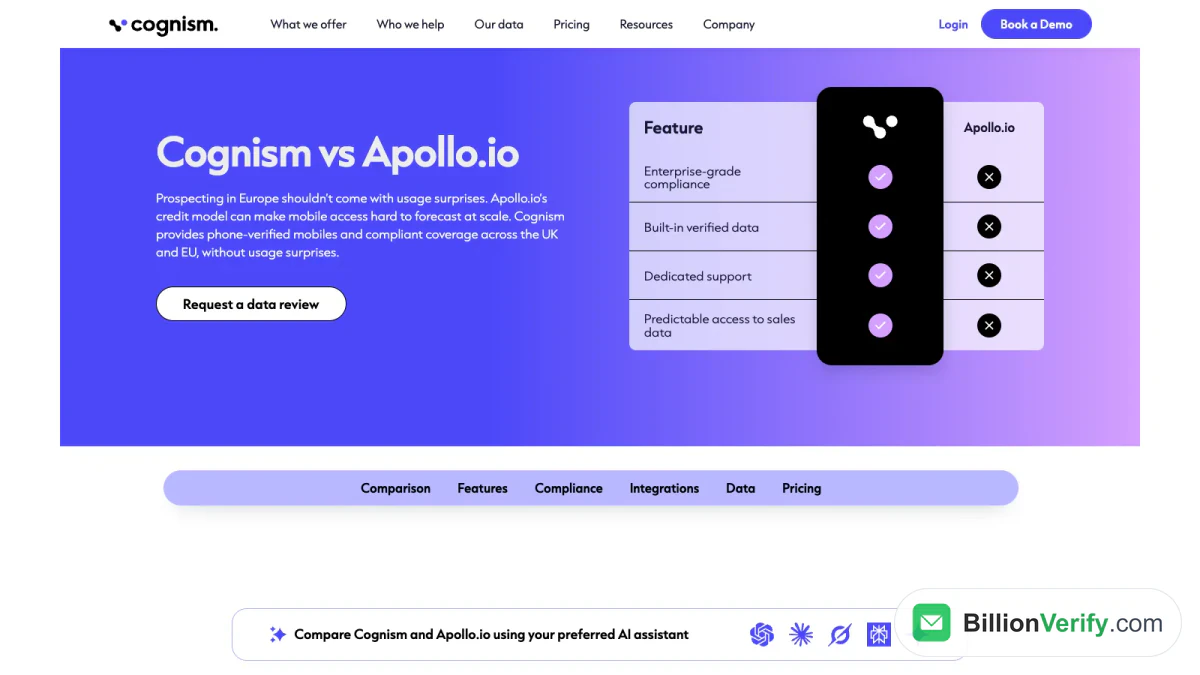
Screenshot: Cognism's own comparison with Apollo.io.
Cognism keeps similar pages for other competitors. That Apollo.io page is Cognism's view, so read it as a vendor pitch. Its claims are specific, though. Cognism says it screens mobile numbers against do-not-call lists in 15 countries, including TPS and CTPS in the UK. Its pricing lists two packages, Standard and Pro, and Pro includes 5 seats and on-demand mobile verification. It shows no prices. Its FAQ says pricing "is tailored based on the product you need, your team setup and how you plan to use the platform."
Best for: sellers who call buyers in Europe on verified mobiles. Our page on verifying Cognism emails shows the check step.
4. RocketReach
RocketReach is a lookup tool, and a simple Apollo.io alternative for teams that send from elsewhere. Its products page lists "700M+ verified professional profiles." A new account gets 5 lookups with no card, and RocketReach refunds a lookup when it finds no address or phone.
On October 14, 2026, RocketReach listed three self-serve plans:
| RocketReach plan | Monthly equivalent | Yearly charge | Contact types |
|---|---|---|---|
| Essentials | $33 | $399 | Addresses only |
| Pro | $75 | $899 | Addresses, phones |
| Ultimate | $142 | $1,699 | Addresses, phones |
Team plans start at $6K a year. RocketReach has no sequences. Read our RocketReach guide, or the longer comparison of RocketReach alternatives.
Best for: quick lookups when you already know the name.
5. Hunter
Hunter began as a finder by domain. Its homepage now calls it "the all-in-one email outreach platform to find verified decision makers and turn them into leads." It offers "50 free leads/month" with no card.
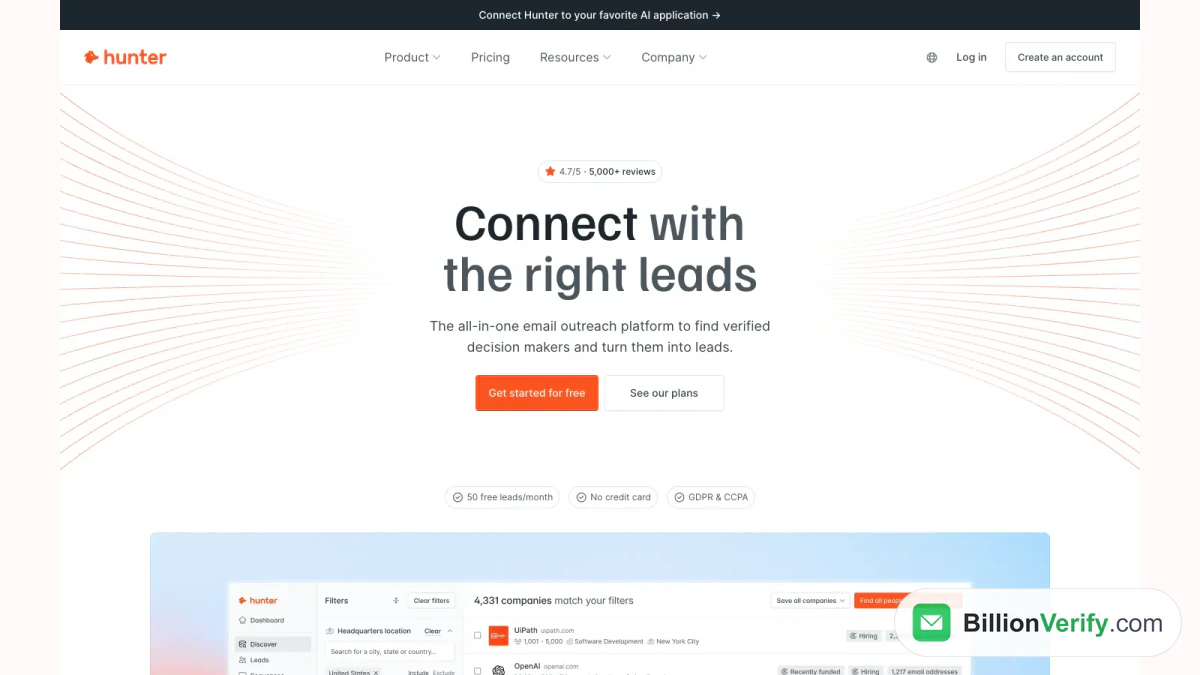
Screenshot: the Hunter homepage.
Hunter's plans look like this with yearly billing:
| Hunter plan | Monthly equivalent | Yearly charge | Allowance |
|---|---|---|---|
| Free | $0 | None | 50 each month |
| Starter | $34 | $408 | 24,000 a year |
| Growth | $104 | $1,248 | 120,000 a year |
| Scale | $209 | $2,508 | 300,000 a year |
Monthly billing costs more: Starter is $49 and Scale is $299. A found address uses a unit, and a check uses half a unit. Hunter's own wording for every tier is "Unlimited users." Mobile numbers are not part of its model. As an Apollo.io alternative, Hunter is the narrowest one here. Our Hunter verification page explains how to check its results.
Best for: address-only prospecting by company domain.
6. Seamless.AI
Seamless.AI sells a real-time search engine for B2B contacts. Its homepage says it offers "1.6B+ verified business emails and 448M+ phone numbers" and is "Trusted by 1M+ sales leaders worldwide." Its Chrome extension, in the vendor's words, will "Find cell phones, emails, direct dials, and sales insights for any B2B professional on any website."
Its pricing lists no prices. It says: "Get special pricing for unlimited users, bulk credits, prospector, job changes, buyer intent, and enrichment." The site leads to a demo request, while the header still offers a "Sign up free" button. Seamless.AI also promotes a refund rule: "If an email is invalid, we automatically refund your credit." Read the terms before you rely on it. Seamless.AI also runs a comparison hub that lists 11 competitors, Apollo.io and ZoomInfo among them.
Best for: reps who want a contact search engine and are happy to buy by quote. Our page on checking Seamless.AI emails covers the next step.
7. Clay
Clay is the odd one out among Apollo.io competitors, because it owns no database of its own. It sits on top of many vendors. Its FAQ says Data Credits buy contacts "across our 150+ data partners," and that you can bring your own API keys for third-party sources. Every plan includes multi-provider waterfalls, which try each source in turn until a field is filled.
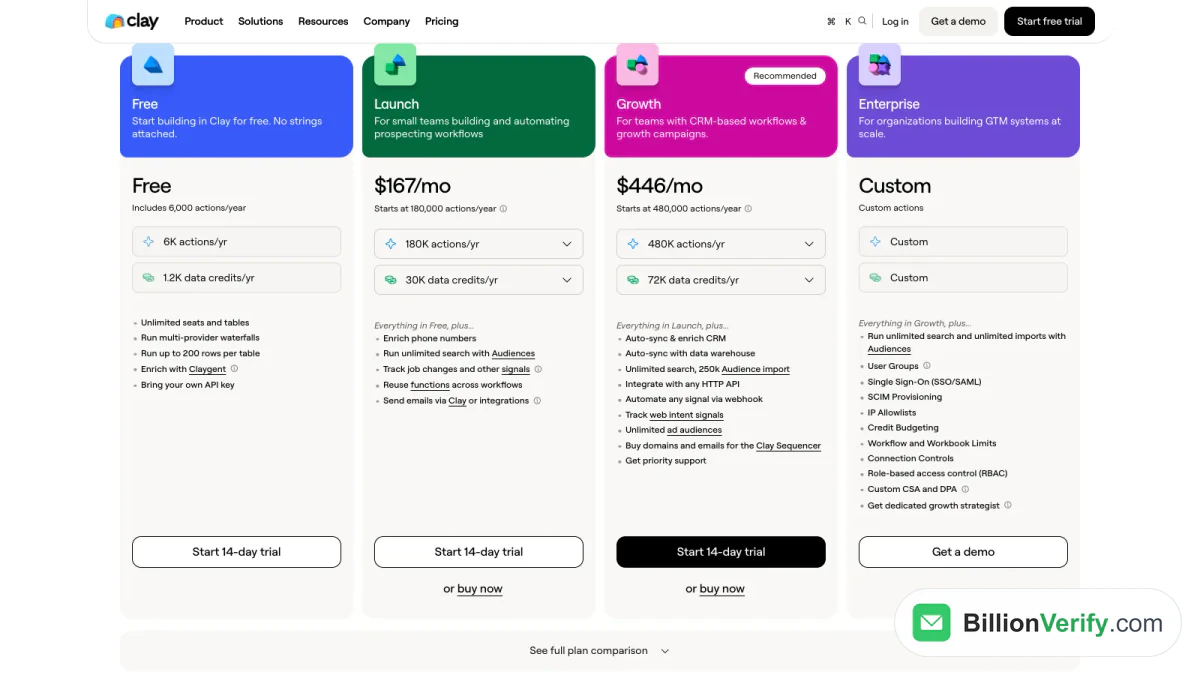
Screenshot: Clay's plans and credit allowances.
Clay splits its units in two. Actions measure platform work and reset each cycle. Data Credits pay for the contacts themselves, and they roll over up to twice the monthly amount on Launch and Growth. The plans, per Clay's FAQ:
| Clay plan | Starting price | Data allowance | Actions |
|---|---|---|---|
| Free | $0 | 100 monthly | 500 monthly |
| Launch | $185 monthly | 2,500 monthly | 15,000 monthly |
| Growth | $495 monthly | 6,000 monthly | 40,000 monthly |
| Enterprise | Custom | 100,000+ | 200,000+ |
The page showed lower figures, $167 for Launch and $446 for Growth, under yearly billing. Mobile enrichment starts on Launch. Clay says that if an enrichment returns no result, you are not charged.
Best for: operations-minded buyers who want to combine several vendors in a table. There is no database to hand you, so budget time to build a workflow.
8. Instantly
Instantly started as a cold sender and now adds a lead database. Its pricing lists a "Database of 450M+ B2B Leads" on its credit plans, along with "Waterfall Work Email Enrichment with 5+ providers." The outreach side and the lead side are priced on separate tabs.
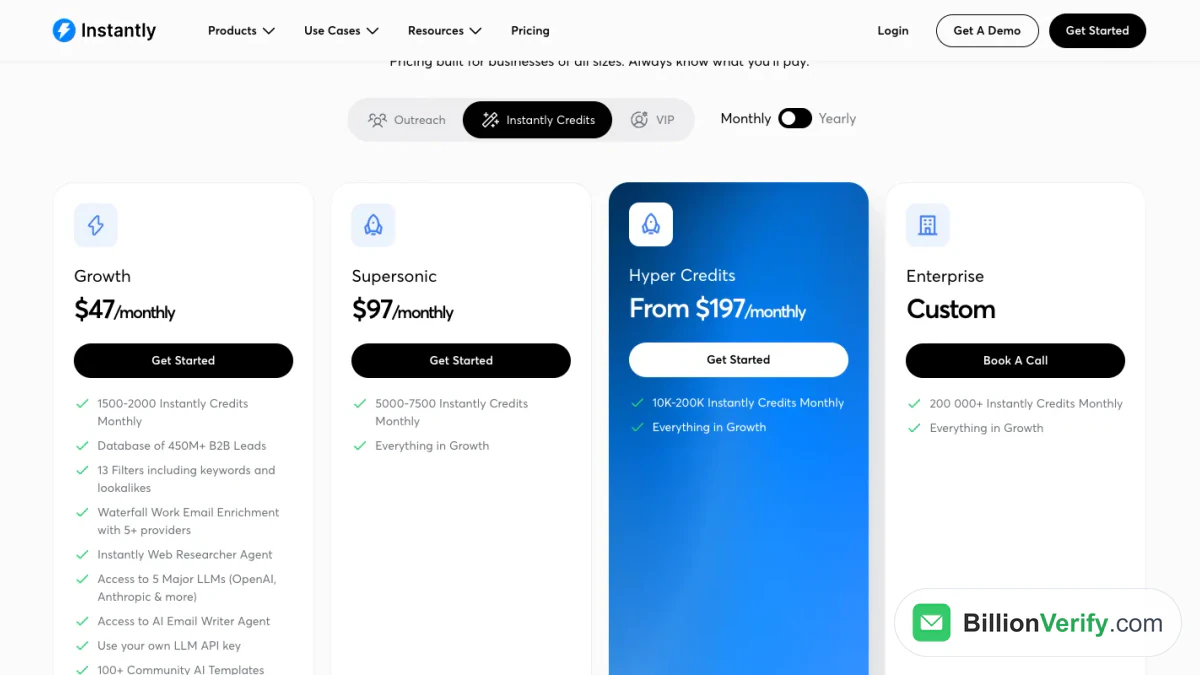
Screenshot: Instantly's monthly allowances.
On monthly billing, the credit plans were:
| Instantly plan | Price | Monthly allowance |
|---|---|---|
| Growth | $47 | 1,500 to 2,000 |
| Supersonic | $97 | 5,000 to 7,500 |
| Hyper Credits | From $197 | 10K to 200K |
The outreach Growth tier was also $47 a month. It lists unlimited sending accounts, unlimited warmup, 5,000 sends and 1,000 uploaded contacts. Instantly says it offers a 14-day trial.
Best for: buyers who want sending, warmup and leads from a vendor and do not need a dialer. For those buyers it is the alternative to Apollo.io that centres on outbound.
The Best Alternatives to Apollo.io: Quick Picks
Short on time? These picks come from what each vendor publishes:
- Best for a small budget: Hunter, with a no-cost tier and a low-priced Starter tier.
- Best for enterprise buyers: ZoomInfo, which sells intent signals and a full suite by quote.
- Best for mobiles in Europe: Cognism, with phone-verified numbers.
- Best for quick reveals: Lusha, with a browser extension and clear unit costs.
- Best for combining vendors: Clay, with waterfalls across many sources.
- Best for sending at volume: Instantly, with unlimited sending accounts.
The best alternative to Apollo.io depends on the job, so treat these picks as a shortlist, not a verdict. Trial two or three competitors on your own leads before you sign. If budget is the main concern, start with the free alternatives below. If you need a full suite, look at the Apollo.io competitors that sell by quote. Either way, keep Apollo.io itself on the list as your baseline, because its free tier makes a side-by-side test quick.
Free Alternatives to Apollo.io
You can test most of these products without a card. Apollo.io's own free plan gives 900 credits a year, released 75 at a time. Lusha's allowance is up to 40 a month and Hunter gives 50. Clay's entry plan adds a small monthly data allowance, RocketReach starts with 5 lookups, and ZoomInfo offers its Lite edition.
Which free alternatives fit which job?
- For mobiles: Lusha adds phone credits at no cost.
- For volume: Apollo.io gives the largest yearly allowance of the tools here.
- For domain searches: Hunter.io is built around that job.
- For testing enrichment: Clay's entry plan lets you build a small table across vendors.
Finding leads by hand
You can also find a lead by hand. This costs time instead of money:
- Check the company website. Team pages, press releases and author bios often show an email.
- Read public documents. Conference agendas, filings and podcast notes can reveal a work email.
- Learn the company's pattern. Most firms use a format such as first.last@. Our guide to email formats shows how to find it.
- Use a LinkedIn profile. It gives the name, role and company you need to build or confirm an address.
Manual research is slow. It works well for a handful of high-value leads.
ZoomInfo vs Apollo.io
ZoomInfo vs Apollo.io is the first matchup most buyers run. Both sell sales intelligence, and both now wrap their contacts in AI. The gap is in how they price access. Searchers also type it as Apollo.io vs ZoomInfo, and the answer does not change.
| ZoomInfo vs Apollo.io | ZoomInfo | Apollo.io |
|---|---|---|
| Stated coverage | 500M+ contacts, 100M+ companies | 240M+ contacts, 30M+ companies |
| Price list | Quote only | Public, from $49 per seat |
| No-cost route | Lite | Free plan |
| Sequences and dialer | Export to other tools | Built in |
ZoomInfo vs Apollo.io on price
Apollo.io publishes every tier, while ZoomInfo asks you to talk to sales. To compare ZoomInfo and Apollo.io fairly, work out the cost per usable contact. Ask the ZoomInfo rep what an address, a direct dial and a company profile each use.
Apollo.io vs ZoomInfo on coverage
ZoomInfo states a larger database, with about twice as many people and more than three times as many companies. A headline count is not a match rate for your market, though. Pick 50 target accounts, look them up in both and count the contacts you get. That small test tells you more than any database size.
ZoomInfo vs Apollo.io on outreach tools
Apollo.io has sequences and a dialer in the same seat. ZoomInfo plans lean on exports to other tools: its Copilot Advanced tier lists "Export emails to Outreach or Salesloft." If a sequencer is already in place, that gap matters less.
ZoomInfo Sales vs Apollo.io on fit
ZoomInfo Sales suits enterprise sellers who rely on intent signals and a negotiated contract. Apollo.io suits smaller companies that want a visible price and outreach in the same seat. Our ZoomInfo vs Apollo guide walks through coverage, cost per contact, integrations and compliance in full.
Hunter.io vs Apollo.io
Hunter.io vs Apollo.io pits a narrow tool against a wide one. Hunter.io finds and checks addresses by company, then sends sequences. Apollo.io does that and adds phones, a dialer, call recording and a larger database.
On price, the two overlap at the low end. The yearly Starter plan at Hunter.io was $34 a month, and Apollo.io's yearly Basic plan was $49 a seat. Hunter.io has no user cap, while Apollo.io bills for each seat. If your team needs only addresses and has many users, the Hunter.io model may cost less. If you need mobiles, Apollo.io sells them.
Apollo.io vs LinkedIn Sales Navigator
Apollo.io vs LinkedIn Sales Navigator is search inside LinkedIn against a contact database. LinkedIn's tool surfaces people and accounts, but it does not hand you addresses. You reach people with InMail or connection requests. Apollo.io gives you the contact details and the outreach tools.
Apollo.io vs LinkedIn Sales Navigator on price
LinkedIn's compare plans page listed the Core plan at US$1,079.88 a year. Apollo.io's Basic plan was $588 a year for a seat, with a credit allowance for contact details.
Apollo.io vs LinkedIn Sales Navigator in practice
Apollo.io's Chrome extension works on LinkedIn pages, but its own docs list limits on Sales Navigator search pages. Many teams use both instead of choosing. Our Sales Navigator guide explains each plan, and our list of Sales Navigator alternatives covers the tools that sit next to it.
Compare the Competitors on Units, Not Just Prices
List prices hide the real cost. What matters is what each action uses. Based on the details each vendor publishes:
| Tool | An address | A mobile or direct dial |
|---|---|---|
| Apollo.io | 1 credit | 8 credits |
| Lusha | 1 credit | 5 credits |
| RocketReach | 1 lookup, refunded if nothing found | Same lookup on Pro and above |
| Hunter | A unit per found address | Not offered |
| Cognism | A unit per revealed contact | Included in that contact |
| Clay | Varies by provider | From Launch, varies by provider |
Two questions settle most choices:
- How many mobiles will you reveal? Apollo.io charges 8 credits a number, and Lusha charges 5.
- Do you need sequences? Apollo.io, Hunter and Instantly all send, so a single subscription may replace two.
Unused balances behave differently as well. Apollo.io credits expire when the cycle ends, while Clay lets Data Credits roll over on Launch and Growth. Check this rule before you buy a year of usage.
Browser Extensions Among Apollo.io Competitors
Many reps never open a dashboard. They reveal contacts from an extension while they read a profile or a company site. Most Apollo.io competitors offer one:
- Apollo.io: a Chrome extension that signs in with your Apollo account. Our Apollo.io Chrome extension guide covers it.
- Lusha: an extension to "reveal contacts on professional network & sites."
- Hunter: a browser extension to find addresses while you browse.
- Cognism: an extension its page says works with LinkedIn, Sales Navigator, Recruiter, Salesforce, HubSpot and company websites.
- Seamless.AI: a Chrome extension listed in its product menu.
If your team prospects mostly on LinkedIn, test each extension on the same ten profiles. Compare how many clicks a reveal takes and what it costs.
Ratings Shown by Apollo.io Competitors
Several vendors show review scores on their own sites. These are the figures that each vendor chose to publish, as shown in October 2026:
| Tool | Rating shown |
|---|---|
| Apollo.io | 4.7 on G2, from 9,840 reviews |
| ZoomInfo | 4.5 out of 5 on G2, from 12,823 reviews |
| Cognism | 4.5/5 on G2 and 4.7/5 on Capterra |
| Lusha | 4.3 out of 5 stars |
| Hunter | 4.7/5 from 5,000+ reviews |
Vendor-picked ratings are a starting point. Read recent reviews on G2 and Capterra yourself, and filter by your company size.
Apollo.io Competitors by Use Case
Different buyers need different things from Apollo.io competitors. Three groups ask most often.
Apollo.io alternatives for recruiters
Recruiters search for candidates more than buyers. ZoomInfo sells a dedicated Talent package, and RocketReach is common among recruiters for plain lookups.
Apollo.io alternatives for agencies
Agencies juggle many client lists, so look for cheap extra seats. Hunter.io allows any number of users. Apollo.io charges per seat. Instantly offers unlimited sending accounts on its outreach plans. Check team terms before you commit.
Apollo.io alternatives for developers
Developers need an API more than a dashboard. Apollo.io says every tier has basic API access, and advanced functions sit on certain tiers. Hunter.io and Clay also advertise API access. Compare rate limits and unit use per call in each vendor's docs. Our guide to the Apollo.io API lists its endpoints and limits.
How to Choose Among the Alternatives to Apollo.io
Use these steps to test replacements without wasting a budget:
- Write down your monthly volume. Count addresses and phones separately.
- Run every trial with the same list. Pick 30 known people and look them up in each tool.
- Count results, not claims. Note how many addresses and phones each competitor returns.
- Do the unit math. Divide the price by the contacts you actually need.
- Test the workflow. Try the extension, the CRM sync and the export.
- Read each competitor's terms. Look for opt-out rules, resale limits and privacy commitments.
- Verify what you got. Run every returned address through a verifier before you compare hit rates.
That last step changes the ranking more often than people expect. A product that returns more addresses is not better if many of them bounce.
Switching From Apollo.io to One of Its Competitors
Moving off Apollo.io to a rival is mostly a data task. Plan it before your renewal date. If you pay yearly, remember that an Apollo.io cancellation takes effect when your current term ends, and a downgrade brings no refund for unused time.
- Export your lists first. Keep the CSV files and saved searches your team built.
- Map the fields. Each product names columns differently, so match name, title, company and address before import.
- Re-verify the old records. Contacts saved months ago may have changed jobs.
- Run both tools for a short overlap. Compare results on live prospects before you cancel.
- Update your CRM rules. Stop the old integration so two tools do not overwrite each other.
- Move sequences last. Active sequences keep sending until you pause them, so finish the contact move first.
A clean switch keeps your pipeline steady while the team learns the new tool.
Mistakes to Avoid With Apollo.io Alternatives
Teams often make the same errors when they trial a replacement:
- Judging on the no-cost route alone. Allowances are small. Test the paid workflow you will actually use.
- Ignoring mobile costs. A tier that looks cheap can get expensive once you reveal mobiles.
- Skipping the terms. Your outreach still has to follow GDPR, CCPA and CAN-SPAM, whatever the vendor says.
- Buying a tool for a single feature. A dialer or a sequencer you do not use is money wasted.
- Sending without a check. Old or guessed addresses bounce. That costs more than a verification.
Whatever You Pick, Verify Before You Send
Every Apollo.io alternative in this list either predicts an address from a pattern or stores one gathered earlier. People change jobs. Domains change mail servers. An address that worked last year may bounce today. Bounces hurt your sender reputation, and that hurts every campaign after it.

BillionVerify checks a CSV export from any contact tool before it reaches your CRM or sequencer.
So add a step after any export. BillionVerify checks whether each address can receive mail. It reports catch-all domains as their own result instead of calling them valid. Unknown results cost nothing, and a re-check within 24 hours is free. You get 20 free credits each day you use your account, up to 600 a month, and no card is needed. Any single address from these tools can go through the free BillionVerify Email Checker, which also flags disposable and role risks.
Our page on verifying Apollo.io emails shows this step for Apollo.io exports. The same steps work for the other tools. Two free tools help with single checks:
- Our reverse email lookup shows the domain, organization and mail routing behind an address.
- Our phone number validator checks whether a number is valid for its country and shows the line type.
FAQs
What are the best alternatives to Apollo.io?
For small teams, the best alternatives to Apollo.io are Hunter and Instantly, because both publish low entry prices. ZoomInfo suits larger companies with bigger budgets. Lusha and RocketReach suit reps who only need contact lookups.
What is the best alternative to Apollo.io for outbound sending?
Instantly is the closest Apollo.io alternative for outbound sending, because it pairs sending, warmup and a lead database. Hunter also sends sequences. Neither includes the dialer that Apollo.io offers.
Is there a free alternative to Apollo.io?
Yes, most rivals of Apollo.io list a no-cost route, and ZoomInfo has a Lite edition. Hunter gives 50 a month and Lusha's allowance is 40. Apollo.io has a free plan too, so you can compare them all without paying.
Who are the main Apollo.io competitors?
The main Apollo.io competitors are Cognism, ZoomInfo, Seamless.AI, Lusha, Hunter and RocketReach. Instantly and Clay compete on enrichment and outreach. They differ in phone data, region and workflow.
Which Apollo.io alternative is best for mobile numbers?
Cognism is the specialist in phone-verified mobiles, with a European focus. Lusha sells mobile numbers for 5 credits each, compared with 8 on Apollo.io. Hunter does not sell mobile numbers.
In ZoomInfo vs Apollo.io, which is better?
ZoomInfo suits enterprise buyers who value intent signals and a custom contract, while Apollo.io suits buyers who prefer public prices and built-in outreach. Neither is better for every buyer, so run a short trial with real target accounts.
Is Hunter.io a good alternative to Apollo.io?
Hunter.io works well when you only need addresses by company domain. Every tier allows unlimited users. It does not sell mobile numbers, so anyone who calls prospects needs a second tool.
Is LinkedIn Sales Navigator an alternative to Apollo.io?
LinkedIn Sales Navigator is only a partial alternative to Apollo.io. It finds buyers on LinkedIn but does not provide addresses, so many teams use it next to a contact tool.
Is Apollo.io cheaper than its competitors?
At the low end, Apollo.io's $49 seat is close to Hunter's $34 Starter plan. Seamless.AI, Cognism and ZoomInfo publish no prices, so you cannot compare them until you get a quote. Compare what each usable lead costs, not the sticker price.
Do I still need to verify emails from Apollo.io alternatives?
Yes, whichever tool you pick instead of Apollo.io, its email addresses still need verification. Every contact database can return addresses that no longer work. Verify each list before you send, so bounces do not damage your sender reputation.
Watch: How to Validate a Phone Number: Free Phone Number Validator
Watch: Free Reverse Email Lookup: What It Shows and What It Can't