



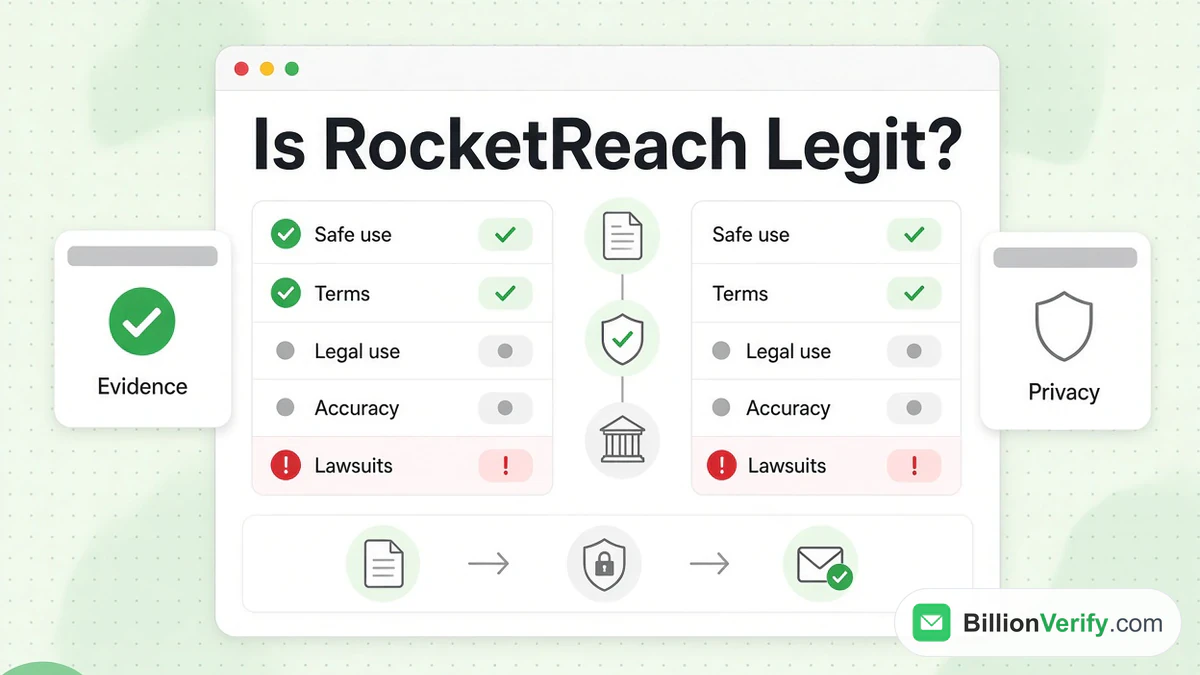
Yes. RocketReach is legit as a business. It has sold B2B contact lookups since 2015, and it publishes its security setup, its privacy rights process and its subscription terms. It also calls itself a data broker in Texas and appears on California's broker list. Still, a legit company is not the same as a perfect product. Some records go stale. Annual plans renew on their own. And courts have heard several privacy cases about how RocketReach shows people's names.
This guide answers the question with evidence, not opinion. We quote RocketReach's own pages, its support articles and its user terms. We add public court records and a dated look at Trustpilot. We also answer the worries people search for most: is RocketReach safe, is RocketReach legal, is RocketReach accurate, and does RocketReach notify the person being searched? Then we give you a checklist that works on any contact tool. Prospecting from review sites? Clutch vs Trustpilot for B2B outreach compares what each one offers.
We are not affiliated with RocketReach. BillionVerify is an email verification service. Every RocketReach fact here was checked in October 2026, and each names its source. For a plain overview of the product, read our RocketReach guide.
Key facts (checked October 2026):
- RocketReach was founded in 2015 and claims over 21 million users, per its About Us page.
- RocketReach claims SOC 2 Type II and ISO 27001 certification on its security page.
- California's broker registry lists RocketReach LLC by name.
- RocketReach's help center states that it does not track or monitor people beyond public business details.
- RocketReach held a 1.2 TrustScore across 1,116 Trustpilot reviews on October 27, 2026.
- Krause v. RocketReach, an Illinois publicity rights class action, ended with a court-approved settlement in September 2023.
Is RocketReach Legit? The Short Answer
RocketReach is legit in the plain sense of the word. It is a registered company with a real product, public terms and a working support channel. The RocketReach About Us page says it was "founded in 2015" and calls itself "a leading Lead and Sales Intelligence platform." Court filings describe the operator as RocketReach, LLC, "a Wyoming limited liability company."
So the short answer to "is RocketReach legit" is yes. The longer answer depends on who is asking. A buyer wants to know if a plan is worth the money and if the contacts work. A professional who found their own profile wants to know if the listing is legal. A security team wants to know if the vendor is safe. Each group needs different evidence, so this guide splits it up.
Why people ask "Is RocketReach legit?"
Most people ask for four main reasons. They got a cold message and wonder how the sender found them. They found their own RocketReach profile in a Google result. They got a one-time privacy notice from RocketReach and think it might be phishing. Or they are about to buy a plan and want to check reviews first. If a sender address looks suspicious, the free Is this email legit? tool can help you check it.
All four are fair. The answers differ, though. The first three are about your rights as a listed person. The last is about value and billing. We cover both sides below, and each section ends with what the evidence means for you.
Is RocketReach legit or a scam?
A scam takes money and delivers nothing, or hides who runs it. Measured that way, RocketReach is legit. It names its legal entity, it provides what customers pay for, and it has answered lawsuits in open court under its own name. People call it a scam mostly after an annual renewal they did not expect. That is a billing complaint, and we cover it below.
Is RocketReach legit for sales teams?
For sales teams, RocketReach is legit, provided you check what you export. Its value is speed: you find a name, a title and a likely work address in a single view. Its risk is age: a contact that was right last quarter may bounce today. A legit tool with a check step beats a perfect list that does not exist.
Is RocketReach legit for recruiters?
Recruiters use RocketReach to reach people who are not job hunting, so a personal or direct contact matters more than a company inbox. RocketReach is legit for that job, and its profile search is built for it. The same caution applies: confirm the person still works where the profile says before you write.
RocketReach Company Facts
Here is what public records and RocketReach's own pages say about the company. We list the source for each line so you can check it yourself.
| Fact | Detail | Source |
|---|---|---|
| Founded | 2015 | About Us page |
| Legal entity | Wyoming LLC | Federal court filings, 2021 |
| Texas status | Self-declared broker | Privacy policy |
| California registry | Listed by name | CPPA registry |
| Representative in Europe | VeraSafe | Privacy policy |
| Privacy contact | privacy@rocketreach.co | Support site |
| Security audits | SOC 2 and ISO 27001 | Security page |
User counts differ across the site. The About page says "over 21 million users." The help article on accuracy says "over 26 million users." Both are the company's own figures, and neither is audited. That gap does not make RocketReach a scam. It does show why you should read any vendor's numbers as marketing until a third party confirms them.
Is RocketReach Safe to Use?
For a paying customer, RocketReach is safe to use in the usual business sense. It publishes its security controls, it runs a public status page, and its terms explain how billing works. In short, it is a safe tool for most teams, but safe use takes a few habits. Whether RocketReach is safe for you also depends on two things you control: how you handle the contacts you export, and how you manage renewals.
Is RocketReach safe for your account?
RocketReach publishes a security page. Its headline names two outside audits and says they keep "your information" protected. The page also says it encrypts traffic and stored records, supports single sign-on with optional multi-factor login, and hires outside firms for yearly penetration tests. Our main RocketReach guide lists those controls in detail, so we will not repeat the full list here.
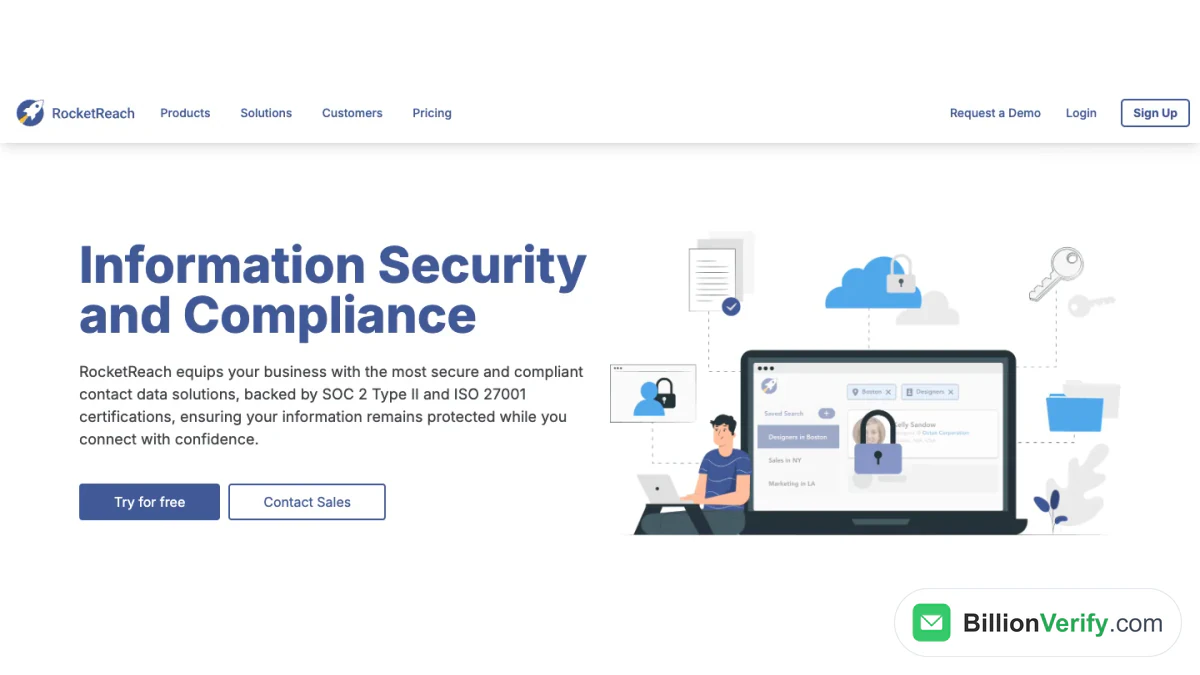
Screenshot: RocketReach's Information Security and Compliance page, October 2026.
Two notes put these claims in context. First, both standards are about process: how a vendor controls access, logs changes and handles incidents. They say nothing about whether a given phone number is right. Second, the same site offers a download link for its audit reports. If your company needs proof that a vendor is safe, ask for the report itself rather than relying on a badge.
Is RocketReach safe for your budget?
Billing is where most RocketReach complaints start, so read the Subscription Agreement before you buy. It says your plan "will automatically renew for successive periods" unless you cancel. It also says "all amounts paid are non-refundable." Cancelling stops the next renewal but does not refund the current term. Auto-renewal is the main reason buyers ask, "Is RocketReach safe to use?"
The same agreement explains how to stop a renewal. You can cancel "at any time from your account page" or by email to support@rocketreach.co. If you buy an annual plan, put a reminder in your calendar a few weeks before the renewal date. That simple step prevents the most common complaint in public reviews.
Five safe habits for RocketReach users
- Use a safe login. Turn on single sign-on or multi-factor login if your plan offers it.
- Keep exports safe. Store exported contacts where only your team can open them, and delete old files.
- Make renewals safe. Set a calendar reminder before each renewal date.
- Keep your domain safe. Verify each list ahead of a campaign so bounces do not hurt your sender name.
- Keep people safe from spam. Honor every opt-out at once and never resell what you export.
Is RocketReach safe for listed people?
If you are a listed professional rather than a customer, the question changes. Is RocketReach safe for people whose names are in it? Its privacy policy lists sources such as "people directories, data brokers, corporate information directories, business partners," and others. It also lets people opt out of "selling" through a "Do Not Sell or Share My Info" tool, and it honors the Global Privacy Control signal in a browser.
RocketReach describes its listings as a "publicly available professional index, similar to how search engines organize and display information." That is the company's framing. You may see it differently, and you have the right to remove your profile. Our RocketReach opt out guide walks through each step of the profile removal form.
The Community Program
One source of RocketReach contact records is less known: its Community Program. Users can sign in with a Google account and let RocketReach read the contacts in it. The article Community Program: What is Shared limits this to "names, company affiliations, job titles, business phone numbers, and email addresses." It adds: "We do not access the content of any emails."
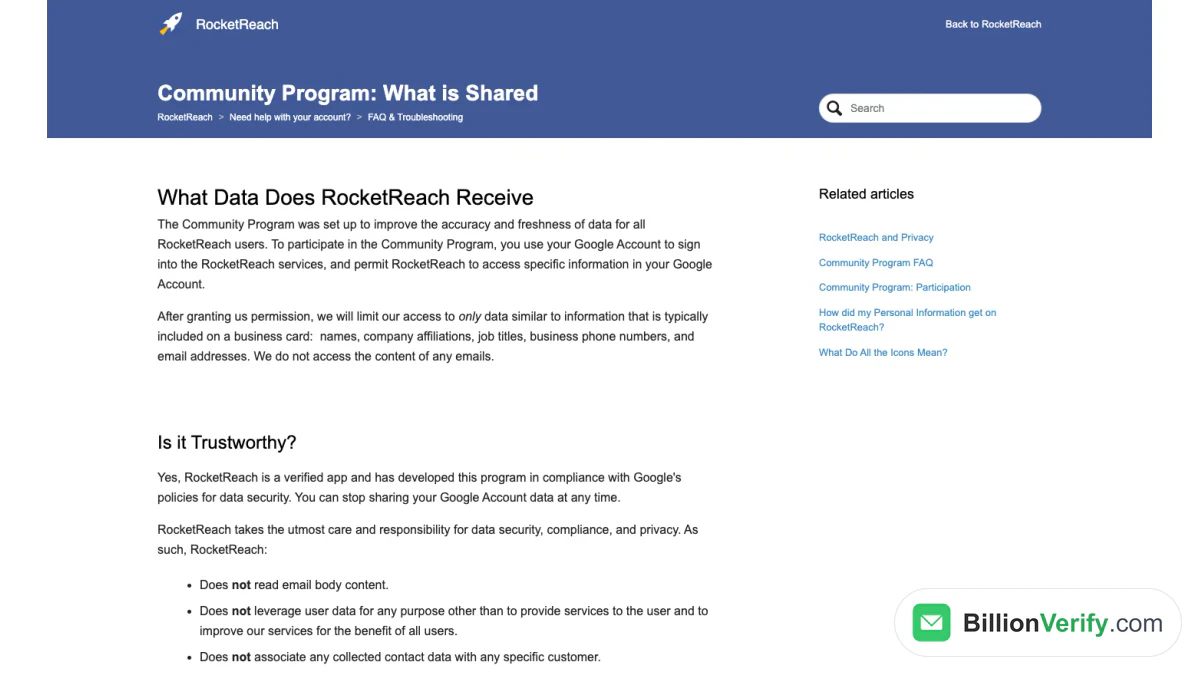
Screenshot: RocketReach's Community Program article, as archived by the Wayback Machine in October 2025.
The same article calls RocketReach "a verified app" under Google's rules and promises it "does not associate any collected contact data with any specific customer." In other words, if a colleague joined the program, your business card details may reach RocketReach without you ever signing up. That explains why many people find a profile they never created.
Is RocketReach Legal?
So is RocketReach legal? In the United States, it is legal to run and legal to use for business outreach, within limits. It discloses its broker status, offers privacy rights to the people it lists, and names a representative for Europe. Whether a given use is legal depends on what you do with a contact once you have it.
Broker registration in Texas and California
Several US states require data brokers to register. RocketReach's policy includes a "Texas Data Broker Notice" that reads: "The entity maintaining this website is a data broker under Texas law." The Texas Secretary of State broker page explains that registry.
California keeps its own list. The California Privacy Protection Agency registry names "RocketReach LLC" with the contact privacy@rocketreach.co. Registration does not mean a state approves a business. It means the company told the state who it is and how people can reach it. A broker that hides from these lists would be a much bigger warning sign.
Is RocketReach legal to use in Europe?
RocketReach serves users worldwide, so EU and UK law can apply to profiles of people who live there. Its policy names VeraSafe as its representative for both regions and lists the rights people have: access, deletion, objection and restriction. Under GDPR, a business that buys or exports contacts also takes on its own duties as a controller. So RocketReach being legal does not make every campaign you run with its contacts legal.
Is RocketReach legal for cold email?
For US email, the FTC's CAN-SPAM compliance guide sets the core rules. Your headers must be honest. Your subject line must not mislead. Each message needs a way to opt out and a valid postal address. You must honor opt-out requests. These rules apply to you as the sender, not to RocketReach as the source of the address.
Limits RocketReach sets on its own users
RocketReach also limits what customers can do. Its fair usage article says rate limits exist to "prevent automated scraping or abusive activity." Its subscription terms add a fair usage policy for plans with unlimited lookups. Breaking these rules can end your account, so plan your volume before you start a large export.
RocketReach Lawsuits: What Court Records Show
Even if RocketReach is legit, it can still face lawsuits. What matters is what the cases claim and how they end. We searched federal dockets on CourtListener, which mirrors PACER, and read the filed orders. Below are the cases we could confirm from primary documents. Allegations are claims, not findings, unless a court says otherwise.
Krause v. RocketReach (Illinois, 2021 to 2023)
Aimee Krause filed a class action in the Northern District of Illinois on April 12, 2021 (No. 1:21-cv-01938). The complaint alleged that free preview pages on RocketReach used people's names to sell subscriptions, which it said broke the Illinois Right of Publicity Act. On September 21, 2021, Judge Elaine E. Bucklo denied RocketReach's motion to dismiss.
The case then settled. On September 12, 2023, Judge Lindsay C. Jenkins granted final approval of a class settlement and dismissed the case with prejudice. The class covered Illinois residents "whose names were displayed on RocketReach's website in connection with a '+Phone Plan' hyperlink" from April 12, 2020. The order notes that no class member objected.
Sant v. RocketReach (Washington, 2024 to 2026)
Four plaintiffs from Washington, California, Illinois and Ohio sued in the Western District of Washington on October 8, 2024 (No. 2:24-cv-01626). They brought claims under the publicity laws of all four states, again about free profile pages. In July 2025, Judge Ricardo S. Martinez denied RocketReach's bid to send the case to arbitration and its motions to dismiss. RocketReach appealed the arbitration ruling to the Ninth Circuit, and the trial court paused the case.
On March 13, 2026, the plaintiffs filed a notice of voluntary dismissal of their claims with prejudice. The docket we read does not show the terms behind that dismissal, so we do not guess at them.
McClure v. RocketReach (Washington, filed 2025)
This putative class action sits in the same Seattle court (No. 2:25-cv-00986). A June 2026 order describes the claim: Colorado residents say RocketReach listed their "personal cell phone numbers" in its paid directory "without their consent," under Colorado's Prevention of Telemarketing Fraud Act. The court refused to compel arbitration and, on June 22, 2026, denied a request to reconsider. RocketReach filed an appeal in July 2026. As of this writing, the case was still open.
Atlas Data Privacy Corp. v. RocketReach (New Jersey)
Atlas Data Privacy Corporation sued RocketReach in New Jersey state court in 2024, and RocketReach moved the case to federal court on April 8, 2024. The claims come under Daniel's Law, a New Jersey statute about disclosing the home addresses and phone details of covered people, such as police officers, after they ask for removal. RocketReach is one of many defendants in a large group of similar Atlas cases.
On August 12, 2026, the Supreme Court of New Jersey answered a question sent to it by the Third Circuit. It held that "Daniel's Law does not contain a mental state requirement for actual damages liability." RocketReach LLC is listed among the appellants in that opinion. The ruling settles a point of law; it does not decide whether RocketReach broke the law.
What the RocketReach lawsuits do and do not show
Read together, the cases share a theme. They are about whether people agreed to have their names, numbers or addresses shown, not about fraud against paying customers. Krause settled, Sant was dropped by the plaintiffs, and two were still open when we checked. None of these orders finds that RocketReach cheated its customers. To check for newer filings, search the company name on CourtListener or PACER.
Does RocketReach Notify the Person?
No official RocketReach page says it alerts someone each time a customer looks them up. Its help center says the opposite of tracking: "RocketReach does not collect or process sensitive personal information, nor do we track or monitor individuals beyond publicly available business data." So the honest answer to "does RocketReach notify the person" is that no lookup alert is described, and we found none in its product pages.
There is one notice people do receive. RocketReach sends some listed people a "One-Time Data Processing and Opt-Out Notification." The article I Received a RocketReach Data Collection and Opt-Out Notice explains it. The notice tells you that RocketReach holds information that "directly or indirectly identifies you" and links to the removal form.
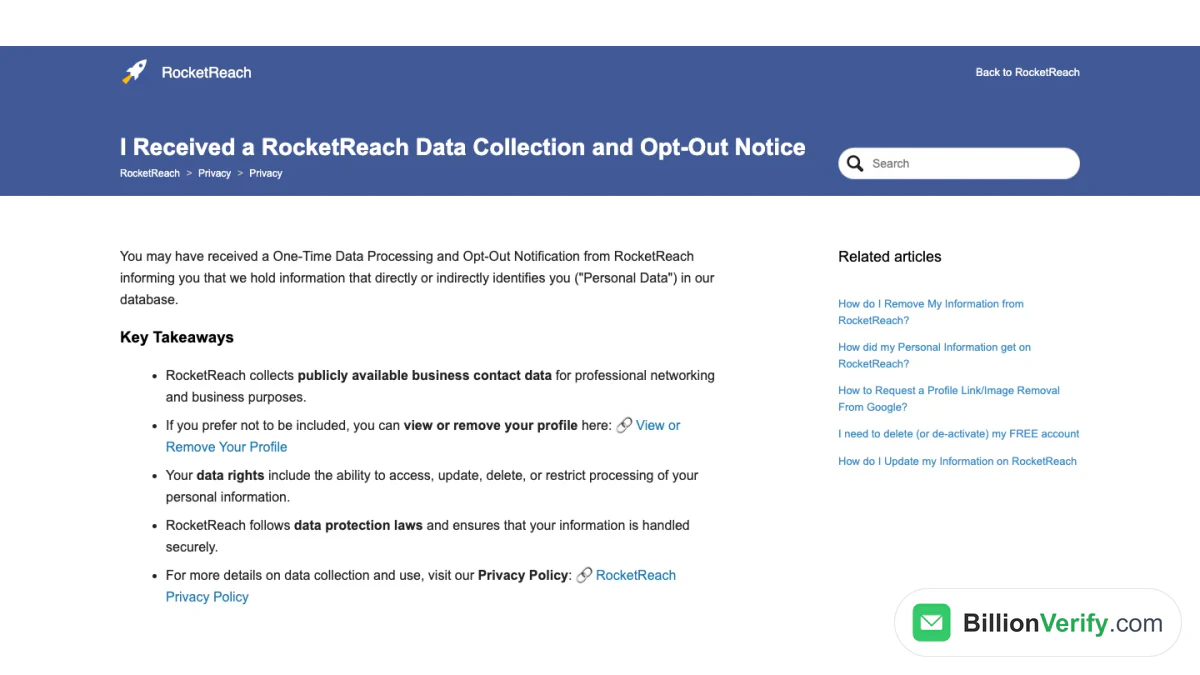
Screenshot: the RocketReach article explaining its one-time notice (Wayback Machine copy, July 2025).
That notice is about the database, not about a search. It is a one-time message tied to privacy law, and it does not name who opened your profile or when. If you got such a message and wonder whether the sender is real, check the sending address before you click. Our free reverse email lookup reads the domain, organization and mail routing behind an inbox from public signals.
Does RocketReach notify people who are looked up?
People who are looked up on RocketReach are not told about it, based on everything RocketReach publishes. A person will only learn of a lookup if the customer then contacts them. That part is in your hands. A cold message that explains who you are and why you reached out lands better than a message that pretends to be a warm lead.
What forum threads say
Many people add a forum name to the query, as in "does RocketReach notify the person Reddit." They hope for first-hand stories. Forum posts can be useful, but they are not proof. A poster may mix up RocketReach with LinkedIn, or mistake a sales email for an alert. For a firm answer, rely on the company's own articles and its policy, both linked above.
Does RocketReach Show Who Viewed Your Profile?
RocketReach does not list a profile viewer feature on its product pages. We checked its products, plans and help articles and found no tool that shows a listed person the names of customers who opened their profile. So if you wonder whether RocketReach can show who viewed your profile, its own pages say no.
The question often comes from LinkedIn, which does show members a list of recent profile viewers. RocketReach profiles are separate. A lookup there does not appear in LinkedIn's viewer list, and LinkedIn visits do not appear on RocketReach. Searches like "RocketReach who viewed my profile" usually mix up the two products.
On RocketReach, can you see who viewed your profile?
On RocketReach, can you see who viewed your profile? Not as a listed person. The company may keep its own logs. A July 2025 court order in the Sant case, summarizing the complaint, said RocketReach "tracks the number of times when and from where these free profile pages are viewed by non-subscribers." That was an allegation, and it described counts, not names shown to you. Nothing we found lets a listed person see who opened their page.
Is RocketReach Accurate?
Is RocketReach accurate? We do not test vendors, so we can only report what RocketReach claims and explain what those claims mean. Its help article How accurate is RocketReach's data? is the main source. It says the founding team "holds 13 patents in high scale data mining" and that the company uses "more than a dozen sources."
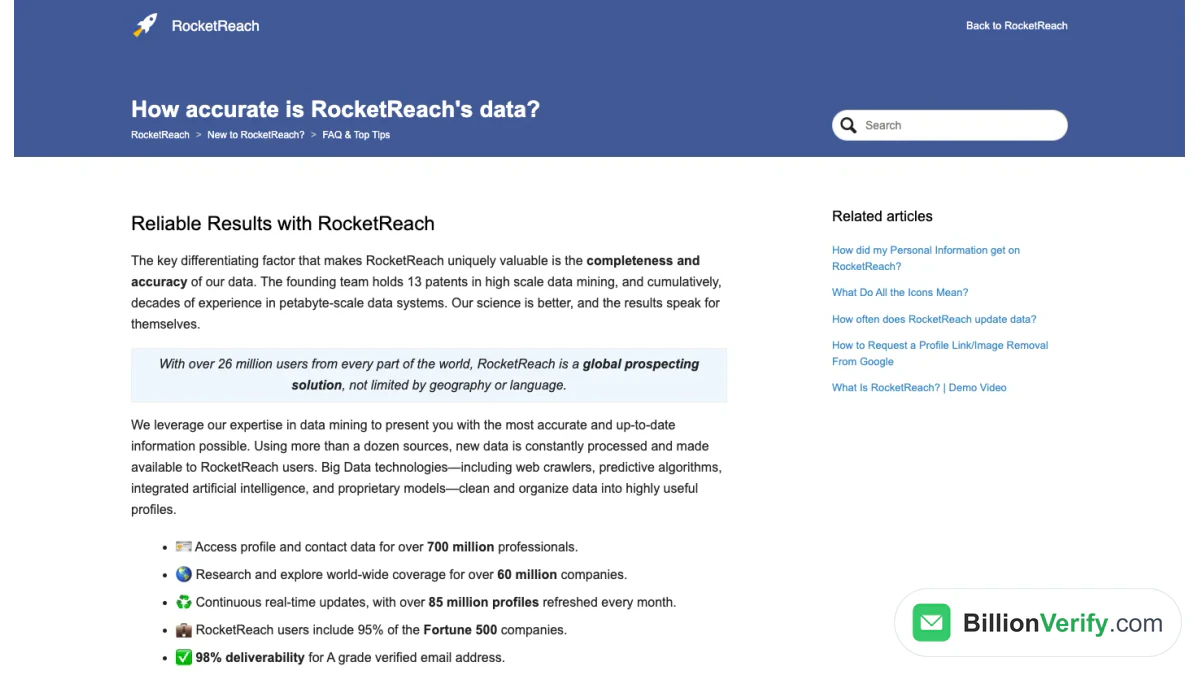
Screenshot: how accurate is RocketReach, in its own support article (Wayback Machine copy, August 2026).
The same article lists several claims: profiles for "over 700 million professionals," "over 85 million profiles refreshed every month," and "98% deliverability for A grade verified email address." It adds that "a typical user experiences 85% or better fill rate for email addresses and a 60% or better fill rate for direct phone numbers." All of these are RocketReach's own numbers. None of them comes from an independent audit.
Is RocketReach accurate enough for cold email?
So how accurate is RocketReach in practice? Read the claims closely. The deliverability figure covers A grade emails, not every address RocketReach returns. A fill rate measures how often RocketReach finds some contact detail, not how often that detail is right. And credits are "used only when we are able to provide a verified email address or verified phone number," so you are not charged for a blank result.
That design is fair, and labeled grades are a good sign. They still leave room for error. People change jobs. Industry estimates put the yearly decay of email lists at around 22.5 percent. Some company domains accept mail for any name, which makes a single inbox hard to confirm. Our RocketReach search guide explains how lookups are built and why some results are inferred.
Is RocketReach Reliable?
Reliability is close to the question "is RocketReach accurate," but it has two parts: is the service up, and are the records current? On the first, RocketReach says its engineers track uptime with automated monitors, and its security page links to a public status page with its history. On the second, it claims to refresh profiles every month and to run checks at the moment of each lookup.
How accurate is RocketReach after a few months? That depends on your use. A recruiter who needs a current contact for a senior hire will likely get value. A team that exports a big list and sends to it weeks later will see more failures, because people move in that time. In both cases, RocketReach is legit; contact records simply age, and every vendor faces that.
RocketReach Reviews: What Users Report
Public reviews show a split picture. On October 27, 2026, RocketReach's Trustpilot page showed a 1.2 score from 1,116 reviews. The company has claimed the profile. Trustpilot's breakdown showed 38 percent five-star reviews and 39 percent one-star reviews, with 75 reviews in the last 12 months.
Trustpilot's AI summary of recent reviews says that "customers frequently experience unexpected annual subscription renewals." Its topic list puts subscription, refund and payment at the top. Some recent one-star reviews also say contact details were out of date. Trustpilot also notes that RocketReach "hasn't invited customers recently, so reviews may not be representative," and that it "hasn't replied to negative reviews."
How should you read that? A low score driven by renewal complaints points to a billing problem, not a fake business. People who feel a charge was unfair are far more likely to post than people whose lookups worked. Still, the pattern is steady enough that a safe plan is to treat auto-renewal as a real risk.
How to Tell if a Contact Tool Is Legit
The same checks work on RocketReach and on any other vendor. Run through them before you pay for a plan or trust a profile you found.
A legit company names itself
A legit vendor tells you its legal name, its address and a privacy contact. RocketReach does: the entity appears in court filings and in California's registry, and the privacy contact is public.
A legit broker registers
If a vendor sells personal contact records in the US, look for it in state broker registries. A legit broker shows up there. A missing entry is worth a question.
A legit service lets people leave
Look for a removal form, a Do Not Sell option and a named contact for EU requests. RocketReach offers all three, so people can take their profile out.
Safe billing terms are clear
Read the renewal and refund clauses before checkout. With RocketReach, plans renew on their own and payments are final, so the risk is yours to manage.
Court and review history
Search CourtListener for the company name, and read reviews with their dates. Look for patterns, not single angry posts.
Your own test
Before a large purchase, run a small batch. Check the results yourself, and measure how many messages bounce. That number tells you more than any vendor claim.
RocketReach Legit or Not: Weighing the Evidence
On the evidence we found, RocketReach is legit. It has a long public history, published security claims, broker disclosures in two states, a removal process and terms that spell out how billing works. The lawsuits are about privacy and consent, and none of the court orders we read found fraud against customers.
For most teams the tool is safe to use, but the real risks are practical. Plans renew automatically and refunds are not offered. Some contact records will be old. And if you contact people, the law treats you as the sender. Go in with those facts and you can decide for yourself whether RocketReach fits your needs.
Verify Contacts Before You Send
A legit vendor can still hand you an address that bounces. Bounces hurt your sender reputation, and a high bounce rate can push your next campaign into spam folders. So check every list before outreach, no matter which tool it came from. Our page on RocketReach email verification shows how to check a RocketReach export before the first send. Suspect an exported address? Paste it into the email checker and read the SMTP result before you hit send.
Our blacklist checker shows whether your sending domain or IP appears on public blocklists.
BillionVerify checks whether an address exists and can receive mail, without sending a message. It reports catch-all domains as their own result instead of counting them as valid. A valid or invalid result uses one credit, unknown results are free, and a re-check within 24 hours is free too. For direct dials from any contact tool, our phone number validator shows whether a number is valid for its country and what line type it is. If your bounce rate has already climbed, run the free blacklist checker on your domain before the next campaign.
FAQs
Is RocketReach legit?
Yes, RocketReach is legit: it is a real company that has offered B2B lookups for more than ten years. It publishes its security claims and subscription terms, and it appears in California's broker registry. That does not mean every record is current, so check contacts before you reach out.
Is RocketReach a scam?
RocketReach is not a scam based on the public evidence we found. It delivers the lookups it sells, and the lawsuits against it are about privacy and consent, not fraud against buyers. Many negative reviews are about automatic renewals, which its terms disclose.
Is RocketReach safe to use?
RocketReach is a safe choice for most business teams, provided you manage renewals and handle exported contacts with care. It reports outside security audits and supports single sign-on. Plans renew automatically and payments are non-refundable, so set a reminder before your term ends.
Is RocketReach legal?
RocketReach is legal to operate in the US, and it discloses its data broker status in Texas and California. It offers removal and Do Not Sell options, and it names VeraSafe for EU and UK requests. Your own outreach must still follow laws such as CAN-SPAM and GDPR.
Does RocketReach notify the person you look up?
RocketReach does not describe any alert that tells a person when a customer runs a lookup on them. Its help center denies tracking individuals beyond public business information. The only notice it describes is a one-time message about being in its database.
Does RocketReach show who viewed your profile?
RocketReach does not offer a feature that tells a listed person who viewed their profile. That feature belongs to LinkedIn, not RocketReach. RocketReach profiles have no viewer list for the people they describe.
How accurate is RocketReach?
RocketReach claims 98% deliverability for its A grade verified emails, but that is its own figure, not an independent test. It also reports fill rates of 85% or better for emails and 60% or better for direct dials. Records can still go stale when people change jobs.
Is RocketReach reliable?
RocketReach is reliable for many single lookups, but large lists exported and used later will include stale records. It says it refreshes profiles monthly and checks details at the moment of lookup. Run a small test batch before you commit to a large plan.
Is RocketReach accurate for phone numbers?
RocketReach finds direct dials less often than emails, by its own account: a typical user gets a direct dial for at least three in five lookups. A found number can still belong to an old desk or a past employer. Check the line type and country before you call or text.
Why do I have a RocketReach profile I never created?
RocketReach builds profiles from public pages, licensed sources and its Community Program, so you do not need to sign up to be listed. The company calls the result a professional index. You can remove the profile through its official form.
How do I remove myself from RocketReach?
You can remove yourself from RocketReach through the removal link at the top of its privacy policy. You enter the email on your profile and confirm by clicking a link. Our step-by-step opt out guide covers the details.
Watch: Blacklist Checker: How to Check a Domain and IP Reputation