




There is no single best email verification service, because the right choice depends on how you verify. A single cleanup of an old list, a signup form that checks each email address live and a monthly subscription reward different billing models. Four rules decide the real price: what a single credit buys, whether unknown replies cost anything, whether leftover credits lapse, and what happens to the file you upload. This guide compares a dozen email verification vendors on those rules and explains how a check works.
The vendors are ZeroBounce, NeverBounce, Bouncer, Kickbox, Emailable, Clearout, DeBounce, Hunter, Email Hippo, MailTester Ninja, VerifiedEmail and BriteVerify. Every price, allowance and rule comes from the vendor's own pricing page, help center or documentation, as read in November 2026. Two sites block automated readers, so for NeverBounce and Email Hippo we read the Internet Archive's copies, dated October 29 and November 9, and the text names them. Vendors change plans and run promotions often, so confirm the live page before you buy. We have no connection with any company listed here, and a vendor missing from the list was simply not read this month. BillionVerify sells verification too, and the last section explains where a pre-send check fits.
Key facts (checked November 2026):
- Kickbox's price table lists 500 verifications for $5 and 100,000 for $500, and an unknown result does not count against the balance.
- Bouncer's price list starts at $8 for 1,000 credits and tops out at $2,000 for a million, and it never bills repeats or unknown outcomes.
- NeverBounce's pricing page charges $8 per thousand credits and expires prepaid credits a year after purchase, as archived in late October.
- Emailable's calculator page gives every new account 250 free credits.
- Amazon SES's sending FAQ puts an account under review at a 5% bounce rate and may pause sending at 10%.
What an Email Verification Service Checks
An email verification service tests whether a mailbox can receive mail, without sending a message to it. It reads each email address in stages, and every stage fails in its own way. The first stage checks syntax: one @ sign, permitted characters and sensible lengths. The second looks up the domain and its mail servers in DNS, as our guide to MX record validation explains. The third opens an SMTP conversation with the receiving server. MailTester Ninja describes the step on its verifier page: it talks to the mailbox provider up to the recipient step, reads the reply and stops. No message is delivered.
The recipient step is defined in RFC 5321. Section 3.3 says a server that accepts the recipient returns a 250 reply, and a server that knows the mailbox is not deliverable returns a 550 reply. The same standard describes a VRFY command meant to confirm an email address. Section 7.3 notes that sites may switch it off for security reasons and answer with a 252 code instead. That is why verification tools lean on the recipient step. Our article on SMTP email verification shows what the conversation looks like.
A server's reply is not always the truth. Some domains accept mail for any email address and decide later what to do with it. Kickbox's documentation warns that such a server may silently discard the message or send a bounce after the fact. RFC 5321 admits in section 6.2 that dropping mail without notice is permitted in practice. A careful vendor files these entries in a separate group, as our piece on catch-all email detection describes, instead of guessing. A slow or unreachable server causes a different outcome, a label of unknown, and most vendors do not bill it.
How Vendors Label Results
Each verification service labels results in its own way. Kickbox publishes the clearest definitions we read. Each email address receives one of four labels: deliverable, undeliverable, risky or unknown. Accept-all entries, throwaway domains and shared inboxes all land in the risky group. Other vendors use their own words, and the sections below quote them. Compare the labels before you move rules from one tool to another.
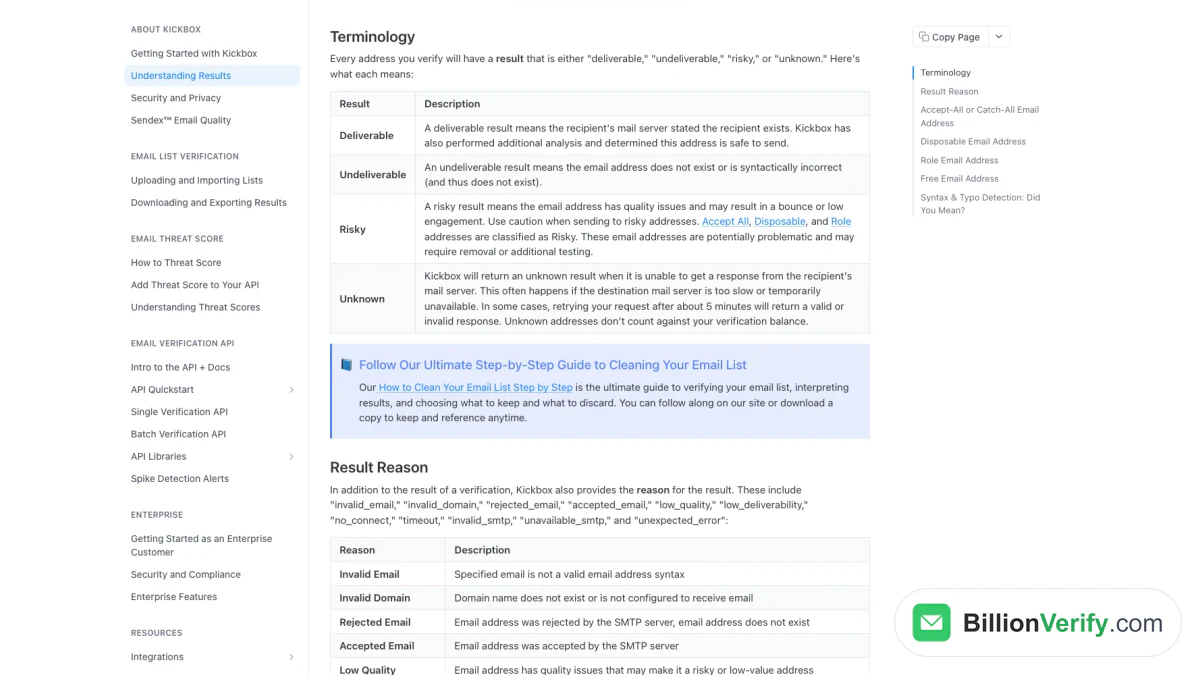
Screenshot: the Kickbox Understanding Results page with its four result definitions, captured in November 2026.
Why Bounces Matter to Your Sending Account
Verification exists to keep hard bounces low. A hard bounce is a permanent failure, and Amazon's FAQ gives "address does not exist" as its example. Temporary trouble such as a full mailbox is not counted. Amazon asks senders to stay under 2%, opens a review at 5% and may pause the account at 10%.
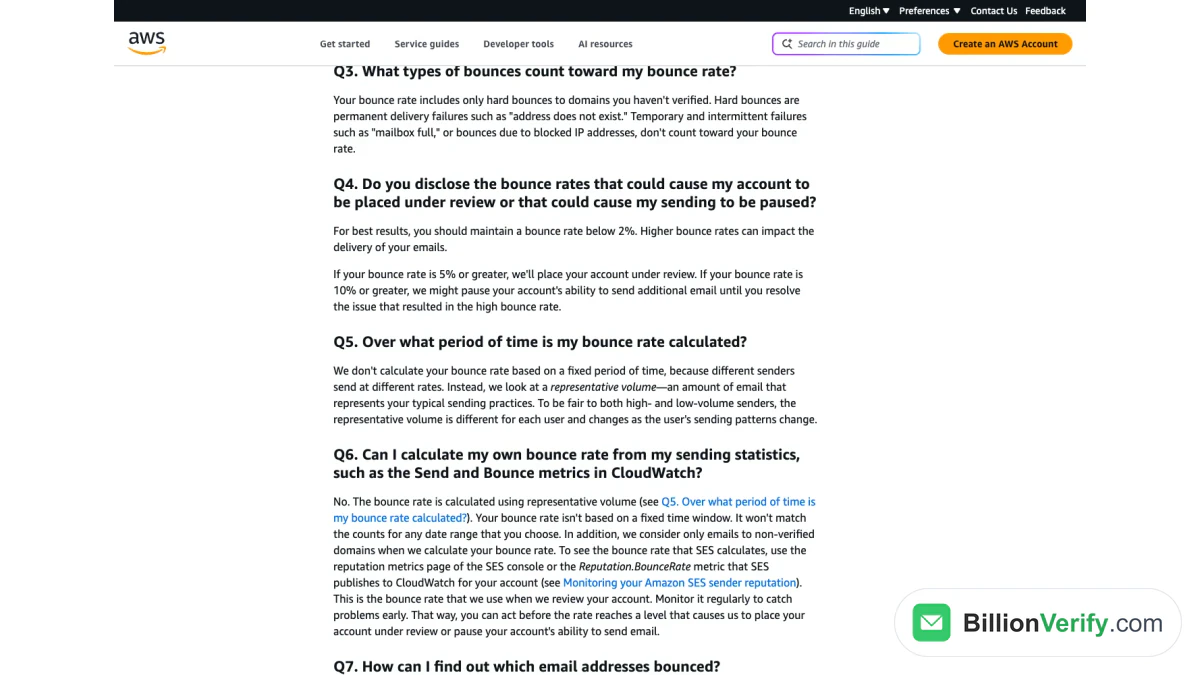
Screenshot: the Amazon SES enforcement FAQ with its bounce limits, as shown in November 2026.
Those numbers belong to a single sending platform, and others set their own. They show how a list problem turns into an account problem. Old lists, purchased lists and hand-typed form entries are where permanent failures come from. Platforms that bill by contact also count every dead entry you store, so a dirty list costs money before it costs deliverability.
How to Choose an Email Verification Service
The sticker price of a verification service tells you little until you know the rules around it. These five points change the bill and the result, whichever candidates you shortlist.
What One Credit Buys
Most vendors sell credits, and a credit usually covers a single email address. The exceptions matter. Hunter counts half a credit per check and draws it from the same allowance as its finder. DeBounce prices catch-all handling at ten credits against a single credit for plain validation. Emailable charges 100 credits for an inbox report. MailTester Ninja skips credits and sells flat-fee access with a daily cap.
A fair comparison is a single 5,000-address file at each published rate. DeBounce shows $15, Bouncer $35, Emailable $38, Kickbox and Clearout $40 each, and ZeroBounce $69. NeverBounce's published rate gives $40 too. These are list prices before promotions. ZeroBounce, Kickbox, Emailable and Clearout all ran Black Friday offers when we read their pages, and none is counted here.
Unknown, Duplicate and Catch-All Results
Vendors differ most on which outcomes cost money. An unknown label means the server gave no clear answer. ZeroBounce, Bouncer, Kickbox, Clearout and Hunter waive the charge for an unknown reply, and Emailable refunds it once a file finishes. Repeated rows cost nothing at ZeroBounce, Bouncer, Clearout, DeBounce and Email Hippo. The catch-all group is where rules diverge. Clearout bills it as a definitive answer, while DeBounce prices that check on a separate line. Read the rule ahead of an upload full of company domains, since many of them accept every address.
Free Starts, Minimums and Expiry
Free starts run from 50 credits monthly at Hunter to 250 credits at Emailable. The smallest packages run from 500 verifications at Kickbox to 5,000 at Emailable. Expiry splits the field. VerifiedEmail, DeBounce, Clearout, Emailable and Bouncer keep purchased balances alive indefinitely, while NeverBounce lets them lapse after a year. A list you clean twice a year favors a vendor whose balance lasts.
Accuracy claims from a verification service need a caution. ZeroBounce's page states a 99.6% accuracy guarantee, and other vendors publish similar figures. Each number is the vendor's own, measured on its own data, so nobody can compare them across vendors. A test of a few hundred addresses from your own list is more useful.
Live Checks, Bulk Files and Integrations
Email verification tools split into file tools and real-time tools. Email Hippo sells them as separate products, CORE for files and MORE for live checks. Bouncer, Emailable and VerifiedEmail offer a form widget, and Clearout offers Form Guard. For a signup form, check the API rate limit before launch. Clearout publishes a limit for each plan, from 3 requests a minute on the free tier to 55 on its larger plan.
Data Handling and Retention
A list is personal data, and the verification service that processes it acts on your behalf. Article 28 of the GDPR requires a contract for that relationship. Retention rules differ. ZeroBounce erases files 30 days after upload, Kickbox keeps them for 90 days, and MailTester Ninja keeps nothing. Ask for a data processing agreement before you upload customer addresses.
The 12 Email Verification Services
The vendors run from the widest suites to the narrowest tools. Prices are in US dollars as listed by each vendor.
ZeroBounce
ZeroBounce is the broadest email verification suite here. It sells validation, AI scoring, an email finder and deliverability tools from a shared balance. Its price calculator shows a Freemium level that refills with 100 validation credits every month. The prepaid side starts at a floor of 2,000, and the calculator quoted $69 for 5,000, or $0.0138 each.
The ZeroBounce ONE subscription begins at $99 monthly, and the minimum purchase is 10,000. It adds warmup seeds, inbox placement tests, blacklist monitors and a DMARC monitor. Removed repeats and unknown outcomes cost nothing. The finder spends 20 credits on each verified email address. Balances survive while the subscription is active, and other cases follow the posted terms.
NeverBounce
NeverBounce is a ZoomInfo email verification product, per its footer, and the live site asks visitors to press and hold to prove they are human. These figures come from the Wayback Machine copy of that page, saved on October 29, 2026. A single purchase runs $0.008 per credit, and unused credits lapse after 12 months. The Growth plan costs $49 monthly for up to 10,000 emails, syncs with a CRM and bills only new, unique entries.
Enterprise terms are custom and aimed at very large monthly volumes. The site lists 80+ integrations and offers new users a list analysis with test credits.
Bouncer
Bouncer is a Polish email verification company, and its site notes that the service is hosted in the EU. It sells credits that carry no expiry date, with a minimum order of 1,000 and 100 credits to start. Packages step up through several tiers and top out at a million credits. A monthly subscription tab sits beside the single-purchase option.
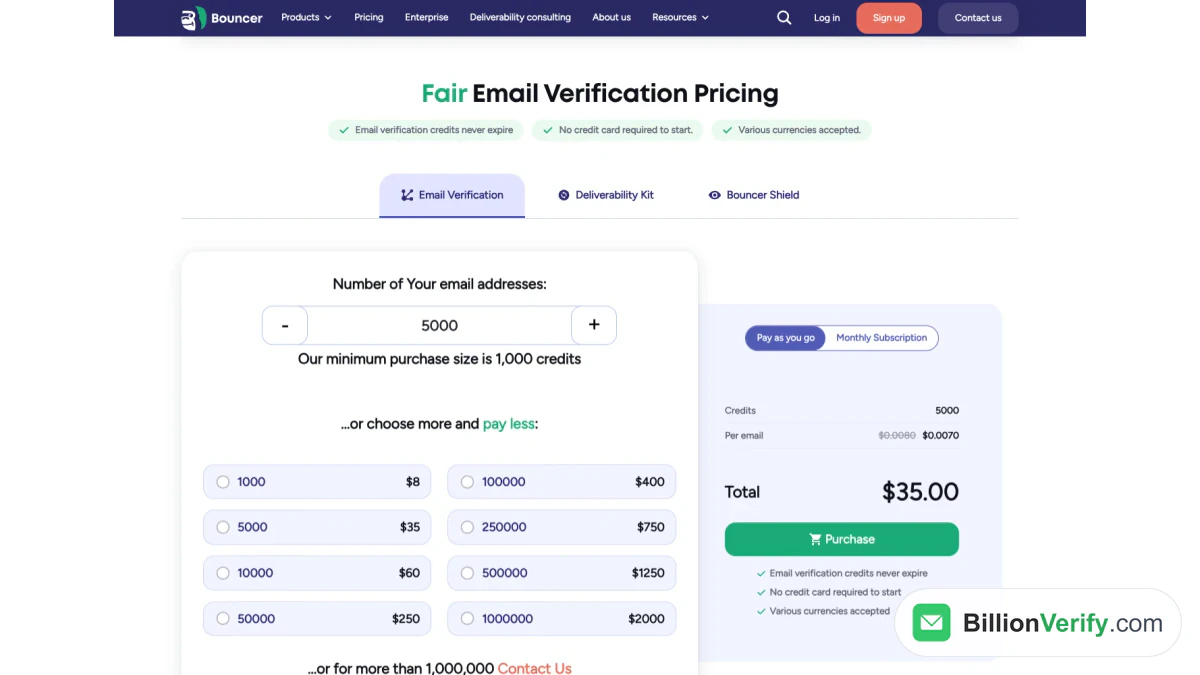
Screenshot: Bouncer's credit calculator set to 5,000, taken in November 2026.
Two other products share the page. The Deliverability Kit costs $25, $125 or $250 a month and covers inbox placement, blocklist, SPF, DKIM and DMARC tests. Bouncer Shield checks addresses live on web forms.
Kickbox
Kickbox sells prepaid email verification packs on a plain table. The first 100 verifications are free, then 1,000 cost $10 and 2,500 cost $25. An unknown result returns its credit, and Kickbox invites you to retry the email address later or spend the credit elsewhere. The company describes itself as GDPR-compliant and SOC II certified, with verification and support based in both the US and the EU.
Its results guide is the reference for the four labels. Its security page adds that uploaded lists vanish automatically after 90 days. API lookups may be cached only as an irreversible hash.
Emailable
Emailable's email verification calculator opens at a 5,000 minimum, priced at $38 or $0.0076 each. New accounts begin with 250 credits at no cost. A single credit pays for a verification through the bulk tool, the single verifier, the API or the widget. Duplicates and unknown answers return to the balance when a file finishes, and balances never lapse.
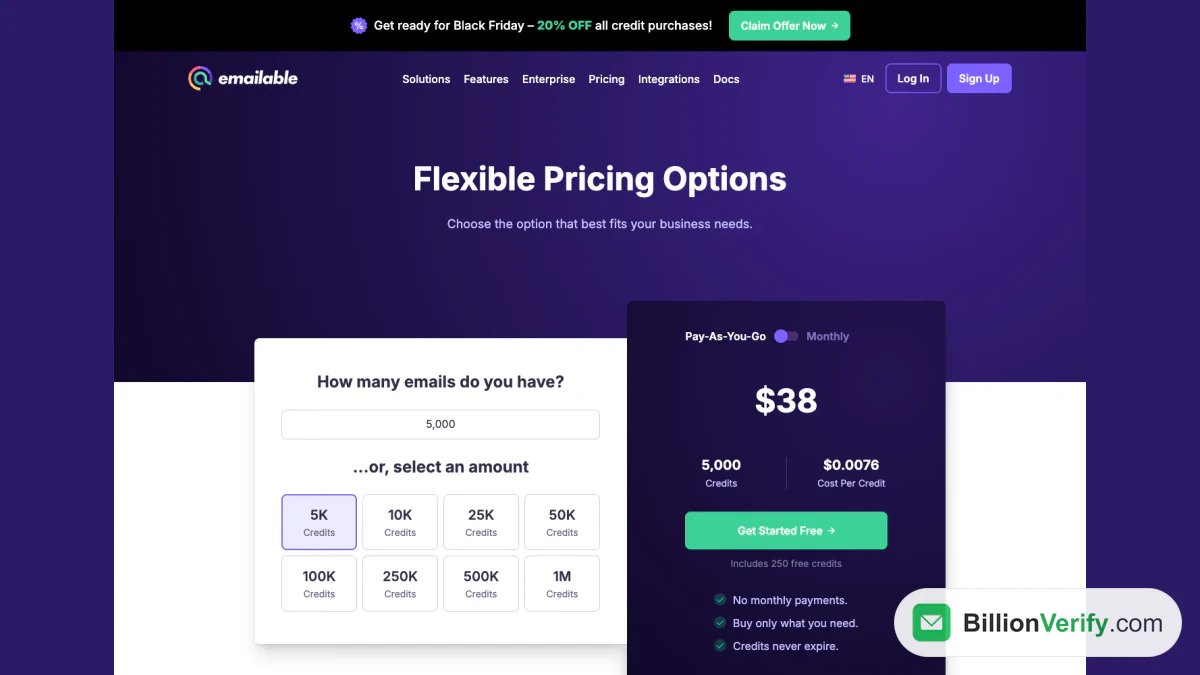
Screenshot: Emailable's calculator with its signup credits note, from the vendor's site in November 2026.
A credits subscription takes 15% off each cycle, and the calculator showed $32.30 monthly for the same level. Deliverability tools use the same balance: an inbox report costs 100 credits and a blacklist check costs 5. The site shows SOC 2 and GDPR badges.
Clearout
Clearout's price list sells prepaid packages of $40 for 5,000 credits and $400 for 100,000. New users receive 100 credits. Subscriptions roll leftovers into the next month. A Black Friday sale was live while we read, so the plan cards showed discounted prices that we left out.
The billing guide spells out the charging rules. A valid, invalid or catch-all label costs a single credit. Unknown outcomes and repeated rows in the same upload are free. Purchased balances do not lapse, though discounted ones may. A refund is possible within 30 days if bounces pass 10 to 20%, but only for the addresses that bounced. Subscriptions are excluded, and so is any request after more than 25% of the credits are spent.
The guarantee carries conditions. Addresses in the Safe-to-Send group must be mailed inside a 24-hour window after verification, because an email's status can change at any time. Education domains, free webmail and some Office 365 servers are excluded. Clearout lists ISO 27001:2022 and SOC 2 Type II among its certifications.
DeBounce
DeBounce's calculator for email verification begins with 100 trial credits and promises that purchases never expire. It quoted $15 for 5,000 and $450 for 500,000. The headline advertises rates from $0.00045 a check, and prices include taxes and fees.
A plain validation uses a single credit. Data enrichment costs 20 credits per successful detection, and catch-all validation costs 10. Duplicates are dropped at no cost, and API access needs no separate purchase. DeBounce does not state how it bills an unknown reply.
Hunter
Hunter sells finding, verifying and outreach in a single account, and anyone can use its verifier. The verifier page offers five free checks a day without signup and returns valid, accept-all, invalid, disposable or unknown. A verified email draws 0.5 credit. An unknown reply is not counted, and disposable addresses are skipped.
On its plans page, the free plan holds 50 credits per month, which equals about 100 checks. Starter is $49 per month with 2,000 credits, or $34 a month billed yearly, with the whole year's credits available upfront. Growth and Scale add more. Team seats are unlimited on every plan. Hunter suits teams that verify what its finder just returned, since both draw on a shared allowance.
Email Hippo
Email Hippo is a UK company, and its live site sits behind a Cloudflare check. The numbers below were read from a Wayback Machine snapshot taken on November 9, 2026, and the vendor's pricing page is the source to confirm. Prices start at $9.88 monthly, and 100 checks are free without a credit card.
Products split by job. CORE verifies uploaded files, as a subscription or per file, and a single file can hold 500,000 emails. It does not bill duplicates. MORE is a real-time API for signup checks, INSIGHT adds enrichment and ASSESS adds fraud signals, from $9.88, $12.26 and $14.63 monthly. The page names ISO 27001 certification, UK and EU data processing and a custom DPA for enterprise buyers.
MailTester Ninja
MailTester Ninja sells time, not credits. Its unlimited plans cost $6.99 weekly for 100,000 emails a day, $23.99 monthly for the same daily cap and $39.99 monthly for double. Buying several units lifts the cap, so five Ultimate units allow a million a day. Requests above the cap are refused, and the quota resets the next day.
The vendor keeps no copy of any address you submit. It checks syntax, then MX, SPF and DMARC records, then runs the SMTP test, and it flags a catch-all server as uncertain. Single checks on the verifier page are free and need no signup. The model suits a team that verifies large lists weekly.
VerifiedEmail
VerifiedEmail offers 200 email verifications at no cost. Its credits guide says each new email address costs a credit, and verifying the same email address again within 24 hours is charged once. A file first locks a credit for every row, and credits for previously verified or unknown rows are released after the run. The help center states that prepaid balances never expire.
The pages we read publish no price table. The vendor pitches real-time checks through a widget with reCAPTCHA, a bulk cleaner and a continuous cleanup that syncs with your email provider. Malformed rows and duplicates are removed at no charge.
BriteVerify
BriteVerify, an email verification engine, now lives inside Validity's Engage platform. A Validity capability page says it checks syntax, domain, MX records and mailbox existence, then labels each email address valid, invalid or risky. It also validates phone numbers and mailing addresses against USPS CASS-certified databases. Rates are not published. Validity's pricing page says plans are built around your goals and volume, so the route is a sales call.
Comparison Tables
The first table lists what each vendor offers at the start and at the entry level. "Entry price" is the smallest paid package or plan published, and Hunter's plan also appears at its yearly rate.
| Service | Free start | Entry price | Billing model |
|---|---|---|---|
| ZeroBounce | 100 monthly credits | $69 for 5K | Credits, or a $99 subscription |
| NeverBounce | List analysis, test credits | $8 per 1K | Credits, or the Growth plan at $49 |
| Bouncer | 100 starter credits | $8 buys 1K | Credits, or a subscription |
| Kickbox | 100 verifications | $5 buys 500 | Prepaid packs |
| Emailable | 250 credits | $38 for 5K | Credits, subscription 15% cheaper |
| Clearout | 100 at signup | $40 for 5K | Credits, or plans with rollover |
| DeBounce | 100 to try | $15 for 5K | Credits |
| Hunter | 50 monthly, about 100 checks | $49 monthly, $34 on yearly billing | Plan allowance, 0.5 credit each |
| Email Hippo | 100 checks | From $9.88 monthly | Subscription or one-off file |
| MailTester Ninja | Single checks on the site | $6.99 weekly | Unlimited daily checks |
| VerifiedEmail | 200 verifications | Not published | Credits |
| BriteVerify | None listed | Sales quote | Enterprise contract |
The second table covers the rules that change the real cost. "Not stated" means the pages are silent.
| Service | Unknown replies not charged | Duplicates not charged | Balance lapses |
|---|---|---|---|
| ZeroBounce | Yes | Yes | No, on a subscription |
| NeverBounce | Not stated | Yes, on Growth | At 12 months |
| Bouncer | Yes | Yes | No |
| Kickbox | Yes | Not stated | Not stated |
| Emailable | Yes | Yes | No |
| Clearout | Yes | Yes | No, unless discounted |
| DeBounce | Not stated | Yes | No |
| Hunter | Yes | Counted once per period | With each plan period |
| Email Hippo | Not stated | Yes, on CORE | Not stated |
| MailTester Ninja | Not applicable | Not applicable | Not applicable |
| VerifiedEmail | Yes | Charged once in 24 hours | No |
| BriteVerify | Not stated | Not stated | Not stated |
Which Service Fits Which Job
No email verification vendor wins every row. The pairings below match a situation with the vendors whose published terms suit it best.
A one-time list cleanup
A low minimum and no charge for unknown replies suit a single file. Kickbox starts at 500 verifications and Bouncer at its entry package, and both waive the unknown outcome. DeBounce shows the lowest price for a small file, but it says nothing on that point. Balances that never lapse also let you keep a remainder for the next file.
Signup forms and live checks
A form needs an API or widget with a rate limit you can live with. Bouncer Shield, the Emailable widget, VerifiedEmail's widget, Clearout's Form Guard and Email Hippo's MORE product were built for it. Look at the free tier's cap first, since Clearout publishes one for every plan. Pair the check with a message that lets people fix a typo.
Regular verification at high volume
MailTester Ninja's flat fees fit teams that check bulky files every week, because the cost does not grow per email address. ZeroBounce's subscription and NeverBounce's Growth plan fit teams that want a monthly plan tied to a bundle of tools or a CRM sync. Teams with occasional files should compare lapse rules before they commit to a monthly plan.
Prospecting lists
Hunter keeps finding and verification in one allowance, and it does not bill unknown answers. That suits a sales team that checks the addresses it just found. A list built from a scraper or a purchased file leans hardest on the catch-all rule, so read each vendor's catch-all line first.
Strict data retention
If a policy limits how long a file may stay with a vendor, compare published retention. MailTester Ninja retains no copies at all, ZeroBounce deletes files after 30 days and Kickbox after 90. Email Hippo and Clearout hold information-security certifications, and Email Hippo offers a tailored DPA. Bouncer hosts its service in the EU.
Enterprise contracts
BriteVerify, Email Hippo's higher tiers and NeverBounce Enterprise are quote-based. Expect a sales process, a contract and custom terms. Ask each verification service for its unknown-reply rule and its retention period in writing.
Verify the List Before You Send
Whichever email verification service you pick, verify a list before it reaches your sending platform. Bounces count against the domain you send from, and the Amazon limits above show how fast a bad file turns into a platform review. A short check also keeps dead entries out of any tool that bills by contact count.
BillionVerify runs syntax, DNS, MX and SMTP checks through its email verifier. It reports catch-all domains as their own category instead of calling them valid. Valid, invalid, catch-all, disposable and role results use a single credit each, and an unknown result is never charged. A recheck inside 24 hours is free. For any email address you doubt, BillionVerify's free checker answers without a signup, and the bulk email verification page covers a whole CSV file. Every account gets 20 credits for each day it is used, up to 600 a month, with no credit card. Prepaid packs start at $20 for 20,000 credits.
Agencies can also resell the API under their own brand through the white label program.
Two more checks help before a big send. A reverse email lookup shows what a suspicious email address is attached to. A phone number validator confirms the numbers in your file before you add an SMS channel.
FAQs
Is email verification the same as email validation?
Vendors use the two terms interchangeably, and this guide does too. Some writers reserve validation for format checks and verification for mailbox checks. Our explainer on email validation versus verification covers the distinction. Look at the checks a vendor lists, not at the word in its name.
Does a verification service send a message to each address?
No. The test stops at the recipient step of the SMTP conversation, before any message body goes out. The server answers whether it would accept the recipient, and the vendor records that reply. Nothing arrives in the mailbox.
What should I do with risky or accept-all results?
Treat them as a decision, not a verdict. Kickbox's documentation says risky addresses may require removal or additional testing, and that accept-all domains can raise bounce rates. A common approach is to mail a small batch first and watch the bounces. Hold the group back from your largest sends while you learn how it behaves.
Should I verify addresses from my own signup form?
It depends on how they were collected. Addresses confirmed through a double opt-in message have already proven they receive mail. Addresses typed into a form without confirmation, imported from an event or older than a few months deserve a check ahead of a large send.
Can I check a whole list for free?
Only a small one. Hunter's 50 monthly credits and Emailable's 250 at signup bracket the range, so a free start covers a sample, not a full file. Hunter also gives five free single lookups each day, and MailTester Ninja checks single addresses free on its site. Use a free start to test a vendor on a few hundred of your own addresses.
How long does a verified result stay reliable?
Not for long. Clearout's guarantee covers only mail sent in the first day after a check, since a mailbox can change status afterward. Kickbox suggests retrying an unknown result after about 5 minutes. Verify close to the send date, and verify again after a long gap.
Watch: How to Turn G2 Leads Into Verified Emails
Watch: Email Validator vs Email Verifier: What Is the Difference?