




B2B email marketing is the practice of sending commercial email to people in their working role, so that a business moves toward a purchase, a renewal or a referral. It differs from consumer email in who reads the message and how the decision gets made. A message to a business email address reaches one member of a buying group, and the reply you want is often a forward to a colleague. The legal rules also differ, because the United States, the United Kingdom, Germany and Canada each treat email to business contacts in a different way.
This guide covers the rules by country, how to build and check a B2B email list, what mailbox providers require, how to segment for buying groups, and what the main B2B email marketing platforms cost. Two sections apply the same ideas to recruiters and to law firm email marketing. Every rule, threshold and price comes from the regulator, standards body or vendor named beside it, as read this month, and the result is a set of B2B email marketing best practices tied to named sources. Laws and filtering rules change, and nothing here is legal advice, so check the live source before you launch. We have no connection with any company or agency named below. BillionVerify is an email verification service, and the section on checking addresses explains where it fits.
Key facts (checked November 2026):
- The FTC's CAN-SPAM guide says the law "makes no exception for business-to-business email" and lists a maximum penalty of $53,088 per email.
- The UK regulator's B2B marketing guidance says the PECR consent rule for email does not apply to corporate subscribers, while sole traders and certain partnerships are treated as individuals.
- Section 7 of Germany's Act against Unfair Competition treats advertising by email without the addressee's agreement beforehand as an unacceptable nuisance, with a narrow exception for existing customers.
- Google's email sender guidelines require senders of more than 5,000 messages a day to personal Gmail accounts to set up DMARC and keep the spam rate below 0.30%.
- A Gartner survey of 632 buyers, published in May 2025, found buying groups of five to 16 people across as many as four functions.
How a Buying Group Changes the Email
Gartner's May 2025 release describes buying groups as "more diverse than ever". Its survey found that groups reaching consensus were 2.5 times more likely to report a high-quality deal. The same release says tailoring for buying group relevance "positively impacts consensus by 20%", while content with individual-level relevance had a 59% negative impact on consensus. The release is written for sales leaders, but the finding applies to email just as well.
The practical meaning is that a first name and a job title are weak personalization in this setting. The stronger move is to write each message around a problem the whole account recognizes, such as a renewal, a migration or an audit, and then change the angle by role. The finance contact sees cost and risk, the technical contact sees setup and limits, and the sponsor sees the outcome. Send these as separate messages to separate people and keep the account in a single record, so that a reply from a colleague changes what the others receive.
A work mailbox has a property that a personal inbox lacks. It belongs to an employer, so it stops working when the person leaves, and a shared mailbox may be read by several people who never signed up. That is why upkeep of a B2B email list is a standing task and not a cleanup you do once.
B2B Email Rules by Country
The first decision in any B2B campaign is whether you need permission before the first message. The answer depends on where the recipient sits, and the four systems below give four different answers. The table summarizes them, and the sections that follow explain the detail and the source of each row.
| Region | Permission needed for a first message | What the source adds |
|---|---|---|
| United States | None, and no exception for B2B in the law | Accurate headers, postal address, working opt-out |
| United Kingdom | None for corporate subscribers; consent, or soft opt-in, for sole traders and some partnerships | Identify yourself, give a valid opt-out route |
| Germany | Consent first, with an existing-customer exception | Sender identity and a free way to stop messages |
| Canada | Express or implied consent; a published email address counts only under conditions | The sender must be able to prove it |
United States
CAN-SPAM covers all commercial email, and the FTC's compliance guide says plainly that B2B messages get no exception. The law does not require opt-in. It requires accurate sender and routing information, a clear identification of the message as an ad, a valid physical postal address and a working opt-out. Opt-out requests must be honored within 10 business days, and the mechanism must keep working for at least 30 days after you send. The guide says each separate violating email is subject to penalties of up to $53,088, a figure the page notes was updated in January 2024 for inflation. Our CAN-SPAM Act guide covers the full list of requirements.
United Kingdom
The Information Commissioner's Office separates two kinds of business recipient. Corporate subscribers are bodies with a separate legal status, such as companies, limited liability partnerships and Scottish partnerships. For them, the ICO says, you "can send B2B direct marketing emails or texts to any corporate body" without consent under PECR, but you must not conceal your identity and must give a valid address for opting out. Sole traders and other types of partnership are individual subscribers, so you need their consent or the soft opt-in, and the ICO advises treating a contact as individual when you are unsure.
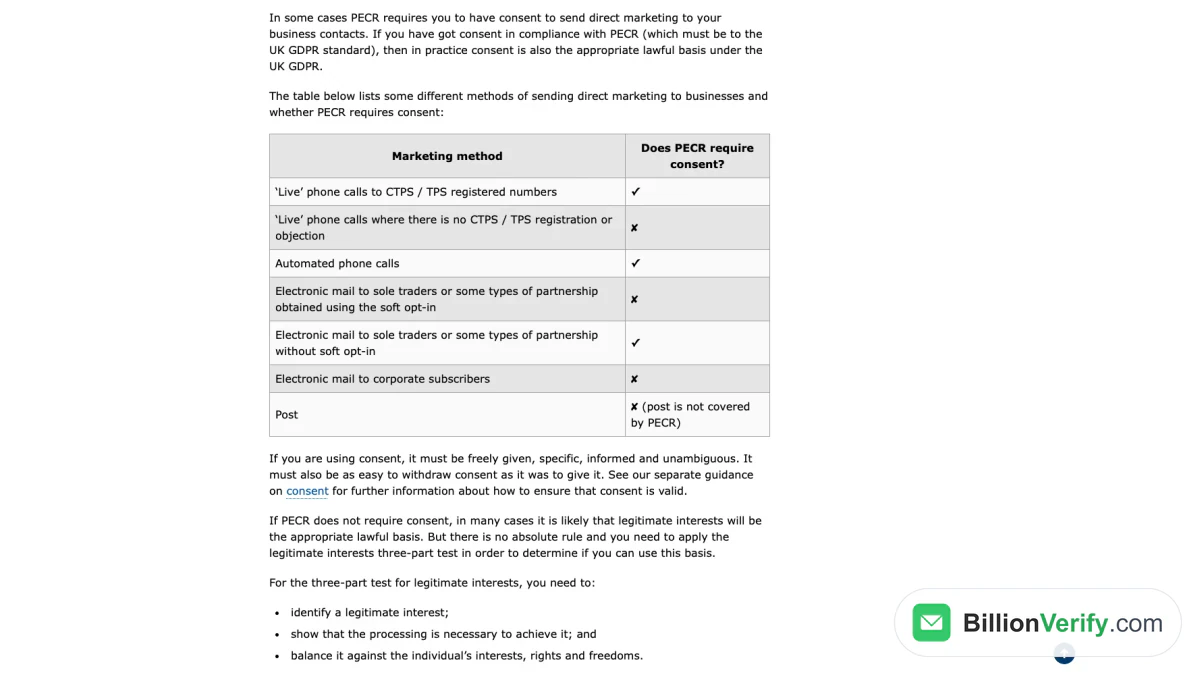
Screenshot: the ICO table of B2B marketing methods and whether PECR requires consent, captured in November 2026.
Data protection law still applies on top of PECR. The ICO says that when marketing to a business contact involves personal data, you must comply with the UK GDPR, including the right to object. If you collect the details from a public source or a third party, you must give privacy information within a reasonable period and no later than one month after collection. The page also warns that the guidance is under review because of the Data (Use and Access) Act, so read the live version. Our GDPR email marketing guide explains the lawful bases in more detail.
Germany
The English translation of the German competition act, published by the Federal Ministry of Justice and updated through an amendment of 12 February 2026, sets the strictest rule of the four. Section 7(2), point 2, says an unacceptable nuisance is always assumed for "advertising using an automated calling machine, a fax machine or electronic mail without the addressee's prior express consent". Section 7(3) lifts that presumption only when the entrepreneur got the address in connection with a sale, uses it for similar goods of its own, the customer has not objected, and the customer was clearly told about the right to object when the address was collected and at each use.
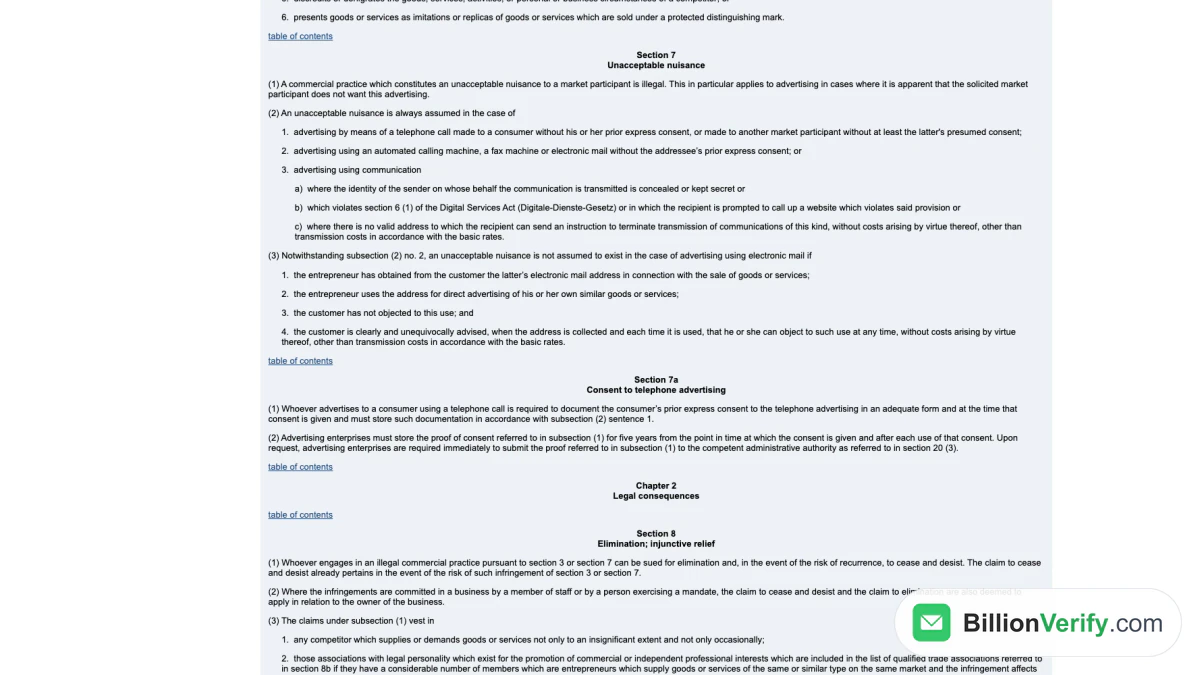
Screenshot: Section 7 in the official English translation, displayed in November 2026.
For a company that sells into Germany, the consequence is that a purchased email list of business contacts is not a safe starting point. Collect each email address through forms, events and conversations where the person agrees to hear from you, and record when and how they agreed.
Canada
Canada's anti-spam law lets a sender rely on implied permission when an address was conspicuously published. The government's guidance says the published address must not carry a statement that the person does not want unsolicited commercial messages, and the message must be relevant to the recipient's "business, role, functions or duties". The CRTC's guidance on implied consent gives an example, read from an archived copy dated September 2026 because the live page blocks automated readers. A training company that emails a chief operating officer about an administrative-assistant course cannot rely on publication, while the same company emailing a marketing officer about a social media course can. The CRTC adds that the sender has the onus of proving that permission, so keep dated records of where each contact was found.
The Canadian government's consent guide repeats the same two conditions in plain language. Our CASL compliance guide goes through the rest of the law. When a file spans several countries, apply the strictest rule to every row or split it by country, because a record of agreement from the person satisfies the first test in all four systems.
Build a B2B Email List You Can Defend
A business email list is easiest to defend when you can say where each entry came from. Google's sender guidelines tell senders not to purchase addresses from other companies, and Yahoo's sender requirements and recommendations give the same advice about mailing lists and pre-checked sign-up boxes. Both providers also say to send only to people who want the mail, because spam reports lower the sending domain's reputation over time. For a B2B team, the sources that hold up are demo requests, trial signups, content downloads, event registrations and replies to your own outreach.
Role mailboxes need a decision of their own. RFC 2142 defines standard mailbox names for organizational functions, among them info, marketing, sales and support. Mail to these names goes to a function, not to a named buyer, so it rarely moves a deal and it can reach people who never asked for your message. Our role account detection page explains how verification flags them, and you can keep them for transactional notices while leaving them out of campaigns.
Store the source, the date and the form text next to each contact. That record answers the Canadian burden of proof, the German requirement and the UK right to be informed with one set of fields. It also shows which source produces replies and which produces complaints, which is useful when you decide where to spend. For sourcing contacts in volume, our guide to B2B sales leads compares the main routes.
What Mailbox Providers Require From B2B Senders
Mailbox providers publish sender requirements, and the three below are the ones most B2B teams meet. Their thresholds apply to consumer inboxes: Google writes its rules for personal accounts that end in @gmail.com or @googlemail.com, and Microsoft's post says its requirements apply to Outlook.com, its consumer service. The pages do not publish thresholds for business domains, which are judged by the recipient company's own gateway or hosted-mail settings. Treat these B2B email marketing best practices as a floor that a B2B sender should meet anyway.
| Requirement | Yahoo | Outlook.com | |
|---|---|---|---|
| Volume that triggers bulk rules | Above 5,000 daily messages | Bulk senders, no figure on the page | More than 5,000 emails a day |
| Authentication | SPF or DKIM for everyone; SPF, DKIM and DMARC at bulk volume | SPF or DKIM at a minimum; both plus DMARC for bulk | DMARC alongside SPF and DKIM |
| Unsubscribe | A single-step header for marketing mail, plus a visible link | A single-step header, visible link, honored within 2 days | A functional, visible link |
| Spam rate | Below 0.10%, never 0.30% | Below 0.3% | No figure in the post |
The single-step row relies on RFC 8058, which defines two headers. A mailing that supports it carries a List-Unsubscribe header with an HTTPS address and a List-Unsubscribe-Post header whose value is List-Unsubscribe=One-Click. The RFC also says the message must have a valid DKIM signature that covers both headers. Parsing the headers below with Python 3.15 returned the values printed after the block.
List-Unsubscribe: <https://mail.example.com/u/8f3a?t=abc123>, <mailto:unsubscribe@mail.example.com?subject=unsubscribe>
List-Unsubscribe-Post: List-Unsubscribe=One-Click
List-Unsubscribe=One-Click
['<https://mail.example.com/u/8f3a?t=abc123>', '<mailto:unsubscribe@mail.example.com?subject=unsubscribe>']
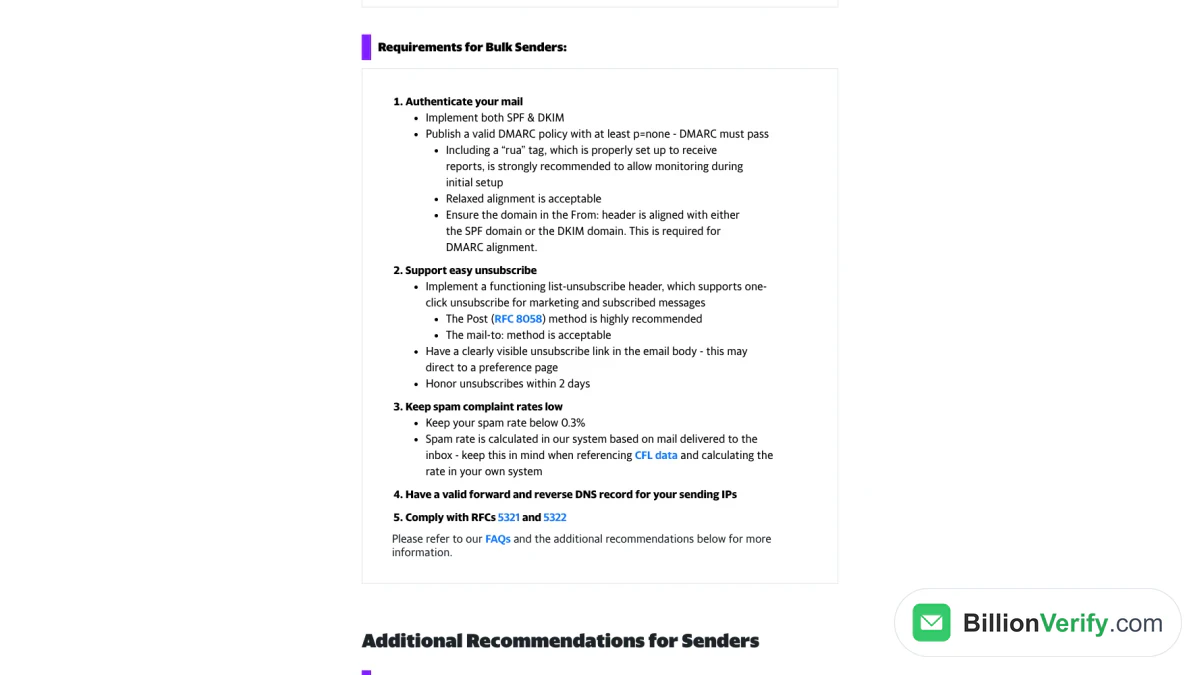
Screenshot: Yahoo's Requirements for Bulk Senders list, shown in November 2026.
Microsoft's April 2025 announcement for high-volume senders says non-compliant mail from such domains is routed to Junk after May 5, 2025, and names a 550 5.7.515 rejection for mail that fails the required authentication level. The post gives both outcomes in different paragraphs, so read its current wording before relying on either. Its FAQ also advises removing inactive or invalid entries monthly or quarterly, which is the same upkeep a business list needs.
Unsubscribes interact with the legal rules. The FTC allows ten business days and Yahoo asks for two days, so building to the shorter limit satisfies both. Google also suggests considering the unsubscribe of recipients who never open or read your messages, which for B2B means trimming accounts that went quiet instead of mailing them forever. Our email deliverability guide covers the DNS setup behind these requirements.
Verify Contacts Before Every Send
Authentication proves that you are who you say you are. It does not stop a message from bouncing because the person left the employer or the mailbox was mistyped on a form. Bounces count against the same domain reputation, so a business email list needs a verification step before each import and each large send.
A quick way to check an email address before you send is to run it through syntax, DNS, MX and SMTP tests, which also catches typos from event forms. For a spreadsheet, the bulk email verification tool processes a CSV, reports catch-all domains as their own category, charges one credit for each valid or invalid result and nothing for unknown results, and gives a 24-hour no-charge recheck. The entry point is the free email verifier, a daily allowance of 20 credits for each day you use the account that tops out at 600 a month, with no credit card.
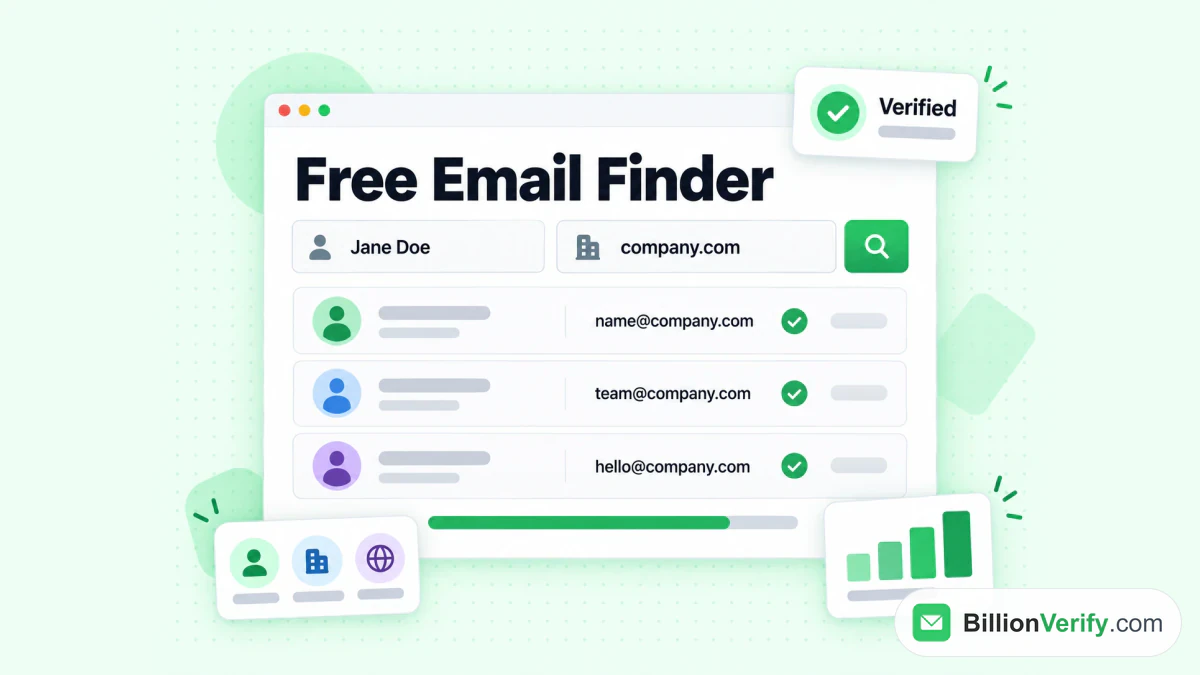
When a target account has no contact on file, the BillionVerify Email Finder takes a name and a business domain and returns one verified work address, charging 10 credits only when it finds one. The finder tools are available to paid accounts only. If an unfamiliar sender turns up in a reply thread, a reverse email lookup shows what it is attached to. When your sequence includes a call step, a phone number validator confirms the number before a rep dials it.
Segment and Nurture for Buying Groups
A B2B email marketing strategy segments on two layers, the account and the person. Account fields such as industry, company size and region decide whether a company is worth a sequence at all. Person fields such as role, seniority and recent behavior decide which version each contact receives. Our email segmentation guide walks through building the segments themselves.
Scoring turns those fields into a rule your platform can act on. HubSpot's lead scoring article describes lead scores that assign numerical scores based on property values and event actions. A fit score uses properties, an engagement score uses events and a combined score uses both. Its own example is a company fit score that reads region, company size and industry and scores a company highly for Northeast, 50 to 200 employees and hospitality. Contact scores need Marketing Hub, and the default maximum for each score is 100 points.
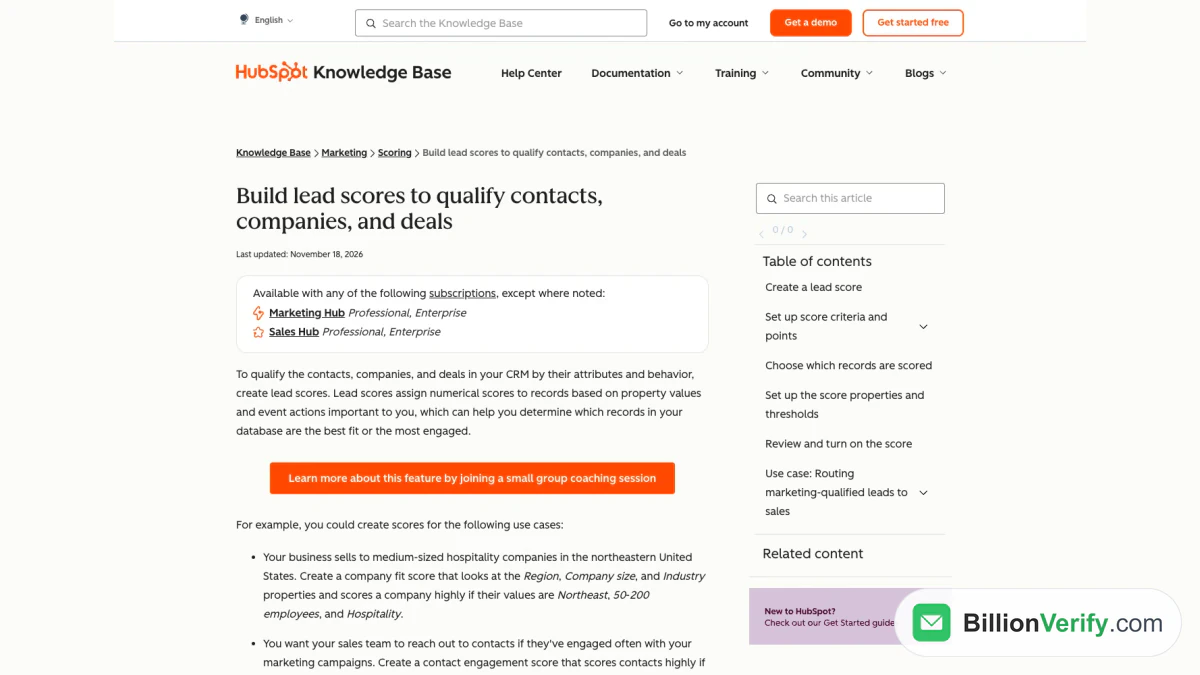
Screenshot: HubSpot's "Build lead scores" article, captured on November 18, 2026, the day it shows as last updated.
A nurture sequence then follows the stage of the buying process. An early email shares evidence about the problem, a middle email helps the group compare options, and a late email removes the obstacles a buying committee raises, such as security review or contract terms. Each email should offer a single next step and be easy to forward. Two or three people receiving different messages from one account is the point of the design, not a defect, as long as your platform stops the sequence once any of them replies. Our lead nurturing email guide has sequence structures for each stage.
Measure Replies and Pipeline, Not Opens
Open rate is a weak signal for B2B mail. Apple's Mail Privacy Protection hides the recipient's IP address and, in Apple's words, "prevents senders from seeing if you've opened the email message they sent you." Opens from readers who turn the setting on are invisible to you, so an open-rate trend tells you little about interest.
The measures that survive are replies, meetings booked, clicks to pricing or documentation, and the stage a deal reaches after the email. Pair them with two health measures you can read directly: the bounce rate on each import, and the spam rate in Google's Postmaster Tools, which Google says to keep below 0.10%. Judge any B2B email marketing strategy by those numbers before you add more volume. Our email marketing metrics guide lists how to calculate each of them.
B2B Email Marketing Platforms and Prices
Most B2B email marketing platforms share records with the CRM, so that sales sees what marketing sent. The two below are built around that arrangement, and both price by the size of the database. Prices are in US dollars as shown on each vendor's page, and the vendors change plans often, so confirm the live page before you buy.
| Platform | Tier | Listed price | Contacts included | Notes from the vendor page |
|---|---|---|---|---|
| HubSpot Marketing Hub | Professional | $800 per month | 2,000 marketing contacts | Three core seats, $3,000 onboarding fee paid once, up to 5 lead scores |
| HubSpot Marketing Hub | Enterprise | $3,600 per month | 10,000 marketing contacts | Five core seats, $7,000 one-time onboarding fee, up to 50 lead scores |
| Salesforce Account Engagement | Growth | $1,250 per month, billed annually | 10,000 | Annual contract required |
| Salesforce Account Engagement | Premium | $15,000 per month, billed annually | 75,000 | Annual contract required |
HubSpot's Marketing Hub pricing page also lists Free and Starter tiers, and it shows two prices beside the Professional tier without labeling which is monthly or annual, so check the toggle on the live page. Salesforce's Account Engagement pricing page lists Growth, Plus, Advanced and Premium editions, each billed annually, with $2,750 for Plus and $4,400 for Advanced. Smaller teams usually start with a general platform instead, and our email marketing tools guide compares twelve of them by price and limits.
Recruitment Email Marketing
Recruitment email marketing is B2B email in disguise, because the candidate is often reached at a business email address and the sender wants a professional relationship. The legal points from the earlier section apply with one addition. Candidates sourced from public profiles are people whose data you did not collect from them, so under the UK rule they are owed privacy information soon after you collect their details, and at the latest within a month. Some candidates are also contractors or sole traders, whom the ICO treats as individual subscribers who need permission or the soft opt-in.
Design the program around permission and relevance. A first message that names the role, the team and the reason you picked this person is more defensible than a template with a merged name. A short follow-up that offers a useful fact, such as the tech stack or the location policy, keeps the thread alive without pressure. Move people who engage into a talent pool where they opted in, and keep a suppression list so a candidate who declines is never contacted again for the same role.
A business email account stops working when a candidate changes employer, so a sourced email list loses entries whenever its people move. A recruiting team should verify the email list before each outreach wave and again before a talent-pool newsletter. Our HR email verification guide covers applicant tracking system exports and career-site forms.
Law Firm Email Marketing
Law firm email marketing usually counts as advertising, so professional conduct rules apply on top of the general email law. Those rules are set by each state, so the label and disclaimer requirements differ. New York's Rule 7.1, published by Cornell's Legal Information Institute as 22 NYCRR 1200.7.1, gives a concrete example. It says that for electronic mail the subject line must contain the notation "ATTORNEY ADVERTISING", and that every advertisement must include the name, principal law office address and telephone number of the lawyer or law firm.
The same rule lets an advertisement contain statements about expected results, comparisons with other lawyers, client testimonials and descriptions of quality only if they meet its conditions. Among them, the claim must be factually supported as of the date of dissemination, and the advertisement must carry the disclaimer "Prior results do not guarantee a similar outcome". A compliance review before each campaign is cheaper than a complaint, so give someone at the firm the job of approving templates. Our legal email compliance guide covers the general framework for law firms.
CAN-SPAM adds the postal address and opt-out requirements, and the matching law of the recipient's country applies to clients abroad. A firm's contact file is also unusually sensitive, since the mere fact that a person appears on it can reveal a legal need. Keep prospect records separate from client matter data, send newsletters only to people who asked, and honor every unsubscribe within the shorter of the legal and provider time limits.
FAQs
Is B2B email exempt from opt-in rules?
No. In the United States and in the UK's corporate-subscriber category no opt-in is needed, but Germany asks for consent first and Canada asks for provable permission. The FTC says CAN-SPAM has no exception for business recipients, and the ICO limits its exemption to corporate bodies.
How often should a company email a business contact?
The sources quoted here set no frequency, so base it on what people signed up for. Yahoo's page advises honoring the frequency of a list's intent and not moving a weekly subscriber to daily mail. For a buying-group sequence, space messages so a new contact has time to forward the last one.
Can a company email a purchased list of contacts?
It is a poor starting point. Google's guidelines say not to purchase addresses, Yahoo says the same about mailing lists, and German law presumes a nuisance without the recipient's agreement beforehand. An email list you collected yourself, with a dated source, is the version you can defend.
What counts as a bad B2B email address?
A mailbox that bounces, a role mailbox that reaches no decision maker, or a contact who has left the employer. Verification catches the first kind directly and flags role mailboxes. The third shows up as a bounce after the person's mailbox is closed.
Do Gmail and Outlook rules apply to company domains?
The published thresholds apply to personal Gmail and Outlook.com accounts. Business domains hosted on other systems follow their own administrators' settings. Meeting the published baseline is still the safe course, since the requirements are mostly good practice.
Which platform fits a small B2B team?
Start from the CRM you already use and the number of contacts you will mail. The table above lists HubSpot and Salesforce prices from $800 to $15,000 monthly, while general platforms cost far less at small sizes. Compare the live pages in your currency before you commit.
Watch: How to Verify Emails From Clutch Agency Listings
Watch: Bulk Email Verification: How to Verify an Email List From a File